

90 Software Networks
purpose, it is common to use VLANs, but with extensions so as not to
have a significant limitation on the number of VLANs supported. One
of the most widely-used techniques is a direct extension of VLANs:
VXLANs.
4.2. VXLAN
VXLAN (Virtual eXtensible LAN) is a solution capable of
delivering communications in Clouds between datacenters. The
technology is fairly similar to that used for VLANs and Carrier-Grade
Ethernet extensions. It was originally developed by Cisco and
VMware. The drawback to the basic solution of VLAN IEEE 802.1Q
is the limitation to 4096 VLANs. VXLAN enables us to extend the
basic technology in parallel to Carrier-Grade Ethernet.
In order to move from one sub-network to another, in VXLANs we
consider that we can go through any network, and therefore we need
to go back through the transport layer. For this reason, the Ethernet
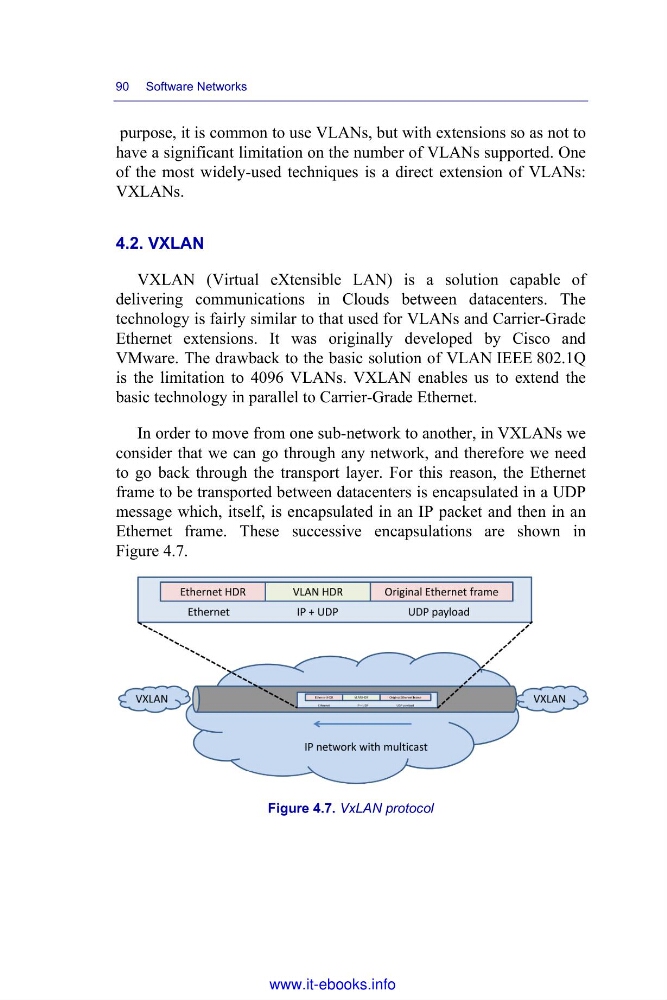
frame to be transported between datacenters is encapsulated in a UDP
message which, itself, is encapsulated in an IP packet and then in an
Ethernet frame. These successive encapsulations are shown in
Figure 4.7.
Figure 4.7. VxLAN protocol
www.it-ebooks.info
purpose, it is common to use VLANs, but with extensions so as not to
have a significant limitation on the number of VLANs supported. One
of the most widely-used techniques is a direct extension of VLANs:
VXLANs.
4.2. VXLAN
VXLAN (Virtual eXtensible LAN) is a solution capable of
delivering communications in Clouds between datacenters. The
technology is fairly similar to that used for VLANs and Carrier-Grade
Ethernet extensions. It was originally developed by Cisco and
VMware. The drawback to the basic solution of VLAN IEEE 802.1Q
is the limitation to 4096 VLANs. VXLAN enables us to extend the
basic technology in parallel to Carrier-Grade Ethernet.
In order to move from one sub-network to another, in VXLANs we
consider that we can go through any network, and therefore we need
to go back through the transport layer. For this reason, the Ethernet
frame to be transported between datacenters is encapsulated in a UDP
message which, itself, is encapsulated in an IP packet and then in an
Ethernet frame. These successive encapsulations are shown in
Figure 4.7.
Figure 4.7. VxLAN protocol
www.it-ebooks.info