

86 Software Networks
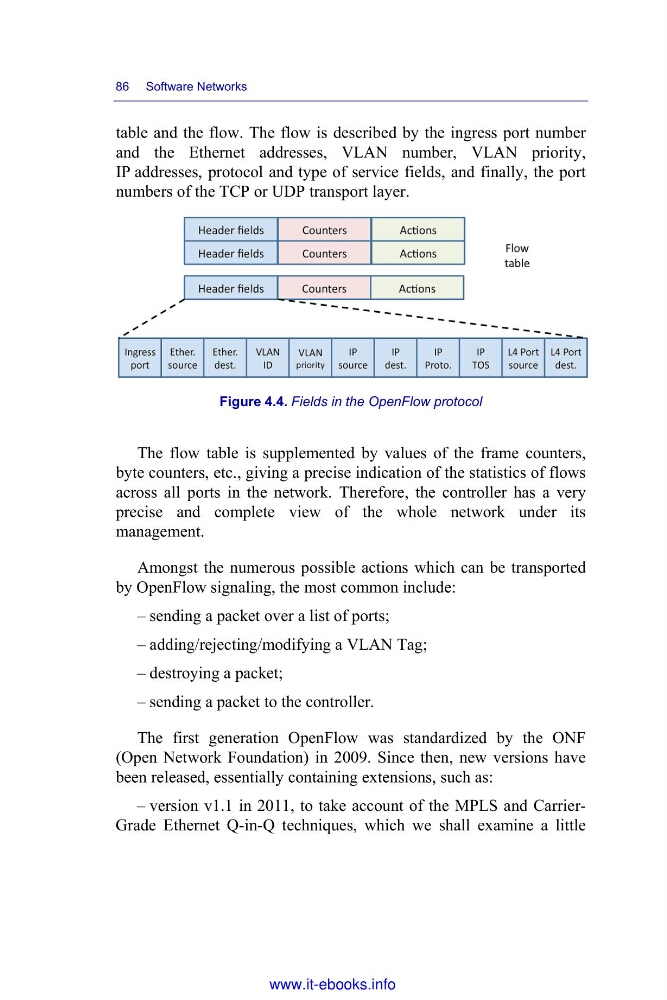
table and the flow. The flow is described by the ingress port number
and the Ethernet addresses, VLAN number, VLAN priority,
IP addresses, protocol and type of service fields, and finally, the port
numbers of the TCP or UDP transport layer.
Figure 4.4. Fields in the OpenFlow protocol
The flow table is supplemented by values of the frame counters,
byte counters, etc., giving a precise indication of the statistics of flows
across all ports in the network. Therefore, the controller has a very
precise and complete view of the whole network under its
management.
Amongst the numerous possible actions which can be transported
by OpenFlow signaling, the most common include:
– sending a packet over a list of ports;
– adding/rejecting/modifying a VLAN Tag;
– destroying a packet;
– sending a packet to the controller.
The first generation OpenFlow was standardized by the ONF
(Open Network Foundation) in 2009. Since then, new versions have
been released, essentially containing extensions, such as:
– version v1.1 in 2011, to take account of the MPLS and CarrierGrade Ethernet Q-in-Q techniques, which we shall examine a little
www.it-ebooks.info
table and the flow. The flow is described by the ingress port number
and the Ethernet addresses, VLAN number, VLAN priority,
IP addresses, protocol and type of service fields, and finally, the port
numbers of the TCP or UDP transport layer.
Figure 4.4. Fields in the OpenFlow protocol
The flow table is supplemented by values of the frame counters,
byte counters, etc., giving a precise indication of the statistics of flows
across all ports in the network. Therefore, the controller has a very
precise and complete view of the whole network under its
management.
Amongst the numerous possible actions which can be transported
by OpenFlow signaling, the most common include:
– sending a packet over a list of ports;
– adding/rejecting/modifying a VLAN Tag;
– destroying a packet;
– sending a packet to the controller.
The first generation OpenFlow was standardized by the ONF
(Open Network Foundation) in 2009. Since then, new versions have
been released, essentially containing extensions, such as:
– version v1.1 in 2011, to take account of the MPLS and CarrierGrade Ethernet Q-in-Q techniques, which we shall examine a little
www.it-ebooks.info