

22
K. KirupaSree et al.
3.7 Nickel
Nickel is most abundantly disturbed in the environment which exists as five stable
isotopes
58 Ni,
60 Ni,
61 Ni,
62 Ni,
64 Ni. Nickel has vital role in the biochemistry of
microbes and plants. Most of the enzyme contains nickel active site such as ureases,
hydrogenases, superoxide dismutases, and glyoxalase enzyme contains in the form
of Ni–Fe clusters or use nickel as a co-factor. Nickel is highly toxic to the humans
and animals because it’s potential to cross the placenta and affect the developing
fetus. Nickel resistance in bacteria is generally mediated by metal efflux pumps, this
resistance mechanism is well studied in Cupriavidus metallidurans CH34 formerly
called Ralstonia metallidurans by Grass et al. (2000). It has been reported that in the
presence of CnrCBA transenvelope efflux pump encoded by the cnrYHXCBAT gene
system, Ni is expelled out of the cell (Maillard et al. 2015). Through cnrY and cnrC
the cnr promoter is initiated while the nickel enters into the periplasm, transcription
occurs. The CnrCBA encodes a highly efficient pump which is activated only in
micromolar concentrations of nickel. These gene products form an efflux pump to
efflux excess nickel outside the cell. Certain standard levels of heavy metals allowed
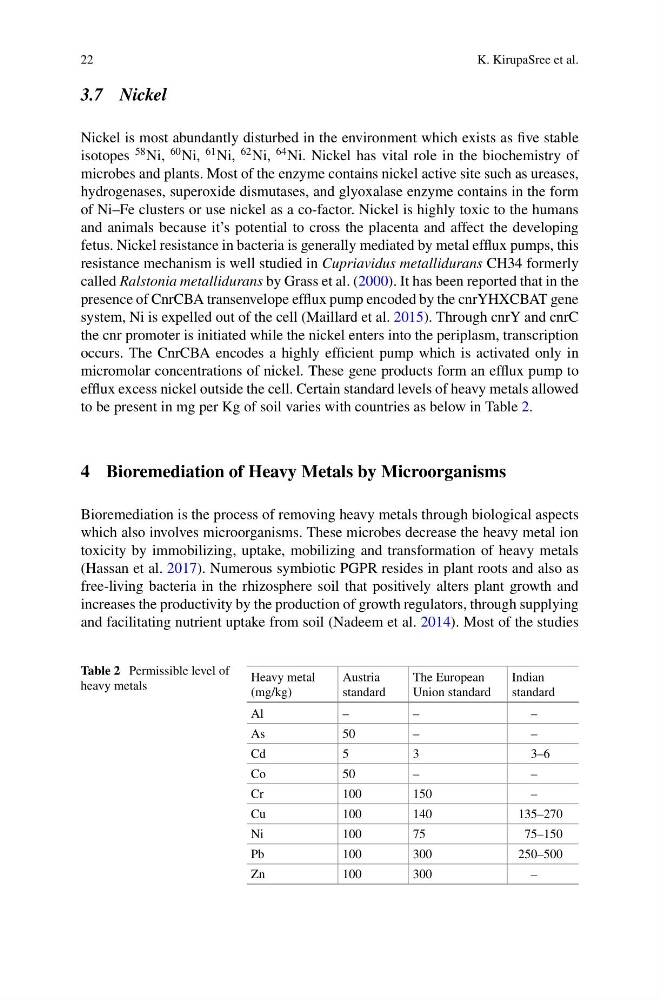
to be present in mg per Kg of soil varies with countries as below in Table 2.
4 Bioremediation of Heavy Metals by Microorganisms
Bioremediation is the process of removing heavy metals through biological aspects
which also involves microorganisms. These microbes decrease the heavy metal ion
toxicity by immobilizing, uptake, mobilizing and transformation of heavy metals
(Hassan et al. 2017). Numerous symbiotic PGPR resides in plant roots and also as
free-living bacteria in the rhizosphere soil that positively alters plant growth and
increases the productivity by the production of growth regulators, through supplying
and facilitating nutrient uptake from soil (Nadeem et al. 2014). Most of the studies
Table 2 Permissible level of
heavy metals
Heavy metal
(mg/kg)
Austria
standard
The European
Union standard
Indian
standard
Al
–
–
–
As
50
–
–
Cd
5
3
3–6
Co
50
–
–
Cr
100
150
–
Cu
100
140
135–270
Ni
100
75
75–150
Pb
100
300
250–500
Zn
100
300
–
K. KirupaSree et al.
3.7 Nickel
Nickel is most abundantly disturbed in the environment which exists as five stable
isotopes
58 Ni,
60 Ni,
61 Ni,
62 Ni,
64 Ni. Nickel has vital role in the biochemistry of
microbes and plants. Most of the enzyme contains nickel active site such as ureases,
hydrogenases, superoxide dismutases, and glyoxalase enzyme contains in the form
of Ni–Fe clusters or use nickel as a co-factor. Nickel is highly toxic to the humans
and animals because it’s potential to cross the placenta and affect the developing
fetus. Nickel resistance in bacteria is generally mediated by metal efflux pumps, this
resistance mechanism is well studied in Cupriavidus metallidurans CH34 formerly
called Ralstonia metallidurans by Grass et al. (2000). It has been reported that in the
presence of CnrCBA transenvelope efflux pump encoded by the cnrYHXCBAT gene
system, Ni is expelled out of the cell (Maillard et al. 2015). Through cnrY and cnrC
the cnr promoter is initiated while the nickel enters into the periplasm, transcription
occurs. The CnrCBA encodes a highly efficient pump which is activated only in
micromolar concentrations of nickel. These gene products form an efflux pump to
efflux excess nickel outside the cell. Certain standard levels of heavy metals allowed
to be present in mg per Kg of soil varies with countries as below in Table 2.
4 Bioremediation of Heavy Metals by Microorganisms
Bioremediation is the process of removing heavy metals through biological aspects
which also involves microorganisms. These microbes decrease the heavy metal ion
toxicity by immobilizing, uptake, mobilizing and transformation of heavy metals
(Hassan et al. 2017). Numerous symbiotic PGPR resides in plant roots and also as
free-living bacteria in the rhizosphere soil that positively alters plant growth and
increases the productivity by the production of growth regulators, through supplying
and facilitating nutrient uptake from soil (Nadeem et al. 2014). Most of the studies
Table 2 Permissible level of
heavy metals
Heavy metal
(mg/kg)
Austria
standard
The European
Union standard
Indian
standard
Al
–
–
–
As
50
–
–
Cd
5
3
3–6
Co
50
–
–
Cr
100
150
–
Cu
100
140
135–270
Ni
100
75
75–150
Pb
100
300
250–500
Zn
100
300
–