

322
V. E. Chahana et al.
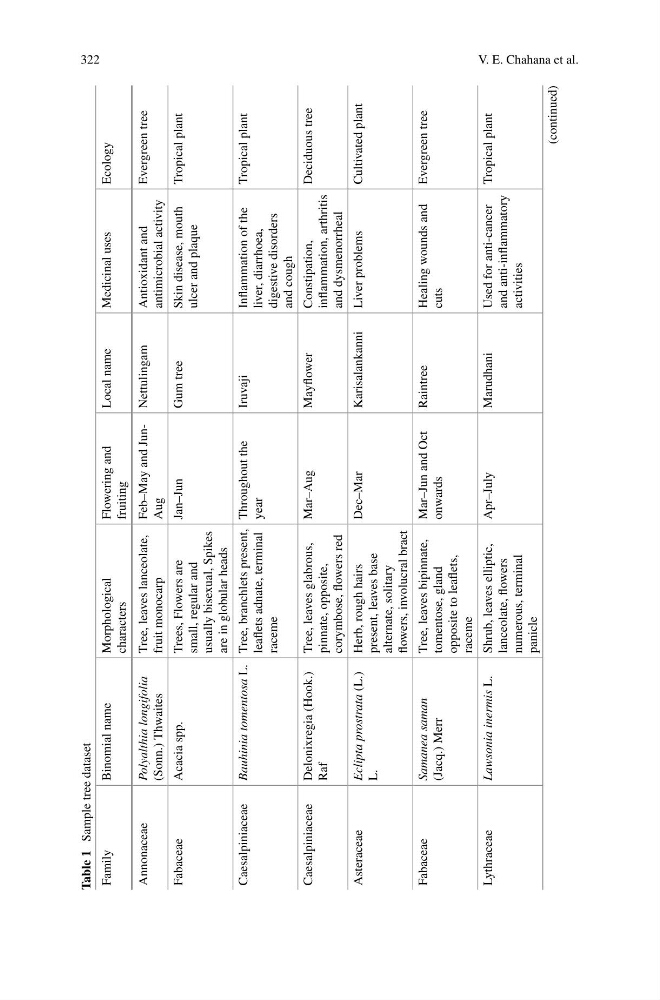
Table 1
Sample tree dataset
Family
Binomial name
Morphological
characters
Flowering and
fruiting
Local name
Medicinal uses
Ecology
Annonaceae
Polyalthia longifolia
(Sonn.) Thwaites
Tree, leaves lanceolate,
fruit monocarp
Feb–May and JunAug
Nettulingam
Antioxidant and
antimicrobial activity
Evergreen tree
Fabaceae
Acacia spp.
Trees, Flowers are
small, regular and
usually bisexual, Spikes
are in globular heads
Jan–Jun
Gum tree
Skin disease, mouth
ulcer and plaque
Tropical plant
Caesalpiniaceae
Bauhinia tomentosa
L. Tree, branchlets present,
leaflets adnate, terminal
raceme
Throughout the
year
Iruvaji
Inflammation of the
liver, diarrhoea,
digestive disorders
and cough
Tropical plant
Caesalpiniaceae
Delonixregia (Hook.)
Raf
Tree, leaves glabrous,
pinnate, opposite,
corymbose, flowers red
Mar–Aug
Mayflower
Constipation,
inflammation, arthritis
and dysmenorrheal
Deciduous tree
Asteraceae
Eclipta prostrata
(L.)
L.
Herb, rough hairs
present, leaves base
alternate, solitary
flowers, involucral bract
Dec–Mar
Karisalankanni
Liver problems
Cultivated plant
Fabaceae
Samanea saman
(Jacq.) Merr
Tree, leaves bipinnate,
tomentose, gland
opposite to leaflets,
raceme
Mar–Jun and Oct
onwards
Raintree
Healing wounds and
cuts
Evergreen tree
Lythraceae
Lawsonia inermis
L.
Shrub, leaves elliptic,
lanceolate, flowers
numerous, terminal
panicle
Apr–July
Marudhani
Used for anti-cancer
and anti-inflammatory
activities
Tropical plant
(continued)
V. E. Chahana et al.
Table 1
Sample tree dataset
Family
Binomial name
Morphological
characters
Flowering and
fruiting
Local name
Medicinal uses
Ecology
Annonaceae
Polyalthia longifolia
(Sonn.) Thwaites
Tree, leaves lanceolate,
fruit monocarp
Feb–May and JunAug
Nettulingam
Antioxidant and
antimicrobial activity
Evergreen tree
Fabaceae
Acacia spp.
Trees, Flowers are
small, regular and
usually bisexual, Spikes
are in globular heads
Jan–Jun
Gum tree
Skin disease, mouth
ulcer and plaque
Tropical plant
Caesalpiniaceae
Bauhinia tomentosa
L. Tree, branchlets present,
leaflets adnate, terminal
raceme
Throughout the
year
Iruvaji
Inflammation of the
liver, diarrhoea,
digestive disorders
and cough
Tropical plant
Caesalpiniaceae
Delonixregia (Hook.)
Raf
Tree, leaves glabrous,
pinnate, opposite,
corymbose, flowers red
Mar–Aug
Mayflower
Constipation,
inflammation, arthritis
and dysmenorrheal
Deciduous tree
Asteraceae
Eclipta prostrata
(L.)
L.
Herb, rough hairs
present, leaves base
alternate, solitary
flowers, involucral bract
Dec–Mar
Karisalankanni
Liver problems
Cultivated plant
Fabaceae
Samanea saman
(Jacq.) Merr
Tree, leaves bipinnate,
tomentose, gland
opposite to leaflets,
raceme
Mar–Jun and Oct
onwards
Raintree
Healing wounds and
cuts
Evergreen tree
Lythraceae
Lawsonia inermis
L.
Shrub, leaves elliptic,
lanceolate, flowers
numerous, terminal
panicle
Apr–July
Marudhani
Used for anti-cancer
and anti-inflammatory
activities
Tropical plant
(continued)