

Screening, Isolation and Molecular Characterization …
253
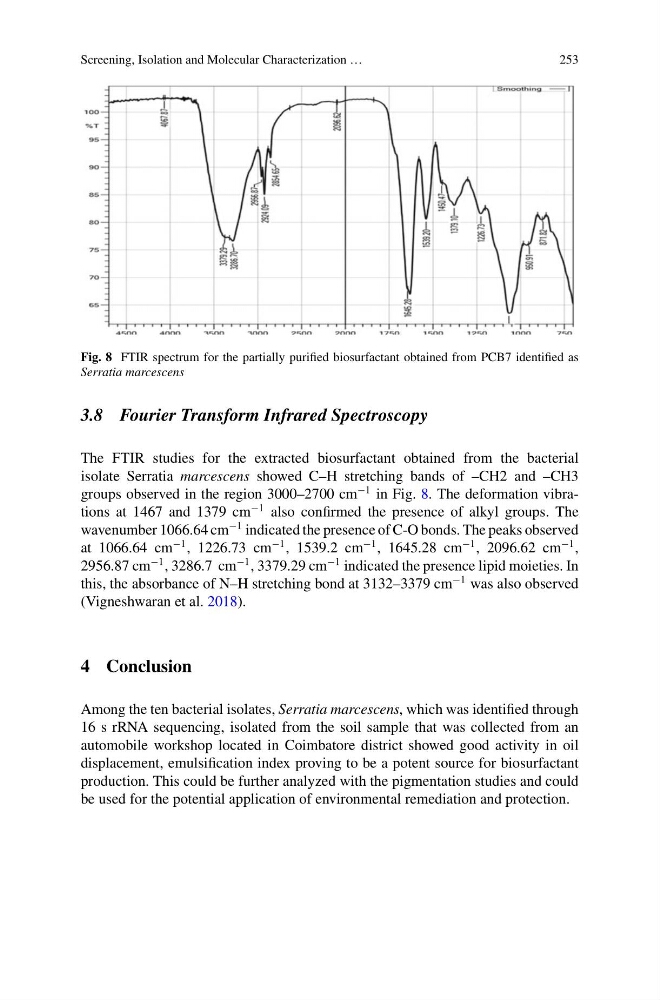
Fig. 8 FTIR spectrum for the partially purified biosurfactant obtained from PCB7 identified as
Serratia marcescens
3.8 Fourier Transform Infrared Spectroscopy
The FTIR studies for the extracted biosurfactant obtained from the bacterial
isolate Serratia marcescens showed C–H stretching bands of –CH2 and –CH3
groups observed in the region 3000–2700 cm
−1 in Fig. 8. The deformation vibrations at 1467 and 1379 cm
−1 also confirmed the presence of alkyl groups. The
wavenumber 1066.64 cm
−1 indicated the presence of C-O bonds. The peaks observed
at 1066.64 cm
−1 , 1226.73 cm
−1 , 1539.2 cm
−1 , 1645.28 cm
−1 , 2096.62 cm
−1 ,
2956.87 cm
−1 , 3286.7 cm
−1 , 3379.29 cm
−1 indicated the presence lipid moieties. In
this, the absorbance of N–H stretching bond at 3132–3379 cm
−1 was also observed
(Vigneshwaran et al. 2018).
4 Conclusion
Among the ten bacterial isolates, Serratia marcescens, which was identified through
16 s rRNA sequencing, isolated from the soil sample that was collected from an
automobile workshop located in Coimbatore district showed good activity in oil
displacement, emulsification index proving to be a potent source for biosurfactant
production. This could be further analyzed with the pigmentation studies and could
be used for the potential application of environmental remediation and protection.
253
Fig. 8 FTIR spectrum for the partially purified biosurfactant obtained from PCB7 identified as
Serratia marcescens
3.8 Fourier Transform Infrared Spectroscopy
The FTIR studies for the extracted biosurfactant obtained from the bacterial
isolate Serratia marcescens showed C–H stretching bands of –CH2 and –CH3
groups observed in the region 3000–2700 cm
−1 in Fig. 8. The deformation vibrations at 1467 and 1379 cm
−1 also confirmed the presence of alkyl groups. The
wavenumber 1066.64 cm
−1 indicated the presence of C-O bonds. The peaks observed
at 1066.64 cm
−1 , 1226.73 cm
−1 , 1539.2 cm
−1 , 1645.28 cm
−1 , 2096.62 cm
−1 ,
2956.87 cm
−1 , 3286.7 cm
−1 , 3379.29 cm
−1 indicated the presence lipid moieties. In
this, the absorbance of N–H stretching bond at 3132–3379 cm
−1 was also observed
(Vigneshwaran et al. 2018).
4 Conclusion
Among the ten bacterial isolates, Serratia marcescens, which was identified through
16 s rRNA sequencing, isolated from the soil sample that was collected from an
automobile workshop located in Coimbatore district showed good activity in oil
displacement, emulsification index proving to be a potent source for biosurfactant
production. This could be further analyzed with the pigmentation studies and could
be used for the potential application of environmental remediation and protection.