

248
V. Vijayalekshmi et al.
2.8 Fourier Transform Infrared Spectroscopy
For identifying types of chemical bonds (functional groups), Fourier transform
infrared spectroscopy (FT-IR) analysis used to elucidate some components of an
unknown mixture (Suryawanshi et al. 2014). One milligram of partially purified
biosurfactant was wholly dried and then analyzed in an FTIR (Shimadzu), device
that obtains the spectrum with high S/N ratio 30,000:1, 1-minute accumulation and
a maximum resolution of 0.5 cm
−1 . All data corrected for the background spectrum.
3 Results and Discussion
Soil samples inoculated in minimal salt medium and serial diluted to obtain bacterial
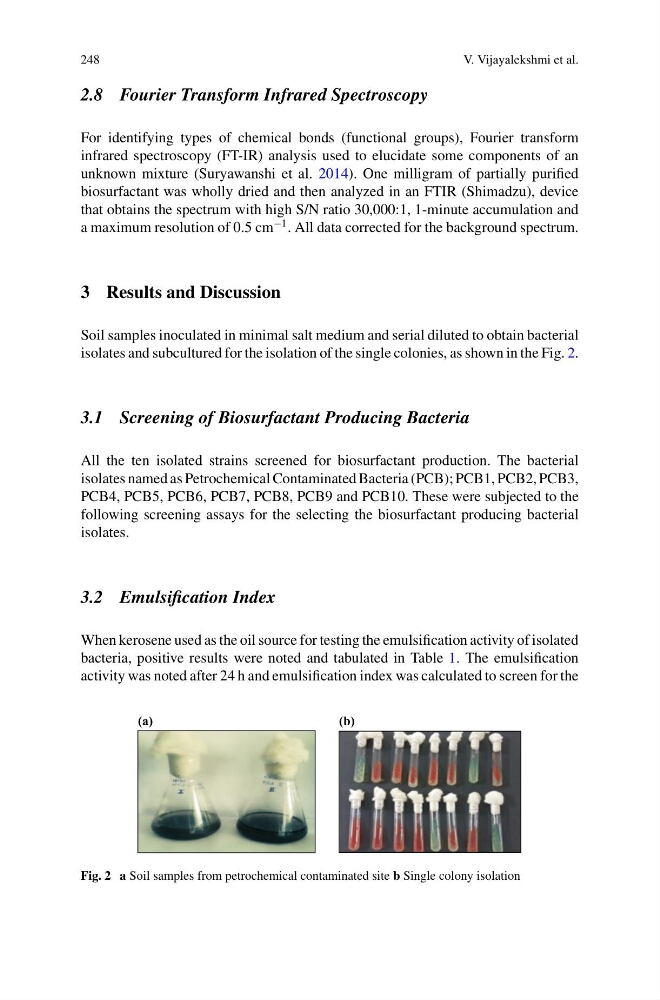
isolates and subcultured for the isolation of the single colonies, as shown in the Fig. 2.
3.1 Screening of Biosurfactant Producing Bacteria
All the ten isolated strains screened for biosurfactant production. The bacterial
isolates named as Petrochemical Contaminated Bacteria (PCB); PCB1, PCB2, PCB3,
PCB4, PCB5, PCB6, PCB7, PCB8, PCB9 and PCB10. These were subjected to the
following screening assays for the selecting the biosurfactant producing bacterial
isolates.
3.2 Emulsification Index
When kerosene used as the oil source for testing the emulsification activity of isolated
bacteria, positive results were noted and tabulated in Table 1. The emulsification
activity was noted after 24 h and emulsification index was calculated to screen for the
(a)
(b)
Fig. 2 a Soil samples from petrochemical contaminated site b Single colony isolation
V. Vijayalekshmi et al.
2.8 Fourier Transform Infrared Spectroscopy
For identifying types of chemical bonds (functional groups), Fourier transform
infrared spectroscopy (FT-IR) analysis used to elucidate some components of an
unknown mixture (Suryawanshi et al. 2014). One milligram of partially purified
biosurfactant was wholly dried and then analyzed in an FTIR (Shimadzu), device
that obtains the spectrum with high S/N ratio 30,000:1, 1-minute accumulation and
a maximum resolution of 0.5 cm
−1 . All data corrected for the background spectrum.
3 Results and Discussion
Soil samples inoculated in minimal salt medium and serial diluted to obtain bacterial
isolates and subcultured for the isolation of the single colonies, as shown in the Fig. 2.
3.1 Screening of Biosurfactant Producing Bacteria
All the ten isolated strains screened for biosurfactant production. The bacterial
isolates named as Petrochemical Contaminated Bacteria (PCB); PCB1, PCB2, PCB3,
PCB4, PCB5, PCB6, PCB7, PCB8, PCB9 and PCB10. These were subjected to the
following screening assays for the selecting the biosurfactant producing bacterial
isolates.
3.2 Emulsification Index
When kerosene used as the oil source for testing the emulsification activity of isolated
bacteria, positive results were noted and tabulated in Table 1. The emulsification
activity was noted after 24 h and emulsification index was calculated to screen for the
(a)
(b)
Fig. 2 a Soil samples from petrochemical contaminated site b Single colony isolation