

Experimentation and Evaluation of Biodegradative Kinetic …
171
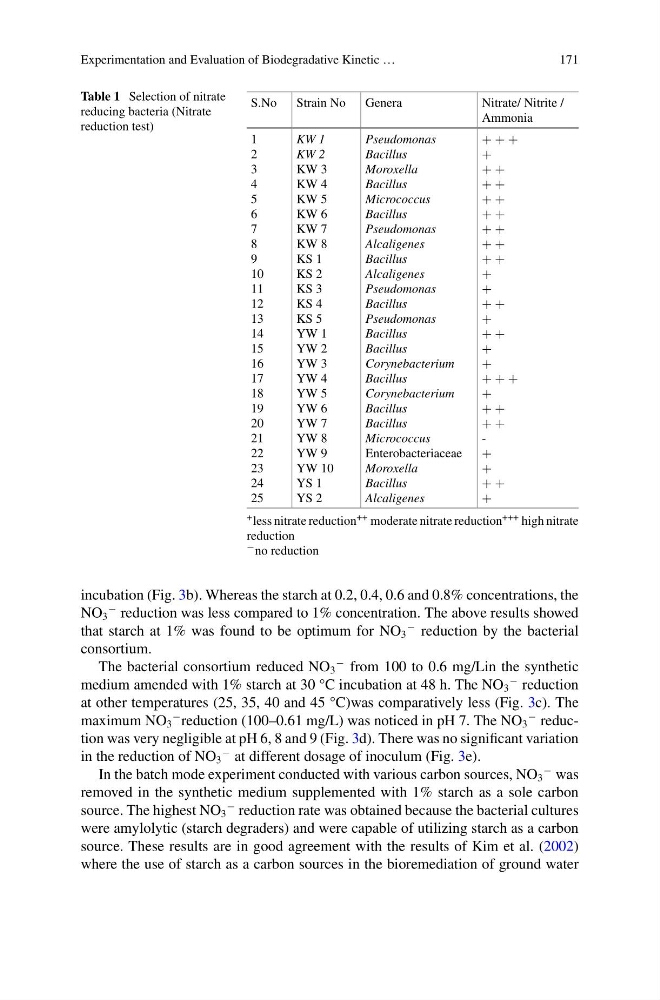
Table 1 Selection of nitrate
reducing bacteria (Nitrate
reduction test)
S.No
Strain No
Genera
Nitrate/ Nitrite /
Ammonia
1
2
3
4
5
6
7
8
9
10
11
12
13
14
15
16
17
18
19
20
21
22
23
24
25
KW 1
KW 2
KW 3
KW 4
KW 5
KW 6
KW 7
KW 8
KS 1
KS 2
KS 3
KS 4
KS 5
YW 1
YW 2
YW 3
YW 4
YW 5
YW 6
YW 7
YW 8
YW 9
YW 10
YS 1
YS 2
Pseudomonas
Bacillus
Moroxella
Bacillus
Micrococcus
Bacillus
Pseudomonas
Alcaligenes
Bacillus
Alcaligenes
Pseudomonas
Bacillus
Pseudomonas
Bacillus
Bacillus
Corynebacterium
Bacillus
Corynebacterium
Bacillus
Bacillus
Micrococcus
Enterobacteriaceae
Moroxella
Bacillus
Alcaligenes
+ + +
+
+ +
+ +
+ +
+ +
+ +
+ +
+ +
+
+
+ +
+
+ +
+
+
+ + +
+
+ +
+ +
-
+
+
+ +
+
+ less nitrate reduction ++ moderate nitrate reduction +++ high nitrate
reduction
− no reduction
incubation (Fig. 3b). Whereas the starch at 0.2, 0.4, 0.6 and 0.8% concentrations, the
NO 3
− reduction was less compared to 1% concentration. The above results showed
that starch at 1% was found to be optimum for NO 3
− reduction by the bacterial
consortium.
The bacterial consortium reduced NO 3
− from 100 to 0.6 mg/Lin the synthetic
medium amended with 1% starch at 30 °C incubation at 48 h. The NO 3
− reduction
at other temperatures (25, 35, 40 and 45 °C)was comparatively less (Fig. 3c). The
maximum NO 3
− reduction (100–0.61 mg/L) was noticed in pH 7. The NO 3
− reduction was very negligible at pH 6, 8 and 9 (Fig. 3d). There was no significant variation
in the reduction of NO 3
− at different dosage of inoculum (Fig. 3e).
In the batch mode experiment conducted with various carbon sources, NO 3
− was
removed in the synthetic medium supplemented with 1% starch as a sole carbon
source. The highest NO 3
− reduction rate was obtained because the bacterial cultures
were amylolytic (starch degraders) and were capable of utilizing starch as a carbon
source. These results are in good agreement with the results of Kim et al. (2002)
where the use of starch as a carbon sources in the bioremediation of ground water
171
Table 1 Selection of nitrate
reducing bacteria (Nitrate
reduction test)
S.No
Strain No
Genera
Nitrate/ Nitrite /
Ammonia
1
2
3
4
5
6
7
8
9
10
11
12
13
14
15
16
17
18
19
20
21
22
23
24
25
KW 1
KW 2
KW 3
KW 4
KW 5
KW 6
KW 7
KW 8
KS 1
KS 2
KS 3
KS 4
KS 5
YW 1
YW 2
YW 3
YW 4
YW 5
YW 6
YW 7
YW 8
YW 9
YW 10
YS 1
YS 2
Pseudomonas
Bacillus
Moroxella
Bacillus
Micrococcus
Bacillus
Pseudomonas
Alcaligenes
Bacillus
Alcaligenes
Pseudomonas
Bacillus
Pseudomonas
Bacillus
Bacillus
Corynebacterium
Bacillus
Corynebacterium
Bacillus
Bacillus
Micrococcus
Enterobacteriaceae
Moroxella
Bacillus
Alcaligenes
+ + +
+
+ +
+ +
+ +
+ +
+ +
+ +
+ +
+
+
+ +
+
+ +
+
+
+ + +
+
+ +
+ +
-
+
+
+ +
+
+ less nitrate reduction ++ moderate nitrate reduction +++ high nitrate
reduction
− no reduction
incubation (Fig. 3b). Whereas the starch at 0.2, 0.4, 0.6 and 0.8% concentrations, the
NO 3
− reduction was less compared to 1% concentration. The above results showed
that starch at 1% was found to be optimum for NO 3
− reduction by the bacterial
consortium.
The bacterial consortium reduced NO 3
− from 100 to 0.6 mg/Lin the synthetic
medium amended with 1% starch at 30 °C incubation at 48 h. The NO 3
− reduction
at other temperatures (25, 35, 40 and 45 °C)was comparatively less (Fig. 3c). The
maximum NO 3
− reduction (100–0.61 mg/L) was noticed in pH 7. The NO 3
− reduction was very negligible at pH 6, 8 and 9 (Fig. 3d). There was no significant variation
in the reduction of NO 3
− at different dosage of inoculum (Fig. 3e).
In the batch mode experiment conducted with various carbon sources, NO 3
− was
removed in the synthetic medium supplemented with 1% starch as a sole carbon
source. The highest NO 3
− reduction rate was obtained because the bacterial cultures
were amylolytic (starch degraders) and were capable of utilizing starch as a carbon
source. These results are in good agreement with the results of Kim et al. (2002)
where the use of starch as a carbon sources in the bioremediation of ground water