

Potential Utilization of a Weed Prosopis Juliflora Leaf Extract …
161
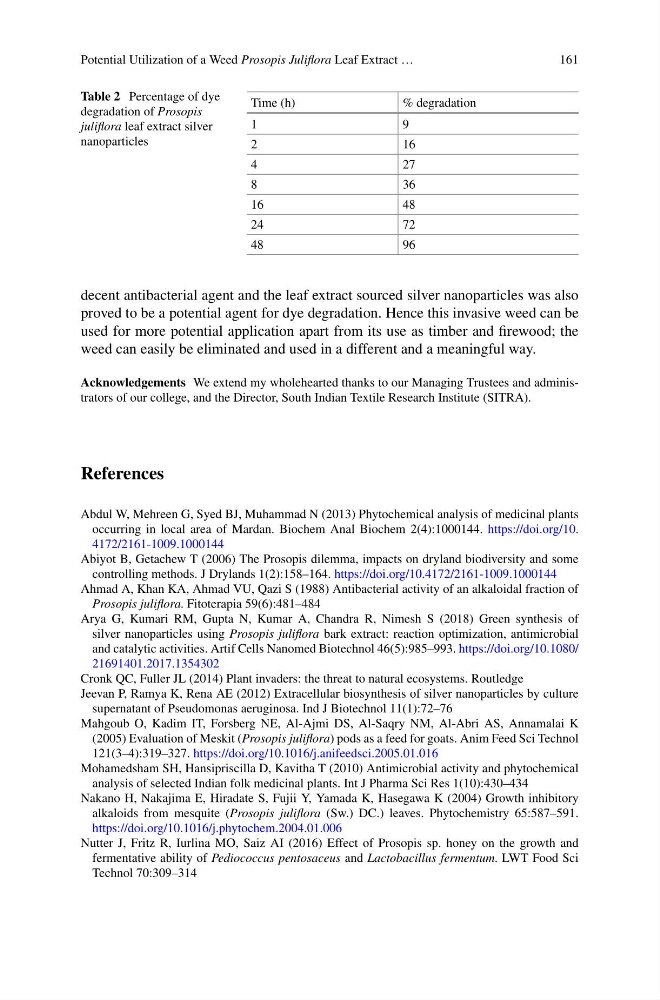
Table 2 Percentage of dye
degradation of Prosopis
juliflora leaf extract silver
nanoparticles
Time (h)
% degradation
1
9
2
16
4
27
8
36
16
48
24
72
48
96
decent antibacterial agent and the leaf extract sourced silver nanoparticles was also
proved to be a potential agent for dye degradation. Hence this invasive weed can be
used for more potential application apart from its use as timber and firewood; the
weed can easily be eliminated and used in a different and a meaningful way.
Acknowledgements We extend my wholehearted thanks to our Managing Trustees and administrators of our college, and the Director, South Indian Textile Research Institute (SITRA).
References
Abdul W, Mehreen G, Syed BJ, Muhammad N (2013) Phytochemical analysis of medicinal plants
occurring in local area of Mardan. Biochem Anal Biochem 2(4):1000144. https://doi.org/10.
4172/2161-1009.1000144
Abiyot B, Getachew T (2006) The Prosopis dilemma, impacts on dryland biodiversity and some
controlling methods. J Drylands 1(2):158–164. https://doi.org/10.4172/2161-1009.1000144
Ahmad A, Khan KA, Ahmad VU, Qazi S (1988) Antibacterial activity of an alkaloidal fraction of
Prosopis juliflora. Fitoterapia 59(6):481–484
Arya G, Kumari RM, Gupta N, Kumar A, Chandra R, Nimesh S (2018) Green synthesis of
silver nanoparticles using Prosopis juliflora bark extract: reaction optimization, antimicrobial
and catalytic activities. Artif Cells Nanomed Biotechnol 46(5):985–993. https://doi.org/10.1080/
21691401.2017.1354302
Cronk QC, Fuller JL (2014) Plant invaders: the threat to natural ecosystems. Routledge
Jeevan P, Ramya K, Rena AE (2012) Extracellular biosynthesis of silver nanoparticles by culture
supernatant of Pseudomonas aeruginosa. Ind J Biotechnol 11(1):72–76
Mahgoub O, Kadim IT, Forsberg NE, Al-Ajmi DS, Al-Saqry NM, Al-Abri AS, Annamalai K
(2005) Evaluation of Meskit (Prosopis juliflora) pods as a feed for goats. Anim Feed Sci Technol
121(3–4):319–327. https://doi.org/10.1016/j.anifeedsci.2005.01.016
Mohamedsham SH, Hansipriscilla D, Kavitha T (2010) Antimicrobial activity and phytochemical
analysis of selected Indian folk medicinal plants. Int J Pharma Sci Res 1(10):430–434
Nakano H, Nakajima E, Hiradate S, Fujii Y, Yamada K, Hasegawa K (2004) Growth inhibitory
alkaloids from mesquite (Prosopis juliflora (Sw.) DC.) leaves. Phytochemistry 65:587–591.
https://doi.org/10.1016/j.phytochem.2004.01.006
Nutter J, Fritz R, Iurlina MO, Saiz AI (2016) Effect of Prosopis sp. honey on the growth and
fermentative ability of Pediococcus pentosaceus and Lactobacillus fermentum. LWT Food Sci
Technol 70:309–314
161
Table 2 Percentage of dye
degradation of Prosopis
juliflora leaf extract silver
nanoparticles
Time (h)
% degradation
1
9
2
16
4
27
8
36
16
48
24
72
48
96
decent antibacterial agent and the leaf extract sourced silver nanoparticles was also
proved to be a potential agent for dye degradation. Hence this invasive weed can be
used for more potential application apart from its use as timber and firewood; the
weed can easily be eliminated and used in a different and a meaningful way.
Acknowledgements We extend my wholehearted thanks to our Managing Trustees and administrators of our college, and the Director, South Indian Textile Research Institute (SITRA).
References
Abdul W, Mehreen G, Syed BJ, Muhammad N (2013) Phytochemical analysis of medicinal plants
occurring in local area of Mardan. Biochem Anal Biochem 2(4):1000144. https://doi.org/10.
4172/2161-1009.1000144
Abiyot B, Getachew T (2006) The Prosopis dilemma, impacts on dryland biodiversity and some
controlling methods. J Drylands 1(2):158–164. https://doi.org/10.4172/2161-1009.1000144
Ahmad A, Khan KA, Ahmad VU, Qazi S (1988) Antibacterial activity of an alkaloidal fraction of
Prosopis juliflora. Fitoterapia 59(6):481–484
Arya G, Kumari RM, Gupta N, Kumar A, Chandra R, Nimesh S (2018) Green synthesis of
silver nanoparticles using Prosopis juliflora bark extract: reaction optimization, antimicrobial
and catalytic activities. Artif Cells Nanomed Biotechnol 46(5):985–993. https://doi.org/10.1080/
21691401.2017.1354302
Cronk QC, Fuller JL (2014) Plant invaders: the threat to natural ecosystems. Routledge
Jeevan P, Ramya K, Rena AE (2012) Extracellular biosynthesis of silver nanoparticles by culture
supernatant of Pseudomonas aeruginosa. Ind J Biotechnol 11(1):72–76
Mahgoub O, Kadim IT, Forsberg NE, Al-Ajmi DS, Al-Saqry NM, Al-Abri AS, Annamalai K
(2005) Evaluation of Meskit (Prosopis juliflora) pods as a feed for goats. Anim Feed Sci Technol
121(3–4):319–327. https://doi.org/10.1016/j.anifeedsci.2005.01.016
Mohamedsham SH, Hansipriscilla D, Kavitha T (2010) Antimicrobial activity and phytochemical
analysis of selected Indian folk medicinal plants. Int J Pharma Sci Res 1(10):430–434
Nakano H, Nakajima E, Hiradate S, Fujii Y, Yamada K, Hasegawa K (2004) Growth inhibitory
alkaloids from mesquite (Prosopis juliflora (Sw.) DC.) leaves. Phytochemistry 65:587–591.
https://doi.org/10.1016/j.phytochem.2004.01.006
Nutter J, Fritz R, Iurlina MO, Saiz AI (2016) Effect of Prosopis sp. honey on the growth and
fermentative ability of Pediococcus pentosaceus and Lactobacillus fermentum. LWT Food Sci
Technol 70:309–314