

Biodegradation of Lead from Accumulated Municipal Solid Waste …
109
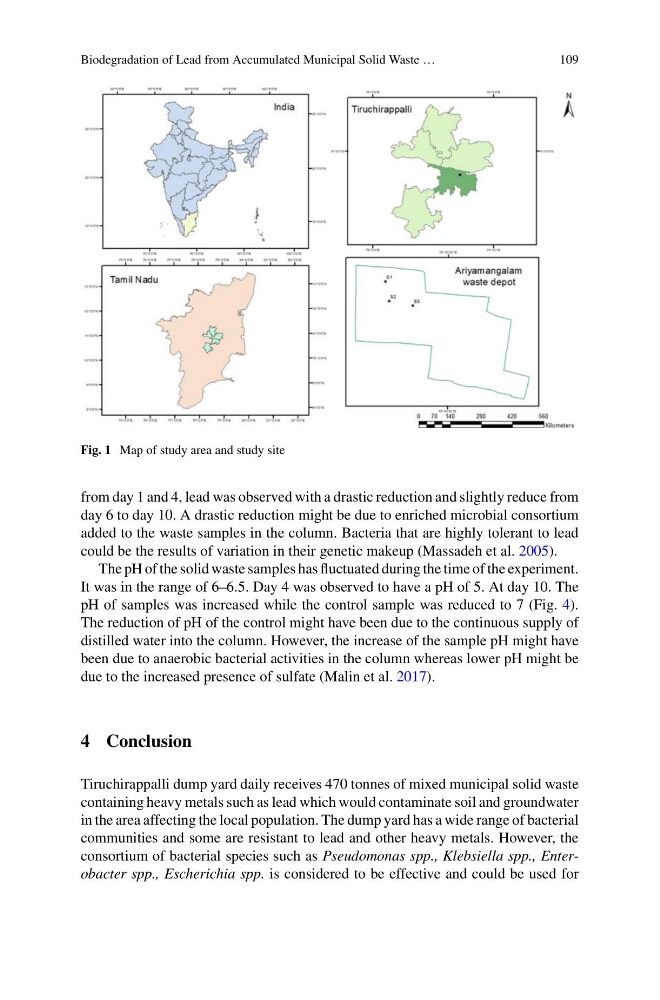
Fig. 1 Map of study area and study site
from day 1 and 4, lead was observed with a drastic reduction and slightly reduce from
day 6 to day 10. A drastic reduction might be due to enriched microbial consortium
added to the waste samples in the column. Bacteria that are highly tolerant to lead
could be the results of variation in their genetic makeup (Massadeh et al. 2005).
The pH of the solid waste samples has fluctuated during the time of the experiment.
It was in the range of 6–6.5. Day 4 was observed to have a pH of 5. At day 10. The
pH of samples was increased while the control sample was reduced to 7 (Fig. 4).
The reduction of pH of the control might have been due to the continuous supply of
distilled water into the column. However, the increase of the sample pH might have
been due to anaerobic bacterial activities in the column whereas lower pH might be
due to the increased presence of sulfate (Malin et al. 2017).
4 Conclusion
Tiruchirappalli dump yard daily receives 470 tonnes of mixed municipal solid waste
containing heavy metals such as lead which would contaminate soil and groundwater
in the area affecting the local population. The dump yard has a wide range of bacterial
communities and some are resistant to lead and other heavy metals. However, the
consortium of bacterial species such as Pseudomonas spp., Klebsiella spp., Enterobacter spp., Escherichia spp. is considered to be effective and could be used for
109
Fig. 1 Map of study area and study site
from day 1 and 4, lead was observed with a drastic reduction and slightly reduce from
day 6 to day 10. A drastic reduction might be due to enriched microbial consortium
added to the waste samples in the column. Bacteria that are highly tolerant to lead
could be the results of variation in their genetic makeup (Massadeh et al. 2005).
The pH of the solid waste samples has fluctuated during the time of the experiment.
It was in the range of 6–6.5. Day 4 was observed to have a pH of 5. At day 10. The
pH of samples was increased while the control sample was reduced to 7 (Fig. 4).
The reduction of pH of the control might have been due to the continuous supply of
distilled water into the column. However, the increase of the sample pH might have
been due to anaerobic bacterial activities in the column whereas lower pH might be
due to the increased presence of sulfate (Malin et al. 2017).
4 Conclusion
Tiruchirappalli dump yard daily receives 470 tonnes of mixed municipal solid waste
containing heavy metals such as lead which would contaminate soil and groundwater
in the area affecting the local population. The dump yard has a wide range of bacterial
communities and some are resistant to lead and other heavy metals. However, the
consortium of bacterial species such as Pseudomonas spp., Klebsiella spp., Enterobacter spp., Escherichia spp. is considered to be effective and could be used for