

96
M. N. Abubacker and M. Prince
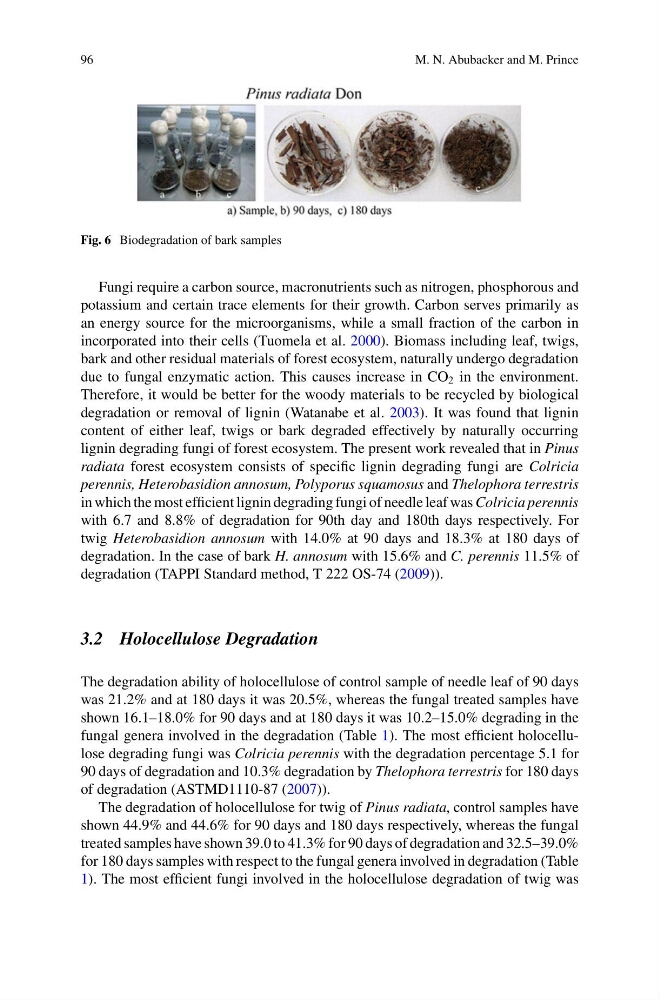
Fig. 6 Biodegradation of bark samples
Fungi require a carbon source, macronutrients such as nitrogen, phosphorous and
potassium and certain trace elements for their growth. Carbon serves primarily as
an energy source for the microorganisms, while a small fraction of the carbon in
incorporated into their cells (Tuomela et al. 2000). Biomass including leaf, twigs,
bark and other residual materials of forest ecosystem, naturally undergo degradation
due to fungal enzymatic action. This causes increase in CO 2 in the environment.
Therefore, it would be better for the woody materials to be recycled by biological
degradation or removal of lignin (Watanabe et al. 2003). It was found that lignin
content of either leaf, twigs or bark degraded effectively by naturally occurring
lignin degrading fungi of forest ecosystem. The present work revealed that in Pinus
radiata forest ecosystem consists of specific lignin degrading fungi are Colricia
perennis, Heterobasidion annosum, Polyporus squamosus and Thelophora terrestris
in which the most efficient lignin degrading fungi of needle leaf was Colricia perennis
with 6.7 and 8.8% of degradation for 90th day and 180th days respectively. For
twig Heterobasidion annosum with 14.0% at 90 days and 18.3% at 180 days of
degradation. In the case of bark H. annosum with 15.6% and C. perennis 11.5% of
degradation (TAPPI Standard method, T 222 OS-74 (2009)).
3.2 Holocellulose Degradation
The degradation ability of holocellulose of control sample of needle leaf of 90 days
was 21.2% and at 180 days it was 20.5%, whereas the fungal treated samples have
shown 16.1–18.0% for 90 days and at 180 days it was 10.2–15.0% degrading in the
fungal genera involved in the degradation (Table 1). The most efficient holocellulose degrading fungi was Colricia perennis with the degradation percentage 5.1 for
90 days of degradation and 10.3% degradation by Thelophora terrestris for 180 days
of degradation (ASTMD1110-87 (2007)).
The degradation of holocellulose for twig of Pinus radiata, control samples have
shown 44.9% and 44.6% for 90 days and 180 days respectively, whereas the fungal
treated samples have shown 39.0 to 41.3% for 90 days of degradation and 32.5–39.0%
for 180 days samples with respect to the fungal genera involved in degradation (Table
1). The most efficient fungi involved in the holocellulose degradation of twig was
M. N. Abubacker and M. Prince
Fig. 6 Biodegradation of bark samples
Fungi require a carbon source, macronutrients such as nitrogen, phosphorous and
potassium and certain trace elements for their growth. Carbon serves primarily as
an energy source for the microorganisms, while a small fraction of the carbon in
incorporated into their cells (Tuomela et al. 2000). Biomass including leaf, twigs,
bark and other residual materials of forest ecosystem, naturally undergo degradation
due to fungal enzymatic action. This causes increase in CO 2 in the environment.
Therefore, it would be better for the woody materials to be recycled by biological
degradation or removal of lignin (Watanabe et al. 2003). It was found that lignin
content of either leaf, twigs or bark degraded effectively by naturally occurring
lignin degrading fungi of forest ecosystem. The present work revealed that in Pinus
radiata forest ecosystem consists of specific lignin degrading fungi are Colricia
perennis, Heterobasidion annosum, Polyporus squamosus and Thelophora terrestris
in which the most efficient lignin degrading fungi of needle leaf was Colricia perennis
with 6.7 and 8.8% of degradation for 90th day and 180th days respectively. For
twig Heterobasidion annosum with 14.0% at 90 days and 18.3% at 180 days of
degradation. In the case of bark H. annosum with 15.6% and C. perennis 11.5% of
degradation (TAPPI Standard method, T 222 OS-74 (2009)).
3.2 Holocellulose Degradation
The degradation ability of holocellulose of control sample of needle leaf of 90 days
was 21.2% and at 180 days it was 20.5%, whereas the fungal treated samples have
shown 16.1–18.0% for 90 days and at 180 days it was 10.2–15.0% degrading in the
fungal genera involved in the degradation (Table 1). The most efficient holocellulose degrading fungi was Colricia perennis with the degradation percentage 5.1 for
90 days of degradation and 10.3% degradation by Thelophora terrestris for 180 days
of degradation (ASTMD1110-87 (2007)).
The degradation of holocellulose for twig of Pinus radiata, control samples have
shown 44.9% and 44.6% for 90 days and 180 days respectively, whereas the fungal
treated samples have shown 39.0 to 41.3% for 90 days of degradation and 32.5–39.0%
for 180 days samples with respect to the fungal genera involved in degradation (Table
1). The most efficient fungi involved in the holocellulose degradation of twig was