

Methods of Transdisciplinary Collaboration …
87
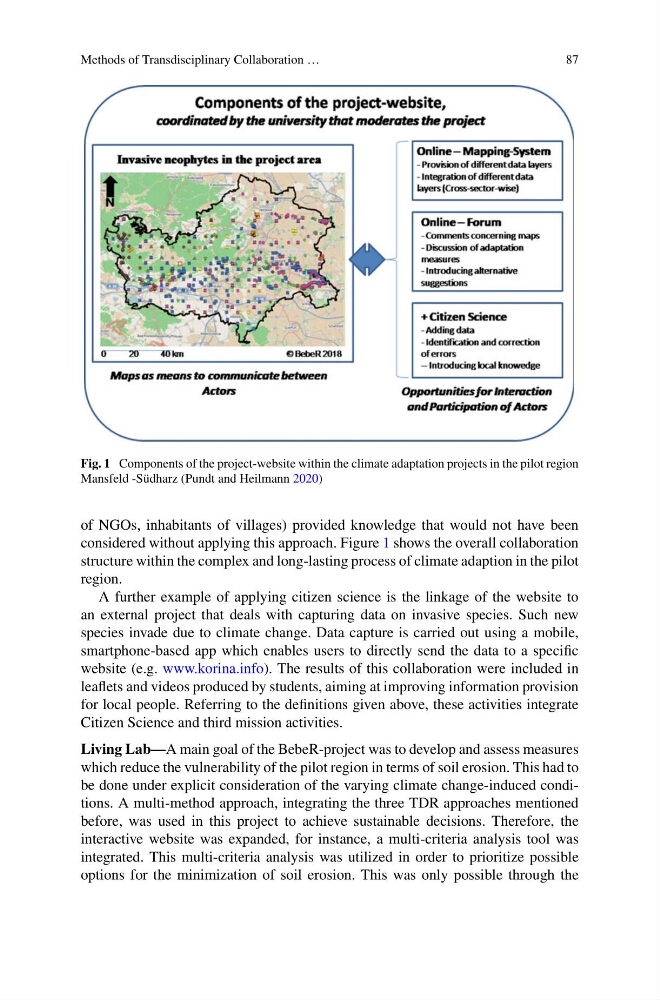
Fig. 1 Components of the project-website within the climate adaptation projects in the pilot region
Mansfeld -Südharz (Pundt and Heilmann 2020)
of NGOs, inhabitants of villages) provided knowledge that would not have been
considered without applying this approach. Figure 1 shows the overall collaboration
structure within the complex and long-lasting process of climate adaption in the pilot
region.
A further example of applying citizen science is the linkage of the website to
an external project that deals with capturing data on invasive species. Such new
species invade due to climate change. Data capture is carried out using a mobile,
smartphone-based app which enables users to directly send the data to a specific
website (e.g. www.korina.info). The results of this collaboration were included in
leaflets and videos produced by students, aiming at improving information provision
for local people. Referring to the definitions given above, these activities integrate
Citizen Science and third mission activities.
Living Lab—A main goal of the BebeR-project was to develop and assess measures
which reduce the vulnerability of the pilot region in terms of soil erosion. This had to
be done under explicit consideration of the varying climate change-induced conditions. A multi-method approach, integrating the three TDR approaches mentioned
before, was used in this project to achieve sustainable decisions. Therefore, the
interactive website was expanded, for instance, a multi-criteria analysis tool was
integrated. This multi-criteria analysis was utilized in order to prioritize possible
options for the minimization of soil erosion. This was only possible through the
87
Fig. 1 Components of the project-website within the climate adaptation projects in the pilot region
Mansfeld -Südharz (Pundt and Heilmann 2020)
of NGOs, inhabitants of villages) provided knowledge that would not have been
considered without applying this approach. Figure 1 shows the overall collaboration
structure within the complex and long-lasting process of climate adaption in the pilot
region.
A further example of applying citizen science is the linkage of the website to
an external project that deals with capturing data on invasive species. Such new
species invade due to climate change. Data capture is carried out using a mobile,
smartphone-based app which enables users to directly send the data to a specific
website (e.g. www.korina.info). The results of this collaboration were included in
leaflets and videos produced by students, aiming at improving information provision
for local people. Referring to the definitions given above, these activities integrate
Citizen Science and third mission activities.
Living Lab—A main goal of the BebeR-project was to develop and assess measures
which reduce the vulnerability of the pilot region in terms of soil erosion. This had to
be done under explicit consideration of the varying climate change-induced conditions. A multi-method approach, integrating the three TDR approaches mentioned
before, was used in this project to achieve sustainable decisions. Therefore, the
interactive website was expanded, for instance, a multi-criteria analysis tool was
integrated. This multi-criteria analysis was utilized in order to prioritize possible
options for the minimization of soil erosion. This was only possible through the