

72
F. Körner et al.
funding from the German Federal Ministry for the Environment, Nature Conservation and Nuclear Safety, the course was introduced for the first time in the summer
semester of 2019. About 50 students from engineering, social sciences and teacher
training study programs participated in the first run.
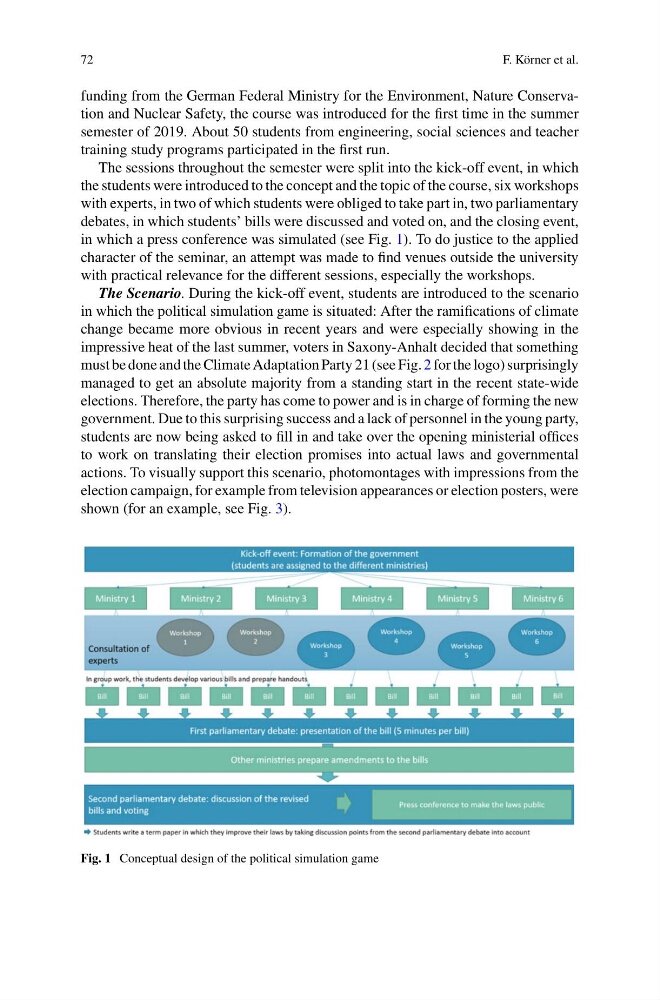
The sessions throughout the semester were split into the kick-off event, in which
the students were introduced to the concept and the topic of the course, six workshops
with experts, in two of which students were obliged to take part in, two parliamentary
debates, in which students’ bills were discussed and voted on, and the closing event,
in which a press conference was simulated (see Fig. 1). To do justice to the applied
character of the seminar, an attempt was made to find venues outside the university
with practical relevance for the different sessions, especially the workshops.
The Scenario. During the kick-off event, students are introduced to the scenario
in which the political simulation game is situated: After the ramifications of climate
change became more obvious in recent years and were especially showing in the
impressive heat of the last summer, voters in Saxony-Anhalt decided that something
must be done and the Climate Adaptation Party 21 (see Fig. 2 for the logo) surprisingly
managed to get an absolute majority from a standing start in the recent state-wide
elections. Therefore, the party has come to power and is in charge of forming the new
government. Due to this surprising success and a lack of personnel in the young party,
students are now being asked to fill in and take over the opening ministerial offices
to work on translating their election promises into actual laws and governmental
actions. To visually support this scenario, photomontages with impressions from the
election campaign, for example from television appearances or election posters, were
shown (for an example, see Fig. 3).
Fig. 1 Conceptual design of the political simulation game
F. Körner et al.
funding from the German Federal Ministry for the Environment, Nature Conservation and Nuclear Safety, the course was introduced for the first time in the summer
semester of 2019. About 50 students from engineering, social sciences and teacher
training study programs participated in the first run.
The sessions throughout the semester were split into the kick-off event, in which
the students were introduced to the concept and the topic of the course, six workshops
with experts, in two of which students were obliged to take part in, two parliamentary
debates, in which students’ bills were discussed and voted on, and the closing event,
in which a press conference was simulated (see Fig. 1). To do justice to the applied
character of the seminar, an attempt was made to find venues outside the university
with practical relevance for the different sessions, especially the workshops.
The Scenario. During the kick-off event, students are introduced to the scenario
in which the political simulation game is situated: After the ramifications of climate
change became more obvious in recent years and were especially showing in the
impressive heat of the last summer, voters in Saxony-Anhalt decided that something
must be done and the Climate Adaptation Party 21 (see Fig. 2 for the logo) surprisingly
managed to get an absolute majority from a standing start in the recent state-wide
elections. Therefore, the party has come to power and is in charge of forming the new
government. Due to this surprising success and a lack of personnel in the young party,
students are now being asked to fill in and take over the opening ministerial offices
to work on translating their election promises into actual laws and governmental
actions. To visually support this scenario, photomontages with impressions from the
election campaign, for example from television appearances or election posters, were
shown (for an example, see Fig. 3).
Fig. 1 Conceptual design of the political simulation game