

504
S. Zenchanka et al.
Goals. The knowledge acquired is used by students at a writing course and diploma
projects and this is the main contribution of this experience to society: disseminating more knowledge on sustainable development and preparing and training future
professionals to deal with sustainability challenges.
2 Methodology
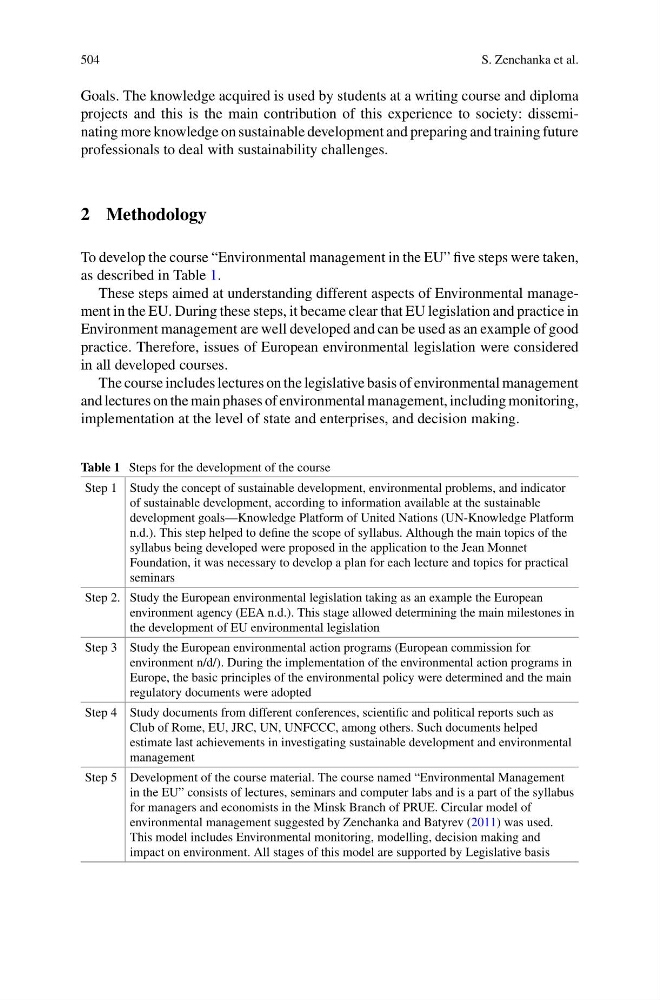
To develop the course “Environmental management in the EU” five steps were taken,
as described in Table 1.
These steps aimed at understanding different aspects of Environmental management in the EU. During these steps, it became clear that EU legislation and practice in
Environment management are well developed and can be used as an example of good
practice. Therefore, issues of European environmental legislation were considered
in all developed courses.
The course includes lectures on the legislative basis of environmental management
and lectures on the main phases of environmental management, including monitoring,
implementation at the level of state and enterprises, and decision making.
Table 1 Steps for the development of the course
Step 1 Study the concept of sustainable development, environmental problems, and indicator
of sustainable development, according to information available at the sustainable
development goals—Knowledge Platform of United Nations (UN-Knowledge Platform
n.d.). This step helped to define the scope of syllabus. Although the main topics of the
syllabus being developed were proposed in the application to the Jean Monnet
Foundation, it was necessary to develop a plan for each lecture and topics for practical
seminars
Step 2. Study the European environmental legislation taking as an example the European
environment agency (EEA n.d.). This stage allowed determining the main milestones in
the development of EU environmental legislation
Step 3 Study the European environmental action programs (European commission for
environment n/d/). During the implementation of the environmental action programs in
Europe, the basic principles of the environmental policy were determined and the main
regulatory documents were adopted
Step 4 Study documents from different conferences, scientific and political reports such as
Club of Rome, EU, JRC, UN, UNFCCC, among others. Such documents helped
estimate last achievements in investigating sustainable development and environmental
management
Step 5 Development of the course material. The course named “Environmental Management
in the EU” consists of lectures, seminars and computer labs and is a part of the syllabus
for managers and economists in the Minsk Branch of PRUE. Circular model of
environmental management suggested by Zenchanka and Batyrev (2011) was used.
This model includes Environmental monitoring, modelling, decision making and
impact on environment. All stages of this model are supported by Legislative basis
S. Zenchanka et al.
Goals. The knowledge acquired is used by students at a writing course and diploma
projects and this is the main contribution of this experience to society: disseminating more knowledge on sustainable development and preparing and training future
professionals to deal with sustainability challenges.
2 Methodology
To develop the course “Environmental management in the EU” five steps were taken,
as described in Table 1.
These steps aimed at understanding different aspects of Environmental management in the EU. During these steps, it became clear that EU legislation and practice in
Environment management are well developed and can be used as an example of good
practice. Therefore, issues of European environmental legislation were considered
in all developed courses.
The course includes lectures on the legislative basis of environmental management
and lectures on the main phases of environmental management, including monitoring,
implementation at the level of state and enterprises, and decision making.
Table 1 Steps for the development of the course
Step 1 Study the concept of sustainable development, environmental problems, and indicator
of sustainable development, according to information available at the sustainable
development goals—Knowledge Platform of United Nations (UN-Knowledge Platform
n.d.). This step helped to define the scope of syllabus. Although the main topics of the
syllabus being developed were proposed in the application to the Jean Monnet
Foundation, it was necessary to develop a plan for each lecture and topics for practical
seminars
Step 2. Study the European environmental legislation taking as an example the European
environment agency (EEA n.d.). This stage allowed determining the main milestones in
the development of EU environmental legislation
Step 3 Study the European environmental action programs (European commission for
environment n/d/). During the implementation of the environmental action programs in
Europe, the basic principles of the environmental policy were determined and the main
regulatory documents were adopted
Step 4 Study documents from different conferences, scientific and political reports such as
Club of Rome, EU, JRC, UN, UNFCCC, among others. Such documents helped
estimate last achievements in investigating sustainable development and environmental
management
Step 5 Development of the course material. The course named “Environmental Management
in the EU” consists of lectures, seminars and computer labs and is a part of the syllabus
for managers and economists in the Minsk Branch of PRUE. Circular model of
environmental management suggested by Zenchanka and Batyrev (2011) was used.
This model includes Environmental monitoring, modelling, decision making and
impact on environment. All stages of this model are supported by Legislative basis