

478
E. Michalopoulou et al.
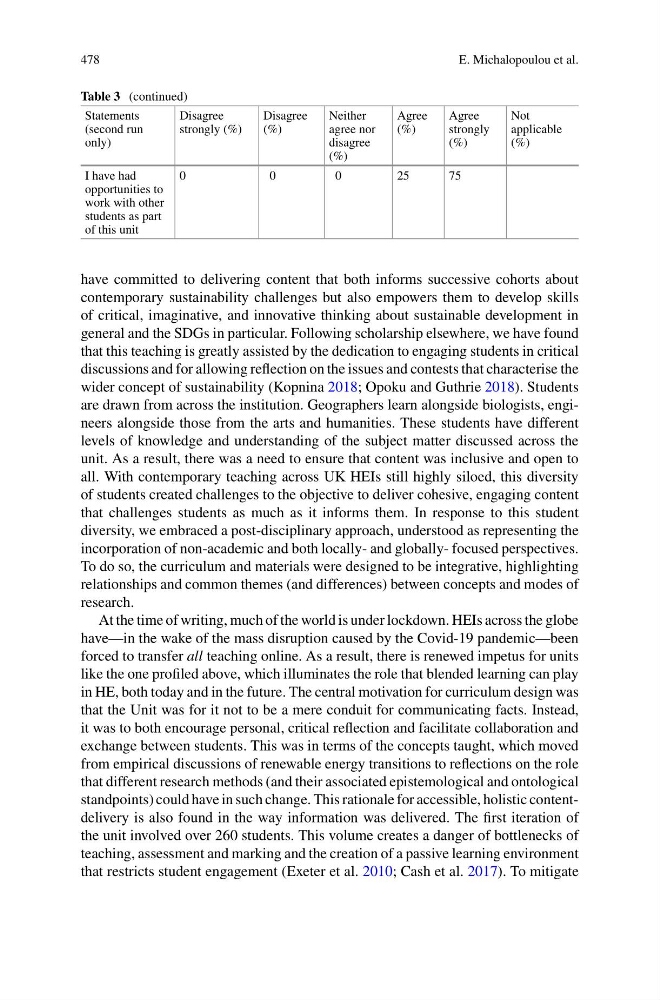
Table 3 (continued)
Statements
(second run
only)
Disagree
strongly (%)
Disagree
(%)
Neither
agree nor
disagree
(%)
Agree
(%)
Agree
strongly
(%)
Not
applicable
(%)
I have had
opportunities to
work with other
students as part
of this unit
0
0
0
25
75
have committed to delivering content that both informs successive cohorts about
contemporary sustainability challenges but also empowers them to develop skills
of critical, imaginative, and innovative thinking about sustainable development in
general and the SDGs in particular. Following scholarship elsewhere, we have found
that this teaching is greatly assisted by the dedication to engaging students in critical
discussions and for allowing reflection on the issues and contests that characterise the
wider concept of sustainability (Kopnina 2018; Opoku and Guthrie 2018). Students
are drawn from across the institution. Geographers learn alongside biologists, engineers alongside those from the arts and humanities. These students have different
levels of knowledge and understanding of the subject matter discussed across the
unit. As a result, there was a need to ensure that content was inclusive and open to
all. With contemporary teaching across UK HEIs still highly siloed, this diversity
of students created challenges to the objective to deliver cohesive, engaging content
that challenges students as much as it informs them. In response to this student
diversity, we embraced a post-disciplinary approach, understood as representing the
incorporation of non-academic and both locally- and globally- focused perspectives.
To do so, the curriculum and materials were designed to be integrative, highlighting
relationships and common themes (and differences) between concepts and modes of
research.
At the time of writing, much of the world is under lockdown. HEIs across the globe
have—in the wake of the mass disruption caused by the Covid-19 pandemic—been
forced to transfer all teaching online. As a result, there is renewed impetus for units
like the one profiled above, which illuminates the role that blended learning can play
in HE, both today and in the future. The central motivation for curriculum design was
that the Unit was for it not to be a mere conduit for communicating facts. Instead,
it was to both encourage personal, critical reflection and facilitate collaboration and
exchange between students. This was in terms of the concepts taught, which moved
from empirical discussions of renewable energy transitions to reflections on the role
that different research methods (and their associated epistemological and ontological
standpoints) could have in such change. This rationale for accessible, holistic contentdelivery is also found in the way information was delivered. The first iteration of
the unit involved over 260 students. This volume creates a danger of bottlenecks of
teaching, assessment and marking and the creation of a passive learning environment
that restricts student engagement (Exeter et al. 2010; Cash et al. 2017). To mitigate
E. Michalopoulou et al.
Table 3 (continued)
Statements
(second run
only)
Disagree
strongly (%)
Disagree
(%)
Neither
agree nor
disagree
(%)
Agree
(%)
Agree
strongly
(%)
Not
applicable
(%)
I have had
opportunities to
work with other
students as part
of this unit
0
0
0
25
75
have committed to delivering content that both informs successive cohorts about
contemporary sustainability challenges but also empowers them to develop skills
of critical, imaginative, and innovative thinking about sustainable development in
general and the SDGs in particular. Following scholarship elsewhere, we have found
that this teaching is greatly assisted by the dedication to engaging students in critical
discussions and for allowing reflection on the issues and contests that characterise the
wider concept of sustainability (Kopnina 2018; Opoku and Guthrie 2018). Students
are drawn from across the institution. Geographers learn alongside biologists, engineers alongside those from the arts and humanities. These students have different
levels of knowledge and understanding of the subject matter discussed across the
unit. As a result, there was a need to ensure that content was inclusive and open to
all. With contemporary teaching across UK HEIs still highly siloed, this diversity
of students created challenges to the objective to deliver cohesive, engaging content
that challenges students as much as it informs them. In response to this student
diversity, we embraced a post-disciplinary approach, understood as representing the
incorporation of non-academic and both locally- and globally- focused perspectives.
To do so, the curriculum and materials were designed to be integrative, highlighting
relationships and common themes (and differences) between concepts and modes of
research.
At the time of writing, much of the world is under lockdown. HEIs across the globe
have—in the wake of the mass disruption caused by the Covid-19 pandemic—been
forced to transfer all teaching online. As a result, there is renewed impetus for units
like the one profiled above, which illuminates the role that blended learning can play
in HE, both today and in the future. The central motivation for curriculum design was
that the Unit was for it not to be a mere conduit for communicating facts. Instead,
it was to both encourage personal, critical reflection and facilitate collaboration and
exchange between students. This was in terms of the concepts taught, which moved
from empirical discussions of renewable energy transitions to reflections on the role
that different research methods (and their associated epistemological and ontological
standpoints) could have in such change. This rationale for accessible, holistic contentdelivery is also found in the way information was delivered. The first iteration of
the unit involved over 260 students. This volume creates a danger of bottlenecks of
teaching, assessment and marking and the creation of a passive learning environment
that restricts student engagement (Exeter et al. 2010; Cash et al. 2017). To mitigate