

458
M. Bizerril et al.
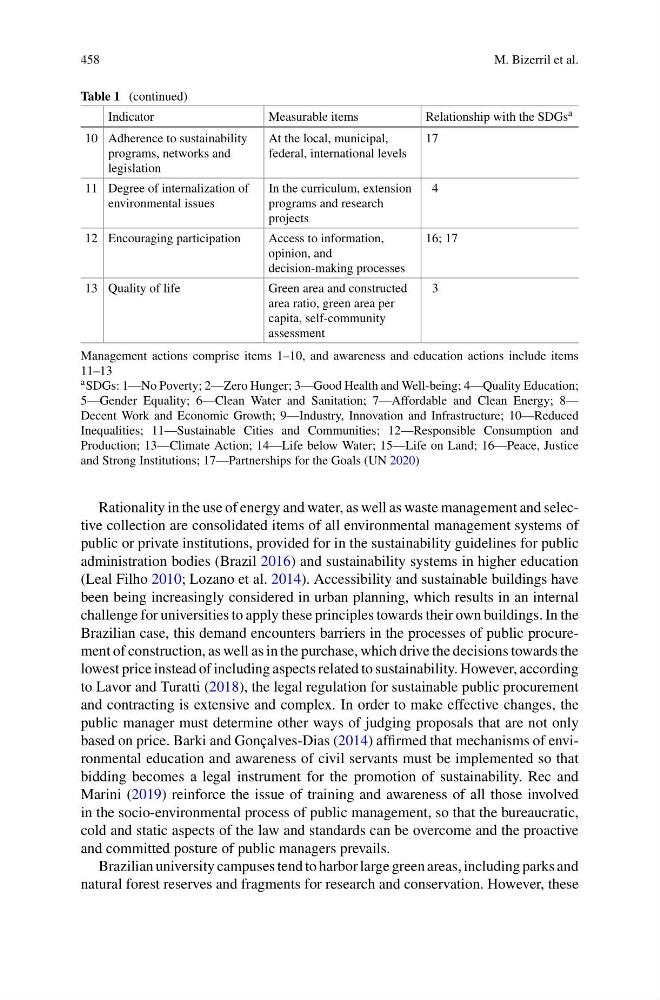
Table 1 (continued)
Indicator
Measurable items
Relationship with the SDGs a
10 Adherence to sustainability
programs, networks and
legislation
At the local, municipal,
federal, international levels
17
11 Degree of internalization of
environmental issues
In the curriculum, extension
programs and research
projects
4
12 Encouraging participation
Access to information,
opinion, and
decision-making processes
16; 17
13 Quality of life
Green area and constructed
area ratio, green area per
capita, self-community
assessment
3
Management actions comprise items 1–10, and awareness and education actions include items
11–13
a SDGs: 1—No Poverty; 2—Zero Hunger; 3—Good Health and Well-being; 4—Quality Education;
5—Gender Equality; 6—Clean Water and Sanitation; 7—Affordable and Clean Energy; 8—
Decent Work and Economic Growth; 9—Industry, Innovation and Infrastructure; 10—Reduced
Inequalities; 11—Sustainable Cities and Communities; 12—Responsible Consumption and
Production; 13—Climate Action; 14—Life below Water; 15—Life on Land; 16—Peace, Justice
and Strong Institutions; 17—Partnerships for the Goals (UN 2020)
Rationality in the use of energy and water, as well as waste management and selective collection are consolidated items of all environmental management systems of
public or private institutions, provided for in the sustainability guidelines for public
administration bodies (Brazil 2016) and sustainability systems in higher education
(Leal Filho 2010; Lozano et al. 2014). Accessibility and sustainable buildings have
been being increasingly considered in urban planning, which results in an internal
challenge for universities to apply these principles towards their own buildings. In the
Brazilian case, this demand encounters barriers in the processes of public procurement of construction, as well as in the purchase, which drive the decisions towards the
lowest price instead of including aspects related to sustainability. However, according
to Lavor and Turatti (2018), the legal regulation for sustainable public procurement
and contracting is extensive and complex. In order to make effective changes, the
public manager must determine other ways of judging proposals that are not only
based on price. Barki and Gonçalves-Dias (2014) affirmed that mechanisms of environmental education and awareness of civil servants must be implemented so that
bidding becomes a legal instrument for the promotion of sustainability. Rec and
Marini (2019) reinforce the issue of training and awareness of all those involved
in the socio-environmental process of public management, so that the bureaucratic,
cold and static aspects of the law and standards can be overcome and the proactive
and committed posture of public managers prevails.
Brazilian university campuses tend to harbor large green areas, including parks and
natural forest reserves and fragments for research and conservation. However, these
M. Bizerril et al.
Table 1 (continued)
Indicator
Measurable items
Relationship with the SDGs a
10 Adherence to sustainability
programs, networks and
legislation
At the local, municipal,
federal, international levels
17
11 Degree of internalization of
environmental issues
In the curriculum, extension
programs and research
projects
4
12 Encouraging participation
Access to information,
opinion, and
decision-making processes
16; 17
13 Quality of life
Green area and constructed
area ratio, green area per
capita, self-community
assessment
3
Management actions comprise items 1–10, and awareness and education actions include items
11–13
a SDGs: 1—No Poverty; 2—Zero Hunger; 3—Good Health and Well-being; 4—Quality Education;
5—Gender Equality; 6—Clean Water and Sanitation; 7—Affordable and Clean Energy; 8—
Decent Work and Economic Growth; 9—Industry, Innovation and Infrastructure; 10—Reduced
Inequalities; 11—Sustainable Cities and Communities; 12—Responsible Consumption and
Production; 13—Climate Action; 14—Life below Water; 15—Life on Land; 16—Peace, Justice
and Strong Institutions; 17—Partnerships for the Goals (UN 2020)
Rationality in the use of energy and water, as well as waste management and selective collection are consolidated items of all environmental management systems of
public or private institutions, provided for in the sustainability guidelines for public
administration bodies (Brazil 2016) and sustainability systems in higher education
(Leal Filho 2010; Lozano et al. 2014). Accessibility and sustainable buildings have
been being increasingly considered in urban planning, which results in an internal
challenge for universities to apply these principles towards their own buildings. In the
Brazilian case, this demand encounters barriers in the processes of public procurement of construction, as well as in the purchase, which drive the decisions towards the
lowest price instead of including aspects related to sustainability. However, according
to Lavor and Turatti (2018), the legal regulation for sustainable public procurement
and contracting is extensive and complex. In order to make effective changes, the
public manager must determine other ways of judging proposals that are not only
based on price. Barki and Gonçalves-Dias (2014) affirmed that mechanisms of environmental education and awareness of civil servants must be implemented so that
bidding becomes a legal instrument for the promotion of sustainability. Rec and
Marini (2019) reinforce the issue of training and awareness of all those involved
in the socio-environmental process of public management, so that the bureaucratic,
cold and static aspects of the law and standards can be overcome and the proactive
and committed posture of public managers prevails.
Brazilian university campuses tend to harbor large green areas, including parks and
natural forest reserves and fragments for research and conservation. However, these