

426
T. Ambrizzi et al.
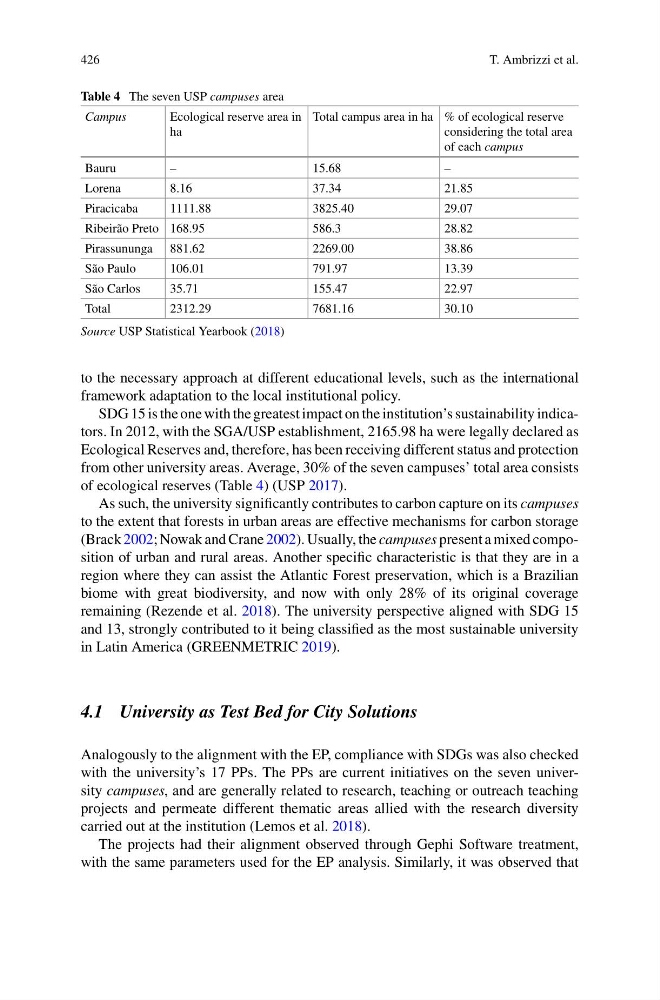
Table 4 The seven USP campuses area
Campus
Ecological reserve area in
ha
Total campus area in ha % of ecological reserve
considering the total area
of each campus
Bauru
–
15.68
–
Lorena
8.16
37.34
21.85
Piracicaba
1111.88
3825.40
29.07
Ribeirão Preto 168.95
586.3
28.82
Pirassununga 881.62
2269.00
38.86
São Paulo
106.01
791.97
13.39
São Carlos
35.71
155.47
22.97
Total
2312.29
7681.16
30.10
Source USP Statistical Yearbook (2018)
to the necessary approach at different educational levels, such as the international
framework adaptation to the local institutional policy.
SDG 15 is the one with the greatest impact on the institution’s sustainability indicators. In 2012, with the SGA/USP establishment, 2165.98 ha were legally declared as
Ecological Reserves and, therefore, has been receiving different status and protection
from other university areas. Average, 30% of the seven campuses’ total area consists
of ecological reserves (Table 4) (USP 2017).
As such, the university significantly contributes to carbon capture on its campuses
to the extent that forests in urban areas are effective mechanisms for carbon storage
(Brack 2002; Nowak and Crane 2002). Usually, the campuses present a mixed composition of urban and rural areas. Another specific characteristic is that they are in a
region where they can assist the Atlantic Forest preservation, which is a Brazilian
biome with great biodiversity, and now with only 28% of its original coverage
remaining (Rezende et al. 2018). The university perspective aligned with SDG 15
and 13, strongly contributed to it being classified as the most sustainable university
in Latin America (GREENMETRIC 2019).
4.1 University as Test Bed for City Solutions
Analogously to the alignment with the EP, compliance with SDGs was also checked
with the university’s 17 PPs. The PPs are current initiatives on the seven university campuses, and are generally related to research, teaching or outreach teaching
projects and permeate different thematic areas allied with the research diversity
carried out at the institution (Lemos et al. 2018).
The projects had their alignment observed through Gephi Software treatment,
with the same parameters used for the EP analysis. Similarly, it was observed that
T. Ambrizzi et al.
Table 4 The seven USP campuses area
Campus
Ecological reserve area in
ha
Total campus area in ha % of ecological reserve
considering the total area
of each campus
Bauru
–
15.68
–
Lorena
8.16
37.34
21.85
Piracicaba
1111.88
3825.40
29.07
Ribeirão Preto 168.95
586.3
28.82
Pirassununga 881.62
2269.00
38.86
São Paulo
106.01
791.97
13.39
São Carlos
35.71
155.47
22.97
Total
2312.29
7681.16
30.10
Source USP Statistical Yearbook (2018)
to the necessary approach at different educational levels, such as the international
framework adaptation to the local institutional policy.
SDG 15 is the one with the greatest impact on the institution’s sustainability indicators. In 2012, with the SGA/USP establishment, 2165.98 ha were legally declared as
Ecological Reserves and, therefore, has been receiving different status and protection
from other university areas. Average, 30% of the seven campuses’ total area consists
of ecological reserves (Table 4) (USP 2017).
As such, the university significantly contributes to carbon capture on its campuses
to the extent that forests in urban areas are effective mechanisms for carbon storage
(Brack 2002; Nowak and Crane 2002). Usually, the campuses present a mixed composition of urban and rural areas. Another specific characteristic is that they are in a
region where they can assist the Atlantic Forest preservation, which is a Brazilian
biome with great biodiversity, and now with only 28% of its original coverage
remaining (Rezende et al. 2018). The university perspective aligned with SDG 15
and 13, strongly contributed to it being classified as the most sustainable university
in Latin America (GREENMETRIC 2019).
4.1 University as Test Bed for City Solutions
Analogously to the alignment with the EP, compliance with SDGs was also checked
with the university’s 17 PPs. The PPs are current initiatives on the seven university campuses, and are generally related to research, teaching or outreach teaching
projects and permeate different thematic areas allied with the research diversity
carried out at the institution (Lemos et al. 2018).
The projects had their alignment observed through Gephi Software treatment,
with the same parameters used for the EP analysis. Similarly, it was observed that