

418
T. Ambrizzi et al.
and moral authority to improve their environmental resolutions by keeping a strong
regulatory system towards efficiency, and at the same time, avoiding the eventual
public policy regression, since they can improve common interest among social and
academic communities.
USP has been careful towards environmental public policies non-regression and
has been making an effort to the development of SDGs through its EP. The SDGs
have been promoting non-regression principles, thus, emerging in states and at an
international level applied in public policies, as included in “The Future We Want”
(United Nations 2012).
Regression takes many forms. It is seldom explicit since governments do not dare
to announce backtracking in environmental protection officially due to fear of an unfavorable public response from environmental and public policy. Note that this principle
has been first established by a referendum in California (on November 2nd, 2010)
when the majority of voters refused to suspend a climate change and greenhouse
gas emissions reduction regulation, as requested by oil companies (Prieur 2012). It
has been demonstrated that this principle may present significant implications on the
environmental public policies with social interest.
3 Materials and Methods
To map the Agenda 2030 thematic context (United Nations 2015) at USP’s environment, two thematic association stages were carried out using a consensus-based
expert elicitation process with different backgrounds specialists. This approach has
been inspired by the SDGs mappings developed by Nerini et al. (2018) and Vinuesa
et al. (2020). It can potentially reduce uncertainty and also help to elaborate frameworks to support decision making. In this study, mainly institutional policy and
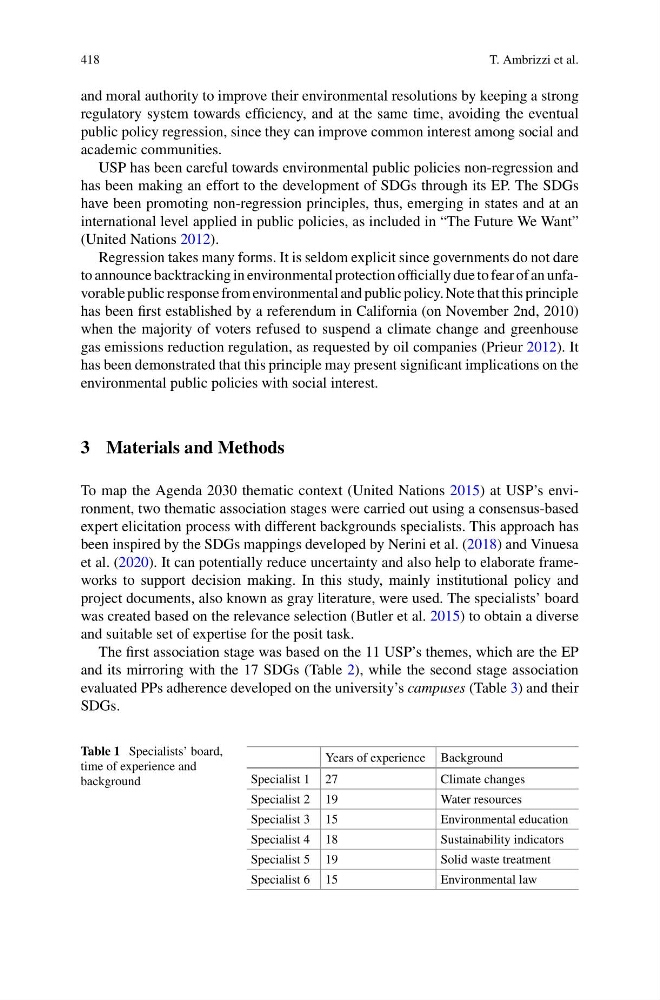
project documents, also known as gray literature, were used. The specialists’ board
was created based on the relevance selection (Butler et al. 2015) to obtain a diverse
and suitable set of expertise for the posit task.
The first association stage was based on the 11 USP’s themes, which are the EP
and its mirroring with the 17 SDGs (Table 2), while the second stage association
evaluated PPs adherence developed on the university’s campuses (Table 3) and their
SDGs.
Table 1 Specialists’ board,
time of experience and
background
Years of experience Background
Specialist 1 27
Climate changes
Specialist 2 19
Water resources
Specialist 3 15
Environmental education
Specialist 4 18
Sustainability indicators
Specialist 5 19
Solid waste treatment
Specialist 6 15
Environmental law
T. Ambrizzi et al.
and moral authority to improve their environmental resolutions by keeping a strong
regulatory system towards efficiency, and at the same time, avoiding the eventual
public policy regression, since they can improve common interest among social and
academic communities.
USP has been careful towards environmental public policies non-regression and
has been making an effort to the development of SDGs through its EP. The SDGs
have been promoting non-regression principles, thus, emerging in states and at an
international level applied in public policies, as included in “The Future We Want”
(United Nations 2012).
Regression takes many forms. It is seldom explicit since governments do not dare
to announce backtracking in environmental protection officially due to fear of an unfavorable public response from environmental and public policy. Note that this principle
has been first established by a referendum in California (on November 2nd, 2010)
when the majority of voters refused to suspend a climate change and greenhouse
gas emissions reduction regulation, as requested by oil companies (Prieur 2012). It
has been demonstrated that this principle may present significant implications on the
environmental public policies with social interest.
3 Materials and Methods
To map the Agenda 2030 thematic context (United Nations 2015) at USP’s environment, two thematic association stages were carried out using a consensus-based
expert elicitation process with different backgrounds specialists. This approach has
been inspired by the SDGs mappings developed by Nerini et al. (2018) and Vinuesa
et al. (2020). It can potentially reduce uncertainty and also help to elaborate frameworks to support decision making. In this study, mainly institutional policy and
project documents, also known as gray literature, were used. The specialists’ board
was created based on the relevance selection (Butler et al. 2015) to obtain a diverse
and suitable set of expertise for the posit task.
The first association stage was based on the 11 USP’s themes, which are the EP
and its mirroring with the 17 SDGs (Table 2), while the second stage association
evaluated PPs adherence developed on the university’s campuses (Table 3) and their
SDGs.
Table 1 Specialists’ board,
time of experience and
background
Years of experience Background
Specialist 1 27
Climate changes
Specialist 2 19
Water resources
Specialist 3 15
Environmental education
Specialist 4 18
Sustainability indicators
Specialist 5 19
Solid waste treatment
Specialist 6 15
Environmental law