

408
L. Brandli et al.
Step 1—Diagnosis of the project under study
This step aims to characterize and describe the project. The methodology adapted
from Bardin (2011) was used, following the phases: analysis, exploration and treatment of the content. In this step, contact was made with the professors responsible
for the project, and access to the project activity report was obtained.
Step 2—Identification and characterization of the project’s actions
This step aimed to identify the actions carried out by the project and characterize
them. A detailed analysis of the available documents and the collection of the necessary data were carried out. According to Bardin (2011), this is a relevant phase, as it
consists in the choice of the data to be analyzed. First, it was searched by the actions
promoted by he project so far. For this moment, the project’s performance report was
used as a source of information, describing the activities carried out. In parallel, a
search was conducted on the UPF institutional website to identify news about the
project’s actions.
Step 3—Identification of the contribution to the SDGs
Finally, the project contribution to the consolidation of the SDGs was highlighted.
The third phase covers the data treatment. The information was filtered and treated,
as well analyzed regarding the contributions to the SDGs achievement. Each activity
was analyzed from the perspective of the SDGs and their targets.
3 Results and Discussion
3.1 Diagnosis of the Project Under Study
The activities within the context of the “UniverCidade Educadora e Inteligente”
Project started in 2011, but it was in 2016 that the project was officially launched
and in 2017 it promoted its first event: “1st Meeting on Smart and Learning Cities”.
Among its purposes are the strengthening of social participation and the improvement
and revitalization of public spaces (UPF 2020b).
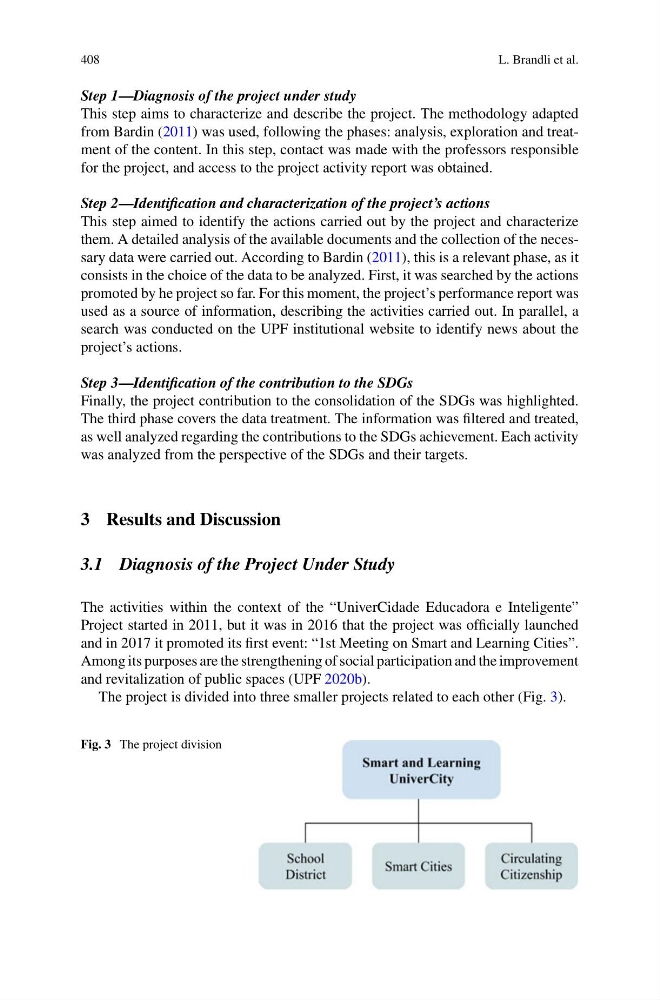
The project is divided into three smaller projects related to each other (Fig. 3).
Fig. 3 The project division
L. Brandli et al.
Step 1—Diagnosis of the project under study
This step aims to characterize and describe the project. The methodology adapted
from Bardin (2011) was used, following the phases: analysis, exploration and treatment of the content. In this step, contact was made with the professors responsible
for the project, and access to the project activity report was obtained.
Step 2—Identification and characterization of the project’s actions
This step aimed to identify the actions carried out by the project and characterize
them. A detailed analysis of the available documents and the collection of the necessary data were carried out. According to Bardin (2011), this is a relevant phase, as it
consists in the choice of the data to be analyzed. First, it was searched by the actions
promoted by he project so far. For this moment, the project’s performance report was
used as a source of information, describing the activities carried out. In parallel, a
search was conducted on the UPF institutional website to identify news about the
project’s actions.
Step 3—Identification of the contribution to the SDGs
Finally, the project contribution to the consolidation of the SDGs was highlighted.
The third phase covers the data treatment. The information was filtered and treated,
as well analyzed regarding the contributions to the SDGs achievement. Each activity
was analyzed from the perspective of the SDGs and their targets.
3 Results and Discussion
3.1 Diagnosis of the Project Under Study
The activities within the context of the “UniverCidade Educadora e Inteligente”
Project started in 2011, but it was in 2016 that the project was officially launched
and in 2017 it promoted its first event: “1st Meeting on Smart and Learning Cities”.
Among its purposes are the strengthening of social participation and the improvement
and revitalization of public spaces (UPF 2020b).
The project is divided into three smaller projects related to each other (Fig. 3).
Fig. 3 The project division