

392
O. Khalaim and S. Urenje
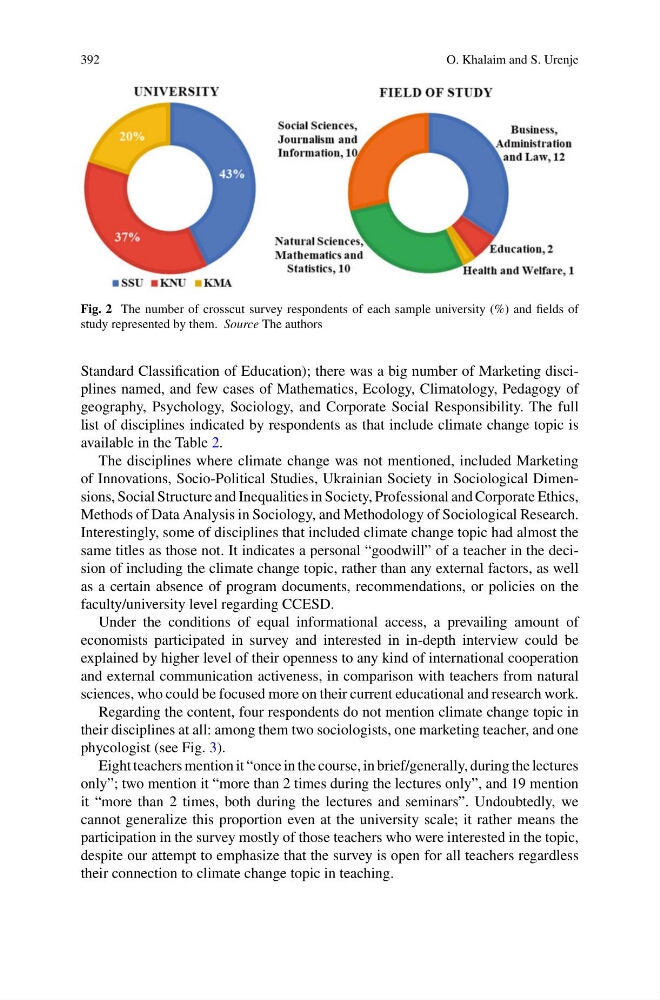
Fig. 2 The number of crosscut survey respondents of each sample university (%) and fields of
study represented by them. Source The authors
Standard Classification of Education); there was a big number of Marketing disciplines named, and few cases of Mathematics, Ecology, Climatology, Pedagogy of
geography, Psychology, Sociology, and Corporate Social Responsibility. The full
list of disciplines indicated by respondents as that include climate change topic is
available in the Table 2.
The disciplines where climate change was not mentioned, included Marketing
of Innovations, Socio-Political Studies, Ukrainian Society in Sociological Dimensions, Social Structure and Inequalities in Society, Professional and Corporate Ethics,
Methods of Data Analysis in Sociology, and Methodology of Sociological Research.
Interestingly, some of disciplines that included climate change topic had almost the
same titles as those not. It indicates a personal “goodwill” of a teacher in the decision of including the climate change topic, rather than any external factors, as well
as a certain absence of program documents, recommendations, or policies on the
faculty/university level regarding CCESD.
Under the conditions of equal informational access, a prevailing amount of
economists participated in survey and interested in in-depth interview could be
explained by higher level of their openness to any kind of international cooperation
and external communication activeness, in comparison with teachers from natural
sciences, who could be focused more on their current educational and research work.
Regarding the content, four respondents do not mention climate change topic in
their disciplines at all: among them two sociologists, one marketing teacher, and one
phycologist (see Fig. 3).
Eight teachers mention it “once in the course, in brief/generally, during the lectures
only”; two mention it “more than 2 times during the lectures only”, and 19 mention
it “more than 2 times, both during the lectures and seminars”. Undoubtedly, we
cannot generalize this proportion even at the university scale; it rather means the
participation in the survey mostly of those teachers who were interested in the topic,
despite our attempt to emphasize that the survey is open for all teachers regardless
their connection to climate change topic in teaching.
O. Khalaim and S. Urenje
Fig. 2 The number of crosscut survey respondents of each sample university (%) and fields of
study represented by them. Source The authors
Standard Classification of Education); there was a big number of Marketing disciplines named, and few cases of Mathematics, Ecology, Climatology, Pedagogy of
geography, Psychology, Sociology, and Corporate Social Responsibility. The full
list of disciplines indicated by respondents as that include climate change topic is
available in the Table 2.
The disciplines where climate change was not mentioned, included Marketing
of Innovations, Socio-Political Studies, Ukrainian Society in Sociological Dimensions, Social Structure and Inequalities in Society, Professional and Corporate Ethics,
Methods of Data Analysis in Sociology, and Methodology of Sociological Research.
Interestingly, some of disciplines that included climate change topic had almost the
same titles as those not. It indicates a personal “goodwill” of a teacher in the decision of including the climate change topic, rather than any external factors, as well
as a certain absence of program documents, recommendations, or policies on the
faculty/university level regarding CCESD.
Under the conditions of equal informational access, a prevailing amount of
economists participated in survey and interested in in-depth interview could be
explained by higher level of their openness to any kind of international cooperation
and external communication activeness, in comparison with teachers from natural
sciences, who could be focused more on their current educational and research work.
Regarding the content, four respondents do not mention climate change topic in
their disciplines at all: among them two sociologists, one marketing teacher, and one
phycologist (see Fig. 3).
Eight teachers mention it “once in the course, in brief/generally, during the lectures
only”; two mention it “more than 2 times during the lectures only”, and 19 mention
it “more than 2 times, both during the lectures and seminars”. Undoubtedly, we
cannot generalize this proportion even at the university scale; it rather means the
participation in the survey mostly of those teachers who were interested in the topic,
despite our attempt to emphasize that the survey is open for all teachers regardless
their connection to climate change topic in teaching.