

“Evolution of Knowledge Sharing of Education …
369
Table 1 Educational approaches towards ESD
Educational approach towards ESD Degree of involvement of learners
Education about sustainability
Knowing facts and figures about certain topics of
sustainability
Education in sustainability
Active involvement in understanding the scope and
interdependencies of sustainability as a whole
Education for sustainability
Critical and reflective ability to discover opportunities for
transformation towards greater sustainability, constant
development of new capacities in relation to changing
economical, ecological of social environments
Own illustration following Sterling (2001)
This ability to view questions from a multitude of perspectives, integrating these
perspectives and finding ways to transform systems towards increased attention
concerning sustainability is one main outcome of successful ESD, be it in higher
education or other settings. In addition to above discussion, the thoughts of Sterling
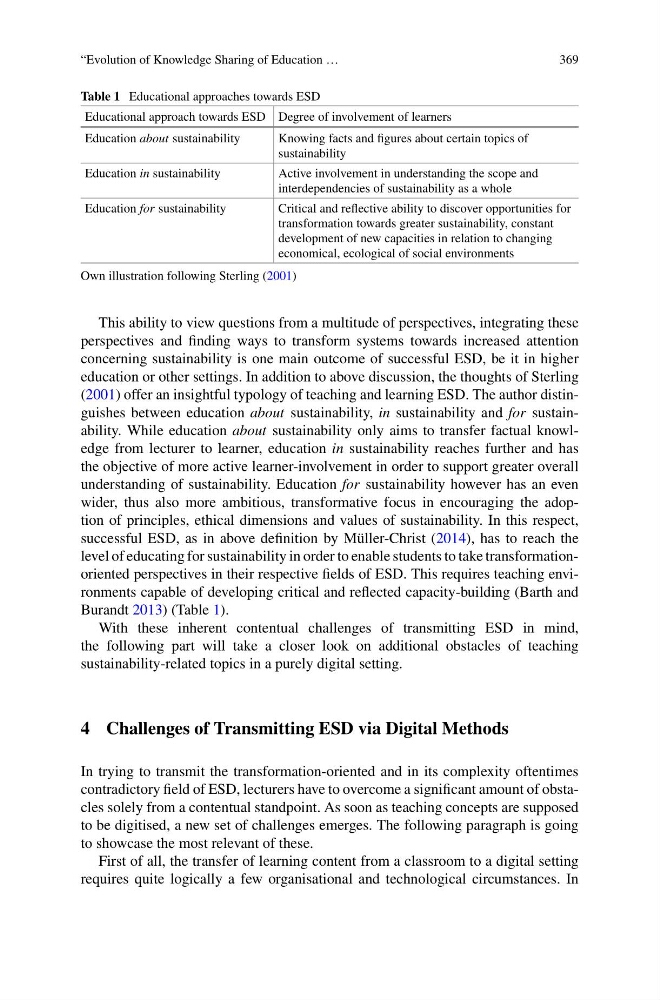
(2001) offer an insightful typology of teaching and learning ESD. The author distinguishes between education about sustainability, in sustainability and for sustainability. While education about sustainability only aims to transfer factual knowledge from lecturer to learner, education in sustainability reaches further and has
the objective of more active learner-involvement in order to support greater overall
understanding of sustainability. Education for sustainability however has an even
wider, thus also more ambitious, transformative focus in encouraging the adoption of principles, ethical dimensions and values of sustainability. In this respect,
successful ESD, as in above definition by Müller-Christ (2014), has to reach the
level of educating for sustainability in order to enable students to take transformationoriented perspectives in their respective fields of ESD. This requires teaching environments capable of developing critical and reflected capacity-building (Barth and
Burandt 2013) (Table 1).
With these inherent contentual challenges of transmitting ESD in mind,
the following part will take a closer look on additional obstacles of teaching
sustainability-related topics in a purely digital setting.
4 Challenges of Transmitting ESD via Digital Methods
In trying to transmit the transformation-oriented and in its complexity oftentimes
contradictory field of ESD, lecturers have to overcome a significant amount of obstacles solely from a contentual standpoint. As soon as teaching concepts are supposed
to be digitised, a new set of challenges emerges. The following paragraph is going
to showcase the most relevant of these.
First of all, the transfer of learning content from a classroom to a digital setting
requires quite logically a few organisational and technological circumstances. In
369
Table 1 Educational approaches towards ESD
Educational approach towards ESD Degree of involvement of learners
Education about sustainability
Knowing facts and figures about certain topics of
sustainability
Education in sustainability
Active involvement in understanding the scope and
interdependencies of sustainability as a whole
Education for sustainability
Critical and reflective ability to discover opportunities for
transformation towards greater sustainability, constant
development of new capacities in relation to changing
economical, ecological of social environments
Own illustration following Sterling (2001)
This ability to view questions from a multitude of perspectives, integrating these
perspectives and finding ways to transform systems towards increased attention
concerning sustainability is one main outcome of successful ESD, be it in higher
education or other settings. In addition to above discussion, the thoughts of Sterling
(2001) offer an insightful typology of teaching and learning ESD. The author distinguishes between education about sustainability, in sustainability and for sustainability. While education about sustainability only aims to transfer factual knowledge from lecturer to learner, education in sustainability reaches further and has
the objective of more active learner-involvement in order to support greater overall
understanding of sustainability. Education for sustainability however has an even
wider, thus also more ambitious, transformative focus in encouraging the adoption of principles, ethical dimensions and values of sustainability. In this respect,
successful ESD, as in above definition by Müller-Christ (2014), has to reach the
level of educating for sustainability in order to enable students to take transformationoriented perspectives in their respective fields of ESD. This requires teaching environments capable of developing critical and reflected capacity-building (Barth and
Burandt 2013) (Table 1).
With these inherent contentual challenges of transmitting ESD in mind,
the following part will take a closer look on additional obstacles of teaching
sustainability-related topics in a purely digital setting.
4 Challenges of Transmitting ESD via Digital Methods
In trying to transmit the transformation-oriented and in its complexity oftentimes
contradictory field of ESD, lecturers have to overcome a significant amount of obstacles solely from a contentual standpoint. As soon as teaching concepts are supposed
to be digitised, a new set of challenges emerges. The following paragraph is going
to showcase the most relevant of these.
First of all, the transfer of learning content from a classroom to a digital setting
requires quite logically a few organisational and technological circumstances. In