

308
I. Hemmer and A.-K. Lindau
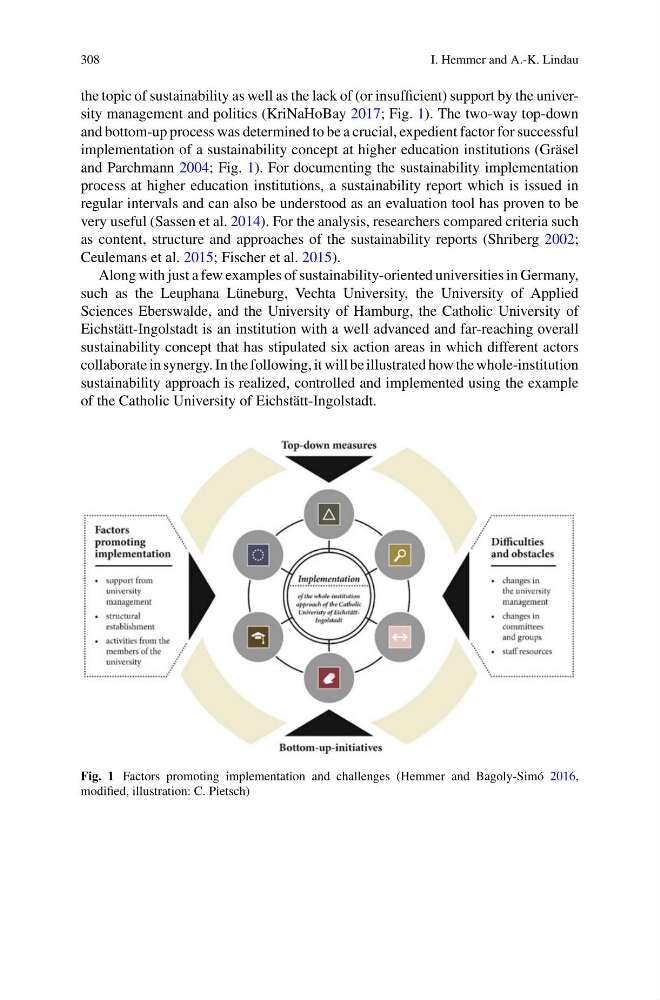
the topic of sustainability as well as the lack of (or insufficient) support by the university management and politics (KriNaHoBay 2017; Fig. 1). The two-way top-down
and bottom-up process was determined to be a crucial, expedient factor for successful
implementation of a sustainability concept at higher education institutions (Gräsel
and Parchmann 2004; Fig. 1). For documenting the sustainability implementation
process at higher education institutions, a sustainability report which is issued in
regular intervals and can also be understood as an evaluation tool has proven to be
very useful (Sassen et al. 2014). For the analysis, researchers compared criteria such
as content, structure and approaches of the sustainability reports (Shriberg 2002;
Ceulemans et al. 2015; Fischer et al. 2015).
Along with just a few examples of sustainability-oriented universities in Germany,
such as the Leuphana Lüneburg, Vechta University, the University of Applied
Sciences Eberswalde, and the University of Hamburg, the Catholic University of
Eichstätt-Ingolstadt is an institution with a well advanced and far-reaching overall
sustainability concept that has stipulated six action areas in which different actors
collaborate in synergy. In the following, it will be illustrated how the whole-institution
sustainability approach is realized, controlled and implemented using the example
of the Catholic University of Eichstätt-Ingolstadt.
Fig. 1 Factors promoting implementation and challenges (Hemmer and Bagoly-Simó 2016,
modified, illustration: C. Pietsch)
I. Hemmer and A.-K. Lindau
the topic of sustainability as well as the lack of (or insufficient) support by the university management and politics (KriNaHoBay 2017; Fig. 1). The two-way top-down
and bottom-up process was determined to be a crucial, expedient factor for successful
implementation of a sustainability concept at higher education institutions (Gräsel
and Parchmann 2004; Fig. 1). For documenting the sustainability implementation
process at higher education institutions, a sustainability report which is issued in
regular intervals and can also be understood as an evaluation tool has proven to be
very useful (Sassen et al. 2014). For the analysis, researchers compared criteria such
as content, structure and approaches of the sustainability reports (Shriberg 2002;
Ceulemans et al. 2015; Fischer et al. 2015).
Along with just a few examples of sustainability-oriented universities in Germany,
such as the Leuphana Lüneburg, Vechta University, the University of Applied
Sciences Eberswalde, and the University of Hamburg, the Catholic University of
Eichstätt-Ingolstadt is an institution with a well advanced and far-reaching overall
sustainability concept that has stipulated six action areas in which different actors
collaborate in synergy. In the following, it will be illustrated how the whole-institution
sustainability approach is realized, controlled and implemented using the example
of the Catholic University of Eichstätt-Ingolstadt.
Fig. 1 Factors promoting implementation and challenges (Hemmer and Bagoly-Simó 2016,
modified, illustration: C. Pietsch)