

20
M. C. Mifsud
researchers state MPAs are more likely to meet their biological and social goals if
the human dimensions is integrated into the MPA design and evaluation process
(Pollnaca et al. 2010). MPA management strategies that find the “middle-ground”
between government-led and community-based approaches may be most effective
(Jones 2002).
The aim of this research project was to understand the perceptions and attitudes
of stakeholders involved in the fisheries sector towards the implementation of new
MPAs especially with regard to the impact these MPAs would have on their livelihood.
Although there have been some studies carried out in other countries, this is one
of the first such qualitative studies to be undertaken in the Maltese Islands. The
study also attempts to highlight the role of higher education institutions and other
various authorities in helping to achieve a balance between the fisheries sector and
conservation.
2 Livelihoods and the Local Context
Livelihoods are usually defined as
“…the assets (natural, physical, human, financial and social capital), the activities, and
the access to these (mediated by institutions and social relations) that together determine
the living gained by the individual or household” (Allison and Ellis 2001). A livelihood
is sustainable when it can cope with and recover from stresses and shocks and maintain
its capabilities and assets both now and in the future, while not undermining the natural
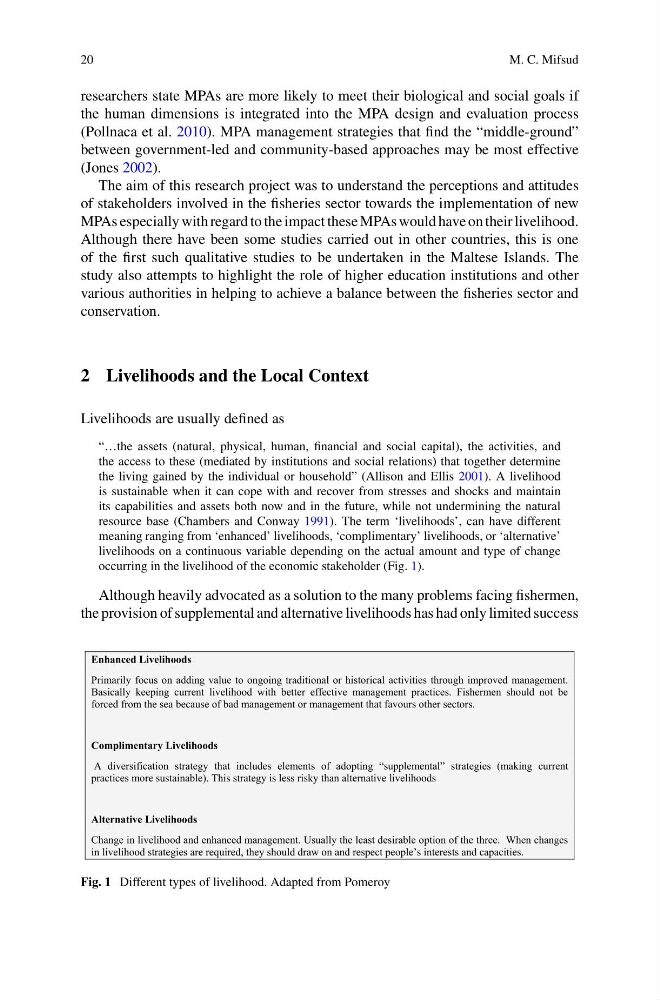
resource base (Chambers and Conway 1991). The term ‘livelihoods’, can have different
meaning ranging from ‘enhanced’ livelihoods, ‘complimentary’ livelihoods, or ‘alternative’
livelihoods on a continuous variable depending on the actual amount and type of change
occurring in the livelihood of the economic stakeholder (Fig. 1).
Although heavily advocated as a solution to the many problems facing fishermen,
the provision of supplemental and alternative livelihoods has had only limited success
Enhanced Livelihoods
Primarily focus on adding value to ongoing traditional or historical activities through improved management.
Basically keeping current livelihood with better effective management practices. Fishermen should not be
forced from the sea because of bad management or management that favours other sectors.
Complimentary Livelihoods
A diversification strategy that includes elements of adopting “supplemental” strategies (making current
practices more sustainable). This strategy is less risky than alternative livelihoods
Alternative Livelihoods
Change in livelihood and enhanced management. Usually the least desirable option of the three. When changes
in livelihood strategies are required, they should draw on and respect people’s interests and capacities.
Fig. 1 Different types of livelihood. Adapted from Pomeroy
M. C. Mifsud
researchers state MPAs are more likely to meet their biological and social goals if
the human dimensions is integrated into the MPA design and evaluation process
(Pollnaca et al. 2010). MPA management strategies that find the “middle-ground”
between government-led and community-based approaches may be most effective
(Jones 2002).
The aim of this research project was to understand the perceptions and attitudes
of stakeholders involved in the fisheries sector towards the implementation of new
MPAs especially with regard to the impact these MPAs would have on their livelihood.
Although there have been some studies carried out in other countries, this is one
of the first such qualitative studies to be undertaken in the Maltese Islands. The
study also attempts to highlight the role of higher education institutions and other
various authorities in helping to achieve a balance between the fisheries sector and
conservation.
2 Livelihoods and the Local Context
Livelihoods are usually defined as
“…the assets (natural, physical, human, financial and social capital), the activities, and
the access to these (mediated by institutions and social relations) that together determine
the living gained by the individual or household” (Allison and Ellis 2001). A livelihood
is sustainable when it can cope with and recover from stresses and shocks and maintain
its capabilities and assets both now and in the future, while not undermining the natural
resource base (Chambers and Conway 1991). The term ‘livelihoods’, can have different
meaning ranging from ‘enhanced’ livelihoods, ‘complimentary’ livelihoods, or ‘alternative’
livelihoods on a continuous variable depending on the actual amount and type of change
occurring in the livelihood of the economic stakeholder (Fig. 1).
Although heavily advocated as a solution to the many problems facing fishermen,
the provision of supplemental and alternative livelihoods has had only limited success
Enhanced Livelihoods
Primarily focus on adding value to ongoing traditional or historical activities through improved management.
Basically keeping current livelihood with better effective management practices. Fishermen should not be
forced from the sea because of bad management or management that favours other sectors.
Complimentary Livelihoods
A diversification strategy that includes elements of adopting “supplemental” strategies (making current
practices more sustainable). This strategy is less risky than alternative livelihoods
Alternative Livelihoods
Change in livelihood and enhanced management. Usually the least desirable option of the three. When changes
in livelihood strategies are required, they should draw on and respect people’s interests and capacities.
Fig. 1 Different types of livelihood. Adapted from Pomeroy