

288
C. R. P. Vasconcelos et al.
ideas, challenges and approaches that are emerging from the growing global sustainability discourse”. This last definition might be more appropriate since the authors
perceive HEI from a much broader perspective. The HEIs’ sustainability practices
often extrapolate the boundaries of their geographical area, bringing benefits to their
local, regional and sometimes national environment.
At the beginning of this century, the work of Cortese (2003) stated that the achievement of HEI sustainability is attained by considering the following four dimensions:
education, research, campus operations and reporting. Later, Lozano (2006a) and
Lozano et al. (2015) complemented the model including three more dimensions:
institutional framework, on-campus experience and outreach and, finally, uniting the
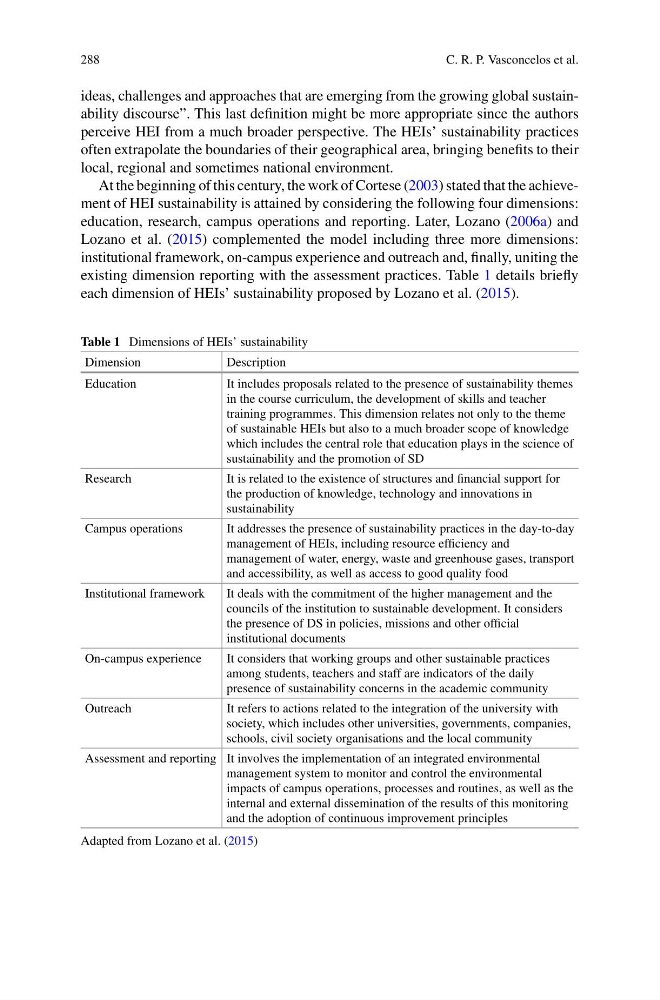
existing dimension reporting with the assessment practices. Table 1 details briefly
each dimension of HEIs’ sustainability proposed by Lozano et al. (2015).
Table 1 Dimensions of HEIs’ sustainability
Dimension
Description
Education
It includes proposals related to the presence of sustainability themes
in the course curriculum, the development of skills and teacher
training programmes. This dimension relates not only to the theme
of sustainable HEIs but also to a much broader scope of knowledge
which includes the central role that education plays in the science of
sustainability and the promotion of SD
Research
It is related to the existence of structures and financial support for
the production of knowledge, technology and innovations in
sustainability
Campus operations
It addresses the presence of sustainability practices in the day-to-day
management of HEIs, including resource efficiency and
management of water, energy, waste and greenhouse gases, transport
and accessibility, as well as access to good quality food
Institutional framework
It deals with the commitment of the higher management and the
councils of the institution to sustainable development. It considers
the presence of DS in policies, missions and other official
institutional documents
On-campus experience
It considers that working groups and other sustainable practices
among students, teachers and staff are indicators of the daily
presence of sustainability concerns in the academic community
Outreach
It refers to actions related to the integration of the university with
society, which includes other universities, governments, companies,
schools, civil society organisations and the local community
Assessment and reporting It involves the implementation of an integrated environmental
management system to monitor and control the environmental
impacts of campus operations, processes and routines, as well as the
internal and external dissemination of the results of this monitoring
and the adoption of continuous improvement principles
Adapted from Lozano et al. (2015)
C. R. P. Vasconcelos et al.
ideas, challenges and approaches that are emerging from the growing global sustainability discourse”. This last definition might be more appropriate since the authors
perceive HEI from a much broader perspective. The HEIs’ sustainability practices
often extrapolate the boundaries of their geographical area, bringing benefits to their
local, regional and sometimes national environment.
At the beginning of this century, the work of Cortese (2003) stated that the achievement of HEI sustainability is attained by considering the following four dimensions:
education, research, campus operations and reporting. Later, Lozano (2006a) and
Lozano et al. (2015) complemented the model including three more dimensions:
institutional framework, on-campus experience and outreach and, finally, uniting the
existing dimension reporting with the assessment practices. Table 1 details briefly
each dimension of HEIs’ sustainability proposed by Lozano et al. (2015).
Table 1 Dimensions of HEIs’ sustainability
Dimension
Description
Education
It includes proposals related to the presence of sustainability themes
in the course curriculum, the development of skills and teacher
training programmes. This dimension relates not only to the theme
of sustainable HEIs but also to a much broader scope of knowledge
which includes the central role that education plays in the science of
sustainability and the promotion of SD
Research
It is related to the existence of structures and financial support for
the production of knowledge, technology and innovations in
sustainability
Campus operations
It addresses the presence of sustainability practices in the day-to-day
management of HEIs, including resource efficiency and
management of water, energy, waste and greenhouse gases, transport
and accessibility, as well as access to good quality food
Institutional framework
It deals with the commitment of the higher management and the
councils of the institution to sustainable development. It considers
the presence of DS in policies, missions and other official
institutional documents
On-campus experience
It considers that working groups and other sustainable practices
among students, teachers and staff are indicators of the daily
presence of sustainability concerns in the academic community
Outreach
It refers to actions related to the integration of the university with
society, which includes other universities, governments, companies,
schools, civil society organisations and the local community
Assessment and reporting It involves the implementation of an integrated environmental
management system to monitor and control the environmental
impacts of campus operations, processes and routines, as well as the
internal and external dissemination of the results of this monitoring
and the adoption of continuous improvement principles
Adapted from Lozano et al. (2015)