

Drawing Sustainability: Helping Students to Know What They Know
231
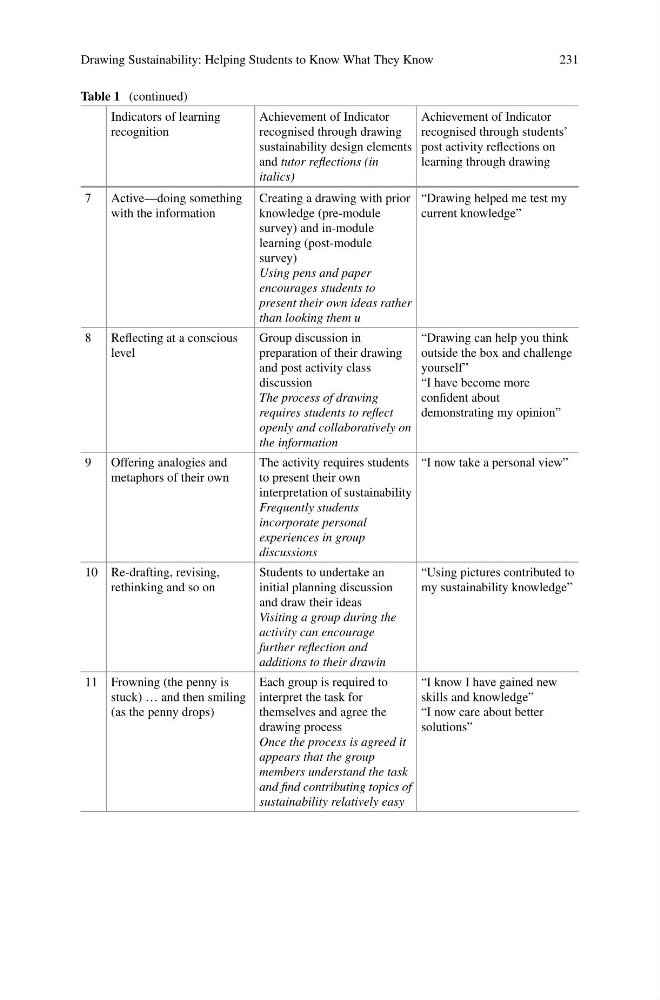
Table 1 (continued)
Indicators of learning
recognition
Achievement of Indicator
recognised through drawing
sustainability design elements
and tutor reflections (in
italics)
Achievement of Indicator
recognised through students’
post activity reflections on
learning through drawing
7
Active—doing something
with the information
Creating a drawing with prior
knowledge (pre-module
survey) and in-module
learning (post-module
survey)
Using pens and paper
encourages students to
present their own ideas rather
than looking them u
“Drawing helped me test my
current knowledge”
8
Reflecting at a conscious
level
Group discussion in
preparation of their drawing
and post activity class
discussion
The process of drawing
requires students to reflect
openly and collaboratively on
the information
“Drawing can help you think
outside the box and challenge
yourself”
“I have become more
confident about
demonstrating my opinion”
9
Offering analogies and
metaphors of their own
The activity requires students
to present their own
interpretation of sustainability
Frequently students
incorporate personal
experiences in group
discussions
“I now take a personal view”
10 Re-drafting, revising,
rethinking and so on
Students to undertake an
initial planning discussion
and draw their ideas
Visiting a group during the
activity can encourage
further reflection and
additions to their drawin
“Using pictures contributed to
my sustainability knowledge”
11 Frowning (the penny is
stuck) … and then smiling
(as the penny drops)
Each group is required to
interpret the task for
themselves and agree the
drawing process
Once the process is agreed it
appears that the group
members understand the task
and find contributing topics of
sustainability relatively easy
“I know I have gained new
skills and knowledge”
“I now care about better
solutions”
231
Table 1 (continued)
Indicators of learning
recognition
Achievement of Indicator
recognised through drawing
sustainability design elements
and tutor reflections (in
italics)
Achievement of Indicator
recognised through students’
post activity reflections on
learning through drawing
7
Active—doing something
with the information
Creating a drawing with prior
knowledge (pre-module
survey) and in-module
learning (post-module
survey)
Using pens and paper
encourages students to
present their own ideas rather
than looking them u
“Drawing helped me test my
current knowledge”
8
Reflecting at a conscious
level
Group discussion in
preparation of their drawing
and post activity class
discussion
The process of drawing
requires students to reflect
openly and collaboratively on
the information
“Drawing can help you think
outside the box and challenge
yourself”
“I have become more
confident about
demonstrating my opinion”
9
Offering analogies and
metaphors of their own
The activity requires students
to present their own
interpretation of sustainability
Frequently students
incorporate personal
experiences in group
discussions
“I now take a personal view”
10 Re-drafting, revising,
rethinking and so on
Students to undertake an
initial planning discussion
and draw their ideas
Visiting a group during the
activity can encourage
further reflection and
additions to their drawin
“Using pictures contributed to
my sustainability knowledge”
11 Frowning (the penny is
stuck) … and then smiling
(as the penny drops)
Each group is required to
interpret the task for
themselves and agree the
drawing process
Once the process is agreed it
appears that the group
members understand the task
and find contributing topics of
sustainability relatively easy
“I know I have gained new
skills and knowledge”
“I now care about better
solutions”