

226
K. Emblen-Perry
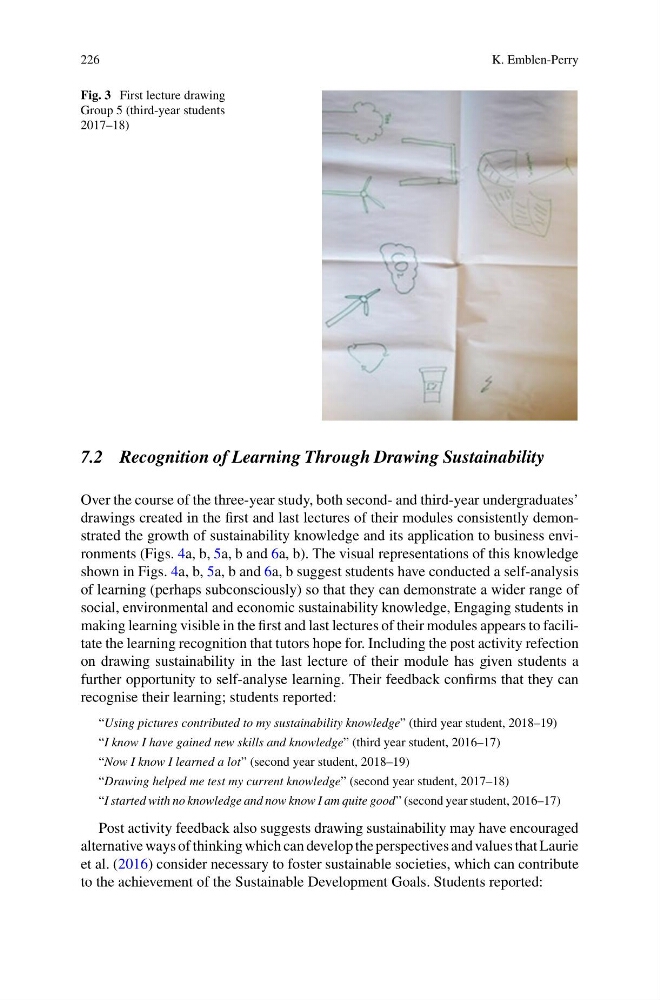
Fig. 3 First lecture drawing
Group 5 (third-year students
2017–18)
7.2 Recognition of Learning Through Drawing Sustainability
Over the course of the three-year study, both second- and third-year undergraduates’
drawings created in the first and last lectures of their modules consistently demonstrated the growth of sustainability knowledge and its application to business environments (Figs. 4a, b, 5a, b and 6a, b). The visual representations of this knowledge
shown in Figs. 4a, b, 5a, b and 6a, b suggest students have conducted a self-analysis
of learning (perhaps subconsciously) so that they can demonstrate a wider range of
social, environmental and economic sustainability knowledge, Engaging students in
making learning visible in the first and last lectures of their modules appears to facilitate the learning recognition that tutors hope for. Including the post activity refection
on drawing sustainability in the last lecture of their module has given students a
further opportunity to self-analyse learning. Their feedback confirms that they can
recognise their learning; students reported:
“Using pictures contributed to my sustainability knowledge” (third year student, 2018–19)
“I know I have gained new skills and knowledge” (third year student, 2016–17)
“Now I know I learned a lot” (second year student, 2018–19)
“Drawing helped me test my current knowledge” (second year student, 2017–18)
“I started with no knowledge and now know I am quite good” (second year student, 2016–17)
Post activity feedback also suggests drawing sustainability may have encouraged
alternative ways of thinking which can develop the perspectives and values that Laurie
et al. (2016) consider necessary to foster sustainable societies, which can contribute
to the achievement of the Sustainable Development Goals. Students reported:
K. Emblen-Perry
Fig. 3 First lecture drawing
Group 5 (third-year students
2017–18)
7.2 Recognition of Learning Through Drawing Sustainability
Over the course of the three-year study, both second- and third-year undergraduates’
drawings created in the first and last lectures of their modules consistently demonstrated the growth of sustainability knowledge and its application to business environments (Figs. 4a, b, 5a, b and 6a, b). The visual representations of this knowledge
shown in Figs. 4a, b, 5a, b and 6a, b suggest students have conducted a self-analysis
of learning (perhaps subconsciously) so that they can demonstrate a wider range of
social, environmental and economic sustainability knowledge, Engaging students in
making learning visible in the first and last lectures of their modules appears to facilitate the learning recognition that tutors hope for. Including the post activity refection
on drawing sustainability in the last lecture of their module has given students a
further opportunity to self-analyse learning. Their feedback confirms that they can
recognise their learning; students reported:
“Using pictures contributed to my sustainability knowledge” (third year student, 2018–19)
“I know I have gained new skills and knowledge” (third year student, 2016–17)
“Now I know I learned a lot” (second year student, 2018–19)
“Drawing helped me test my current knowledge” (second year student, 2017–18)
“I started with no knowledge and now know I am quite good” (second year student, 2016–17)
Post activity feedback also suggests drawing sustainability may have encouraged
alternative ways of thinking which can develop the perspectives and values that Laurie
et al. (2016) consider necessary to foster sustainable societies, which can contribute
to the achievement of the Sustainable Development Goals. Students reported: