

The Role of Higher Education Stakeholder Networks …
129
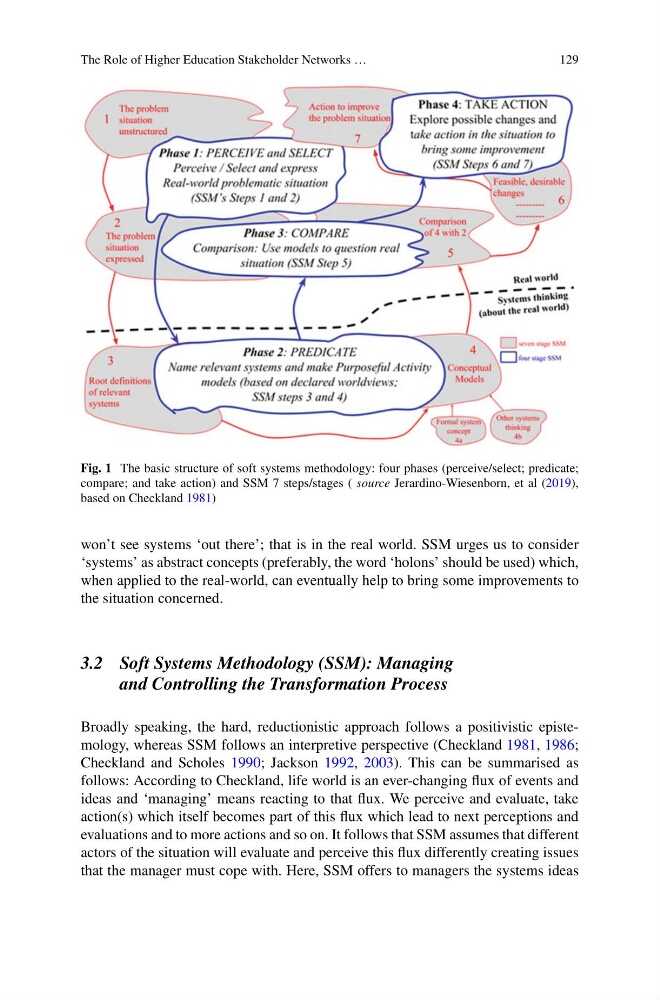
Fig. 1 The basic structure of soft systems methodology: four phases (perceive/select; predicate;
compare; and take action) and SSM 7 steps/stages ( source Jerardino-Wiesenborn, et al (2019),
based on Checkland 1981)
won’t see systems ‘out there’; that is in the real world. SSM urges us to consider
‘systems’ as abstract concepts (preferably, the word ‘holons’ should be used) which,
when applied to the real-world, can eventually help to bring some improvements to
the situation concerned.
3.2 Soft Systems Methodology (SSM): Managing
and Controlling the Transformation Process
Broadly speaking, the hard, reductionistic approach follows a positivistic epistemology, whereas SSM follows an interpretive perspective (Checkland 1981, 1986;
Checkland and Scholes 1990; Jackson 1992, 2003). This can be summarised as
follows: According to Checkland, life world is an ever-changing flux of events and
ideas and ‘managing’ means reacting to that flux. We perceive and evaluate, take
action(s) which itself becomes part of this flux which lead to next perceptions and
evaluations and to more actions and so on. It follows that SSM assumes that different
actors of the situation will evaluate and perceive this flux differently creating issues
that the manager must cope with. Here, SSM offers to managers the systems ideas
129
Fig. 1 The basic structure of soft systems methodology: four phases (perceive/select; predicate;
compare; and take action) and SSM 7 steps/stages ( source Jerardino-Wiesenborn, et al (2019),
based on Checkland 1981)
won’t see systems ‘out there’; that is in the real world. SSM urges us to consider
‘systems’ as abstract concepts (preferably, the word ‘holons’ should be used) which,
when applied to the real-world, can eventually help to bring some improvements to
the situation concerned.
3.2 Soft Systems Methodology (SSM): Managing
and Controlling the Transformation Process
Broadly speaking, the hard, reductionistic approach follows a positivistic epistemology, whereas SSM follows an interpretive perspective (Checkland 1981, 1986;
Checkland and Scholes 1990; Jackson 1992, 2003). This can be summarised as
follows: According to Checkland, life world is an ever-changing flux of events and
ideas and ‘managing’ means reacting to that flux. We perceive and evaluate, take
action(s) which itself becomes part of this flux which lead to next perceptions and
evaluations and to more actions and so on. It follows that SSM assumes that different
actors of the situation will evaluate and perceive this flux differently creating issues
that the manager must cope with. Here, SSM offers to managers the systems ideas