

Geography of Food Summer School ...
111
2.3 Course Phases and Content
Phase 1: e-learning
The first phase was designed so that students could acquire the basics for designing
sustainable FVCs with regard to the UN SDGs through self-study with e-learning
modules. The aim here was to level out the previous knowledge of students with
different backgrounds and to convey the important basics before students met and
worked together during the study period. Three e-learning modules were created for
the project and published online (https://sustainable-food.lsfm.zhaw.ch/). The course
included introductions to sustainability, FVC design and the Agenda 2030, and was
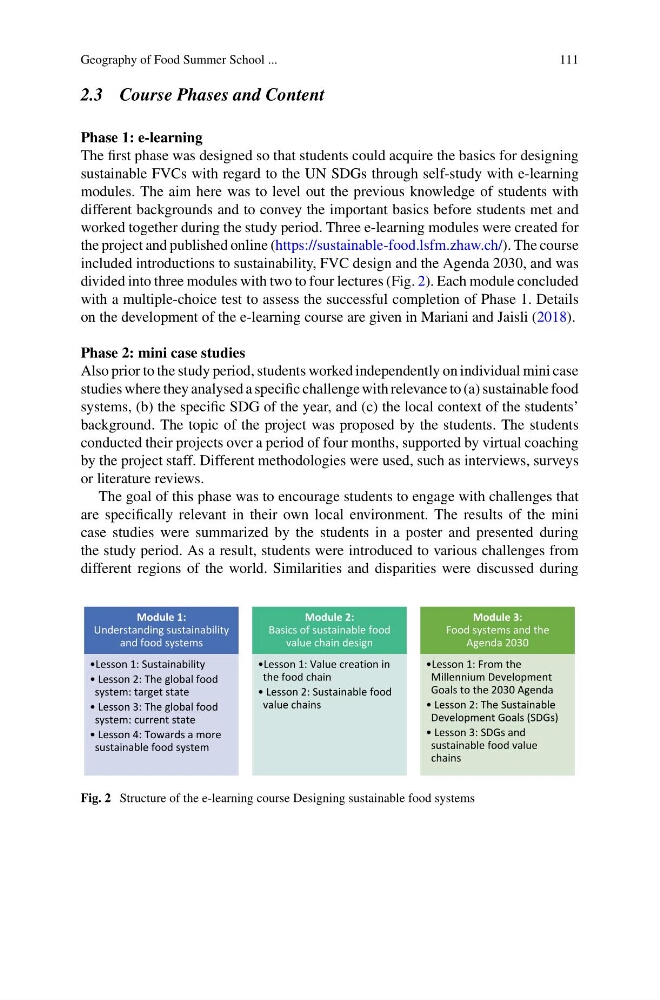
divided into three modules with two to four lectures (Fig. 2). Each module concluded
with a multiple-choice test to assess the successful completion of Phase 1. Details
on the development of the e-learning course are given in Mariani and Jaisli (2018).
Phase 2: mini case studies
Also prior to the study period, students worked independently on individual mini case
studies where they analysed a specific challenge with relevance to (a) sustainable food
systems, (b) the specific SDG of the year, and (c) the local context of the students’
background. The topic of the project was proposed by the students. The students
conducted their projects over a period of four months, supported by virtual coaching
by the project staff. Different methodologies were used, such as interviews, surveys
or literature reviews.
The goal of this phase was to encourage students to engage with challenges that
are specifically relevant in their own local environment. The results of the mini
case studies were summarized by the students in a poster and presented during
the study period. As a result, students were introduced to various challenges from
different regions of the world. Similarities and disparities were discussed during
Module 1:
Understanding sustainability
and food systems
•Lesson 1: Sustainability
• Lesson 2: The global food
system: target state
• Lesson 3: The global food
system: current state
• Lesson 4: Towards a more
sustainable food system
Module 2:
Basics of sustainable food
value chain design
•Lesson 1: Value creation in
the food chain
• Lesson 2: Sustainable food
value chains
Module 3:
Food systems and the
Agenda 2030
•Lesson 1: From the
Millennium Development
Goals to the 2030 Agenda
• Lesson 2: The Sustainable
Development Goals (SDGs)
• Lesson 3: SDGs and
sustainable food value
chains
Fig. 2 Structure of the e-learning course Designing sustainable food systems
111
2.3 Course Phases and Content
Phase 1: e-learning
The first phase was designed so that students could acquire the basics for designing
sustainable FVCs with regard to the UN SDGs through self-study with e-learning
modules. The aim here was to level out the previous knowledge of students with
different backgrounds and to convey the important basics before students met and
worked together during the study period. Three e-learning modules were created for
the project and published online (https://sustainable-food.lsfm.zhaw.ch/). The course
included introductions to sustainability, FVC design and the Agenda 2030, and was
divided into three modules with two to four lectures (Fig. 2). Each module concluded
with a multiple-choice test to assess the successful completion of Phase 1. Details
on the development of the e-learning course are given in Mariani and Jaisli (2018).
Phase 2: mini case studies
Also prior to the study period, students worked independently on individual mini case
studies where they analysed a specific challenge with relevance to (a) sustainable food
systems, (b) the specific SDG of the year, and (c) the local context of the students’
background. The topic of the project was proposed by the students. The students
conducted their projects over a period of four months, supported by virtual coaching
by the project staff. Different methodologies were used, such as interviews, surveys
or literature reviews.
The goal of this phase was to encourage students to engage with challenges that
are specifically relevant in their own local environment. The results of the mini
case studies were summarized by the students in a poster and presented during
the study period. As a result, students were introduced to various challenges from
different regions of the world. Similarities and disparities were discussed during
Module 1:
Understanding sustainability
and food systems
•Lesson 1: Sustainability
• Lesson 2: The global food
system: target state
• Lesson 3: The global food
system: current state
• Lesson 4: Towards a more
sustainable food system
Module 2:
Basics of sustainable food
value chain design
•Lesson 1: Value creation in
the food chain
• Lesson 2: Sustainable food
value chains
Module 3:
Food systems and the
Agenda 2030
•Lesson 1: From the
Millennium Development
Goals to the 2030 Agenda
• Lesson 2: The Sustainable
Development Goals (SDGs)
• Lesson 3: SDGs and
sustainable food value
chains
Fig. 2 Structure of the e-learning course Designing sustainable food systems