

61
elements caused by the climatic changes that favoured dry deposition on 2010 moss
survey and wet deposition on 2015 (Lazo et al. 2019, Qarri et al. 2019).
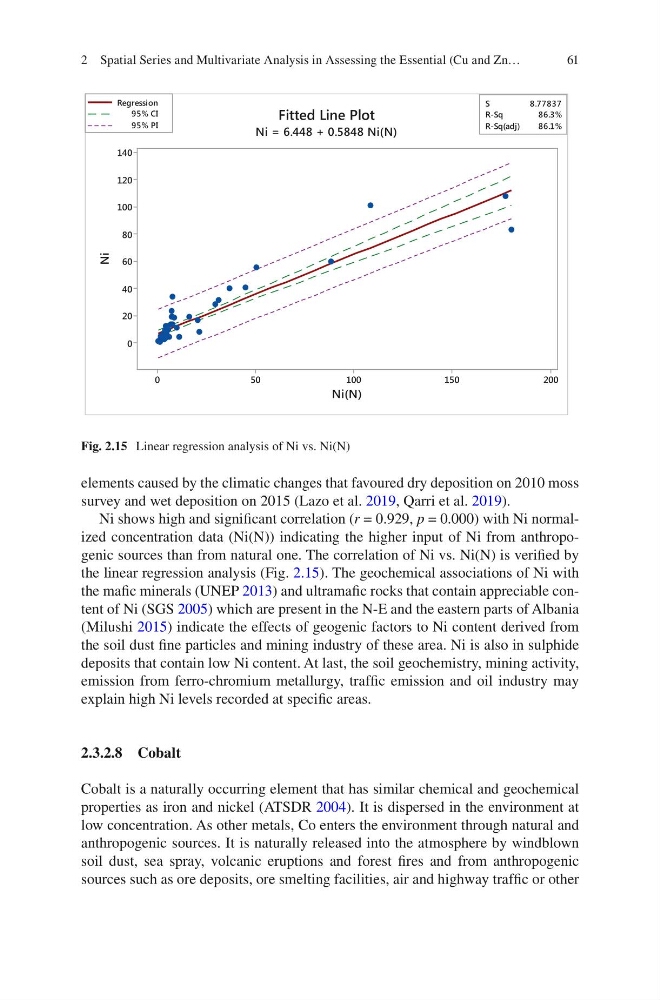
Ni shows high and significant correlation (r = 0.929, p = 0.000) with Ni normalized concentration data (Ni(N)) indicating the higher input of Ni from anthropogenic sources than from natural one. The correlation of Ni vs. Ni(N) is verified by
the linear regression analysis (Fig. 2.15). The geochemical associations of Ni with
the mafic minerals (UNEP 2013) and ultramafic rocks that contain appreciable content of Ni (SGS 2005) which are present in the N-E and the eastern parts of Albania
(Milushi 2015) indicate the effects of geogenic factors to Ni content derived from
the soil dust fine particles and mining industry of these area. Ni is also in sulphide
deposits that contain low Ni content. At last, the soil geochemistry, mining activity,
emission from ferro-chromium metallurgy, traffic emission and oil industry may
explain high Ni levels recorded at specific areas.
2.3.2.8 Cobalt
Cobalt is a naturally occurring element that has similar chemical and geochemical
properties as iron and nickel (ATSDR 2004). It is dispersed in the environment at
low concentration. As other metals, Co enters the environment through natural and
anthropogenic sources. It is naturally released into the atmosphere by windblown
soil dust, sea spray, volcanic eruptions and forest fires and from anthropogenic
sources such as ore deposits, ore smelting facilities, air and highway traffic or other
200
150
100
50
0
140
120
100
80
60
40
20
0
S
8 .77837
R-Sq
86.3%
R-Sq(adj)
8 6.1%
Ni(N)
Ni
Regression
95% CI
95% PI
Fitted Line Plot
Ni = 6.448 + 0.5848 Ni(N)
Fig. 2.15 Linear regression analysis of Ni vs. Ni(N)
2 Spatial Series and Multivariate Analysis in Assessing the Essential (Cu and Zn…
elements caused by the climatic changes that favoured dry deposition on 2010 moss
survey and wet deposition on 2015 (Lazo et al. 2019, Qarri et al. 2019).
Ni shows high and significant correlation (r = 0.929, p = 0.000) with Ni normalized concentration data (Ni(N)) indicating the higher input of Ni from anthropogenic sources than from natural one. The correlation of Ni vs. Ni(N) is verified by
the linear regression analysis (Fig. 2.15). The geochemical associations of Ni with
the mafic minerals (UNEP 2013) and ultramafic rocks that contain appreciable content of Ni (SGS 2005) which are present in the N-E and the eastern parts of Albania
(Milushi 2015) indicate the effects of geogenic factors to Ni content derived from
the soil dust fine particles and mining industry of these area. Ni is also in sulphide
deposits that contain low Ni content. At last, the soil geochemistry, mining activity,
emission from ferro-chromium metallurgy, traffic emission and oil industry may
explain high Ni levels recorded at specific areas.
2.3.2.8 Cobalt
Cobalt is a naturally occurring element that has similar chemical and geochemical
properties as iron and nickel (ATSDR 2004). It is dispersed in the environment at
low concentration. As other metals, Co enters the environment through natural and
anthropogenic sources. It is naturally released into the atmosphere by windblown
soil dust, sea spray, volcanic eruptions and forest fires and from anthropogenic
sources such as ore deposits, ore smelting facilities, air and highway traffic or other
200
150
100
50
0
140
120
100
80
60
40
20
0
S
8 .77837
R-Sq
86.3%
R-Sq(adj)
8 6.1%
Ni(N)
Ni
Regression
95% CI
95% PI
Fitted Line Plot
Ni = 6.448 + 0.5848 Ni(N)
Fig. 2.15 Linear regression analysis of Ni vs. Ni(N)
2 Spatial Series and Multivariate Analysis in Assessing the Essential (Cu and Zn…