

58
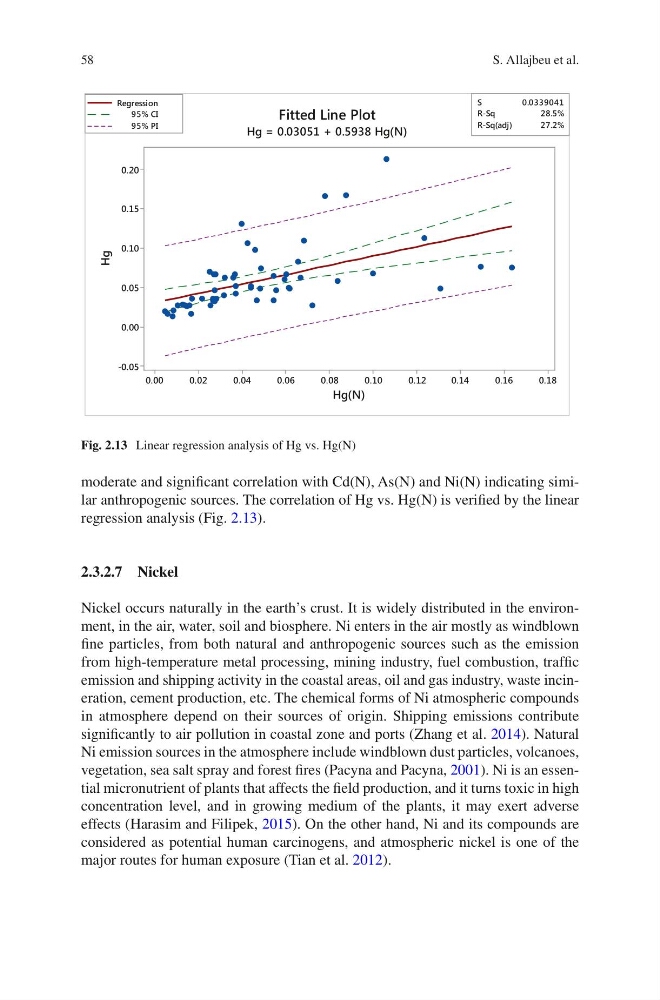
moderate and significant correlation with Cd(N), As(N) and Ni(N) indicating similar anthropogenic sources. The correlation of Hg vs. Hg(N) is verified by the linear
regression analysis (Fig. 2.13).
2.3.2.7 Nickel
Nickel occurs naturally in the earth’s crust. It is widely distributed in the environment, in the air, water, soil and biosphere. Ni enters in the air mostly as windblown
fine particles, from both natural and anthropogenic sources such as the emission
from high-temperature metal processing, mining industry, fuel combustion, traffic
emission and shipping activity in the coastal areas, oil and gas industry, waste incineration, cement production, etc. The chemical forms of Ni atmospheric compounds
in atmosphere depend on their sources of origin. Shipping emissions contribute
significantly to air pollution in coastal zone and ports (Zhang et al. 2014). Natural
Ni emission sources in the atmosphere include windblown dust particles, volcanoes,
vegetation, sea salt spray and forest fires (Pacyna and Pacyna, 2001). Ni is an essential micronutrient of plants that affects the field production, and it turns toxic in high
concentration level, and in growing medium of the plants, it may exert adverse
effects (Harasim and Filipek, 2015). On the other hand, Ni and its compounds are
considered as potential human carcinogens, and atmospheric nickel is one of the
major routes for human exposure (Tian et al. 2012).
0.18
0.16
0.14
0.12
0.10
0.08
0.06
0.04
0.02
0.00
0.20
0.15
0.10
0.05
0.00
-0.05
S
0 .0339041
R-Sq
28.5%
R-Sq(adj)
2 7.2%
Hg(N)
Hg
Regression
95% CI
95% PI
Fitted Line Plot
Hg = 0.03051 + 0.5938 Hg(N)
Fig. 2.13 Linear regression analysis of Hg vs. Hg(N)
S. Allajbeu et al.
moderate and significant correlation with Cd(N), As(N) and Ni(N) indicating similar anthropogenic sources. The correlation of Hg vs. Hg(N) is verified by the linear
regression analysis (Fig. 2.13).
2.3.2.7 Nickel
Nickel occurs naturally in the earth’s crust. It is widely distributed in the environment, in the air, water, soil and biosphere. Ni enters in the air mostly as windblown
fine particles, from both natural and anthropogenic sources such as the emission
from high-temperature metal processing, mining industry, fuel combustion, traffic
emission and shipping activity in the coastal areas, oil and gas industry, waste incineration, cement production, etc. The chemical forms of Ni atmospheric compounds
in atmosphere depend on their sources of origin. Shipping emissions contribute
significantly to air pollution in coastal zone and ports (Zhang et al. 2014). Natural
Ni emission sources in the atmosphere include windblown dust particles, volcanoes,
vegetation, sea salt spray and forest fires (Pacyna and Pacyna, 2001). Ni is an essential micronutrient of plants that affects the field production, and it turns toxic in high
concentration level, and in growing medium of the plants, it may exert adverse
effects (Harasim and Filipek, 2015). On the other hand, Ni and its compounds are
considered as potential human carcinogens, and atmospheric nickel is one of the
major routes for human exposure (Tian et al. 2012).
0.18
0.16
0.14
0.12
0.10
0.08
0.06
0.04
0.02
0.00
0.20
0.15
0.10
0.05
0.00
-0.05
S
0 .0339041
R-Sq
28.5%
R-Sq(adj)
2 7.2%
Hg(N)
Hg
Regression
95% CI
95% PI
Fitted Line Plot
Hg = 0.03051 + 0.5938 Hg(N)
Fig. 2.13 Linear regression analysis of Hg vs. Hg(N)
S. Allajbeu et al.