

47
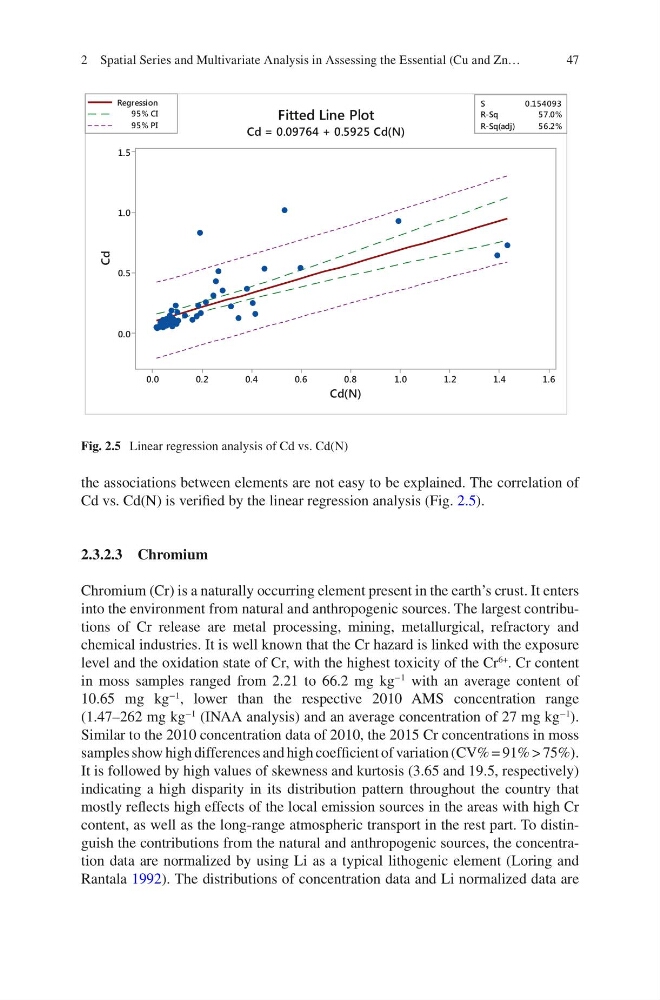
the associations between elements are not easy to be explained. The correlation of
Cd vs. Cd(N) is verified by the linear regression analysis (Fig. 2.5).
2.3.2.3 Chromium
Chromium (Cr) is a naturally occurring element present in the earth’s crust. It enters
into the environment from natural and anthropogenic sources. The largest contributions of Cr release are metal processing, mining, metallurgical, refractory and
chemical industries. It is well known that the Cr hazard is linked with the exposure
level and the oxidation state of Cr, with the highest toxicity of the Cr
6+
. Cr content
in moss samples ranged from 2.21 to 66.2 mg kg
−1
with an average content of
10.65 mg kg
−1
, lower than the respective 2010 AMS concentration range
(1.47–262 mg kg
−1
(INAA analysis) and an average concentration of 27 mg kg
−1
).
Similar to the 2010 concentration data of 2010, the 2015 Cr concentrations in moss
samples show high differences and high coefficient of variation (CV% = 91% > 75%).
It is followed by high values of skewness and kurtosis (3.65 and 19.5, respectively)
indicating a high disparity in its distribution pattern throughout the country that
mostly reflects high effects of the local emission sources in the areas with high Cr
content, as well as the long-range atmospheric transport in the rest part. To distinguish the contributions from the natural and anthropogenic sources, the concentration data are normalized by using Li as a typical lithogenic element (Loring and
Rantala 1992). The distributions of concentration data and Li normalized data are
1.6
1.4
1.2
1.0
0.8
0.6
0.4
0.2
0.0
1.5
1.0
0.5
0.0
S
0 .154093
R-Sq
57.0%
R-Sq(adj)
5 6.2%
Cd(N)
Cd
Regression
95% CI
95% PI
Fitted Line Plot
Cd = 0.09764 + 0.5925 Cd(N)
Fig. 2.5 Linear regression analysis of Cd vs. Cd(N)
2 Spatial Series and Multivariate Analysis in Assessing the Essential (Cu and Zn…
the associations between elements are not easy to be explained. The correlation of
Cd vs. Cd(N) is verified by the linear regression analysis (Fig. 2.5).
2.3.2.3 Chromium
Chromium (Cr) is a naturally occurring element present in the earth’s crust. It enters
into the environment from natural and anthropogenic sources. The largest contributions of Cr release are metal processing, mining, metallurgical, refractory and
chemical industries. It is well known that the Cr hazard is linked with the exposure
level and the oxidation state of Cr, with the highest toxicity of the Cr
6+
. Cr content
in moss samples ranged from 2.21 to 66.2 mg kg
−1
with an average content of
10.65 mg kg
−1
, lower than the respective 2010 AMS concentration range
(1.47–262 mg kg
−1
(INAA analysis) and an average concentration of 27 mg kg
−1
).
Similar to the 2010 concentration data of 2010, the 2015 Cr concentrations in moss
samples show high differences and high coefficient of variation (CV% = 91% > 75%).
It is followed by high values of skewness and kurtosis (3.65 and 19.5, respectively)
indicating a high disparity in its distribution pattern throughout the country that
mostly reflects high effects of the local emission sources in the areas with high Cr
content, as well as the long-range atmospheric transport in the rest part. To distinguish the contributions from the natural and anthropogenic sources, the concentration data are normalized by using Li as a typical lithogenic element (Loring and
Rantala 1992). The distributions of concentration data and Li normalized data are
1.6
1.4
1.2
1.0
0.8
0.6
0.4
0.2
0.0
1.5
1.0
0.5
0.0
S
0 .154093
R-Sq
57.0%
R-Sq(adj)
5 6.2%
Cd(N)
Cd
Regression
95% CI
95% PI
Fitted Line Plot
Cd = 0.09764 + 0.5925 Cd(N)
Fig. 2.5 Linear regression analysis of Cd vs. Cd(N)
2 Spatial Series and Multivariate Analysis in Assessing the Essential (Cu and Zn…