

397
Dol locality, and therefore its accumulation by the plants was much lower. Extraction
tests of As, Sb, and Tl from the soil samples show that the highest level of As was
extracted with an extraction solution of 0.1 M HCl with 7.0% of As, 1.2% of Sb, and
1.2% of Tl.
13.3.5 Assimilation by Plants
Bioaccumulation is extremely important in the scientific evaluation of risks that
toxic elements may pose to humans and the environment and is a current focus of
regulatory effort. Using the results of the analysis of As, Sb, and Tl in different plant
parts (roots, stems, leaves, flowers, and seeds) of the investigated endemic species,
the biological accumulation factor (BAF), defined as the ratio between total content
in certain plant (sum of the content in roots, stems, leaves, flowers, and seeds) and
the content of the element in corresponding soils, and the biological transfer factor
(BTF), defined as the ratio between the content of the element in flowers and that of
the roots, were calculated in all endemic plant species that were gathered from the
Allchar locality.
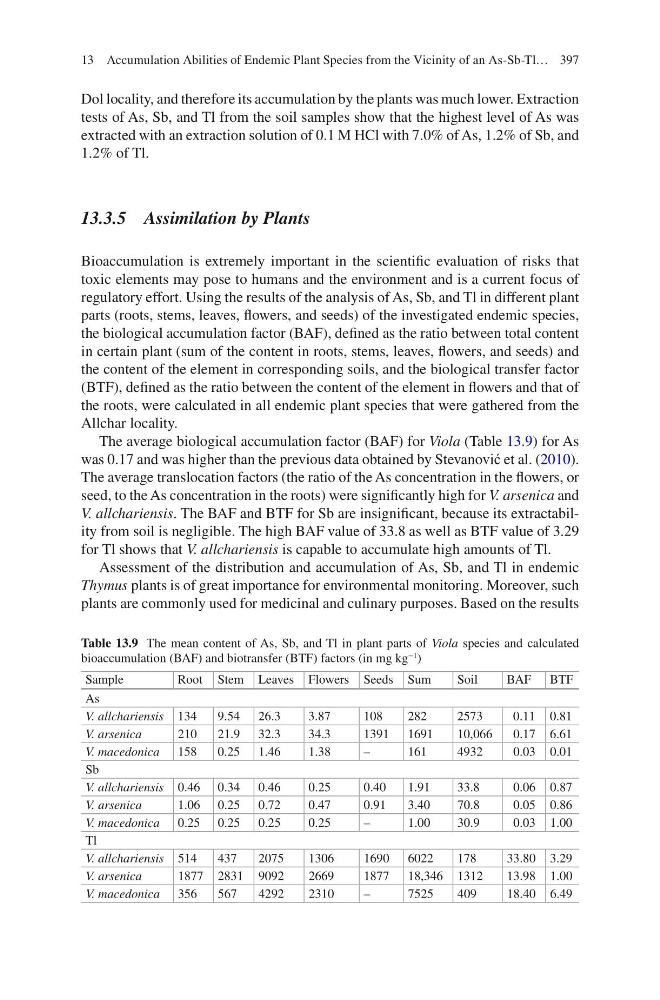
The average biological accumulation factor (BAF) for Viola (Table 13.9) for As
was 0.17 and was higher than the previous data obtained by Stevanović et al. (2010).
The average translocation factors (the ratio of the As concentration in the flowers, or
seed, to the As concentration in the roots) were significantly high for V. arsenica and
V. allchariensis. The BAF and BTF for Sb are insignificant, because its extractability from soil is negligible. The high BAF value of 33.8 as well as BTF value of 3.29
for Tl shows that V. allchariensis is capable to accumulate high amounts of Tl.
Assessment of the distribution and accumulation of As, Sb, and Tl in endemic
Thymus plants is of great importance for environmental monitoring. Moreover, such
plants are commonly used for medicinal and culinary purposes. Based on the results
Table 13.9 The mean content of As, Sb, and Tl in plant parts of Viola species and calculated
bioaccumulation (BAF) and biotransfer (BTF) factors (in mg kg
−1 )
Sample
Root Stem Leaves Flowers Seeds Sum
Soil
BAF BTF
As
V. allchariensis 134
9.54 26.3
3.87
108
282
2573
0.11 0.81
V. arsenica
210
21.9 32.3
34.3
1391 1691
10,066
0.17 6.61
V. macedonica 158
0.25 1.46
1.38
–
161
4932
0.03 0.01
Sb
V. allchariensis 0.46 0.34 0.46
0.25
0.40
1.91
33.8
0.06 0.87
V. arsenica
1.06 0.25 0.72
0.47
0.91
3.40
70.8
0.05 0.86
V. macedonica 0.25 0.25 0.25
0.25
–
1.00
30.9
0.03 1.00
Tl
V. allchariensis 514
437
2075
1306
1690 6022
178
33.80 3.29
V. arsenica
1877 2831 9092
2669
1877 18,346 1312
13.98 1.00
V. macedonica 356
567
4292
2310
–
7525
409
18.40 6.49
13 Accumulation Abilities of Endemic Plant Species from the Vicinity of an As-Sb-Tl…
Dol locality, and therefore its accumulation by the plants was much lower. Extraction
tests of As, Sb, and Tl from the soil samples show that the highest level of As was
extracted with an extraction solution of 0.1 M HCl with 7.0% of As, 1.2% of Sb, and
1.2% of Tl.
13.3.5 Assimilation by Plants
Bioaccumulation is extremely important in the scientific evaluation of risks that
toxic elements may pose to humans and the environment and is a current focus of
regulatory effort. Using the results of the analysis of As, Sb, and Tl in different plant
parts (roots, stems, leaves, flowers, and seeds) of the investigated endemic species,
the biological accumulation factor (BAF), defined as the ratio between total content
in certain plant (sum of the content in roots, stems, leaves, flowers, and seeds) and
the content of the element in corresponding soils, and the biological transfer factor
(BTF), defined as the ratio between the content of the element in flowers and that of
the roots, were calculated in all endemic plant species that were gathered from the
Allchar locality.
The average biological accumulation factor (BAF) for Viola (Table 13.9) for As
was 0.17 and was higher than the previous data obtained by Stevanović et al. (2010).
The average translocation factors (the ratio of the As concentration in the flowers, or
seed, to the As concentration in the roots) were significantly high for V. arsenica and
V. allchariensis. The BAF and BTF for Sb are insignificant, because its extractability from soil is negligible. The high BAF value of 33.8 as well as BTF value of 3.29
for Tl shows that V. allchariensis is capable to accumulate high amounts of Tl.
Assessment of the distribution and accumulation of As, Sb, and Tl in endemic
Thymus plants is of great importance for environmental monitoring. Moreover, such
plants are commonly used for medicinal and culinary purposes. Based on the results
Table 13.9 The mean content of As, Sb, and Tl in plant parts of Viola species and calculated
bioaccumulation (BAF) and biotransfer (BTF) factors (in mg kg
−1 )
Sample
Root Stem Leaves Flowers Seeds Sum
Soil
BAF BTF
As
V. allchariensis 134
9.54 26.3
3.87
108
282
2573
0.11 0.81
V. arsenica
210
21.9 32.3
34.3
1391 1691
10,066
0.17 6.61
V. macedonica 158
0.25 1.46
1.38
–
161
4932
0.03 0.01
Sb
V. allchariensis 0.46 0.34 0.46
0.25
0.40
1.91
33.8
0.06 0.87
V. arsenica
1.06 0.25 0.72
0.47
0.91
3.40
70.8
0.05 0.86
V. macedonica 0.25 0.25 0.25
0.25
–
1.00
30.9
0.03 1.00
Tl
V. allchariensis 514
437
2075
1306
1690 6022
178
33.80 3.29
V. arsenica
1877 2831 9092
2669
1877 18,346 1312
13.98 1.00
V. macedonica 356
567
4292
2310
–
7525
409
18.40 6.49
13 Accumulation Abilities of Endemic Plant Species from the Vicinity of an As-Sb-Tl…