

389
DTPA action (DTPA-CaCl2-TEA), which is often recommended for the extraction
of toxic or biogenic metals (Risser and Baker 1990; Pansu and Gautheyrou 2006).
Additionally, acid reagents are often used to displace potentially available forms
that are not easily extracted (Risser and Baker 1990; Pansu and Gautheyrou 2006).
In our case a solution of 0.1 M HCl was applied. With the simulations of these
extractions, we were able to assess the level of plant-available elements and conditions in live plants.
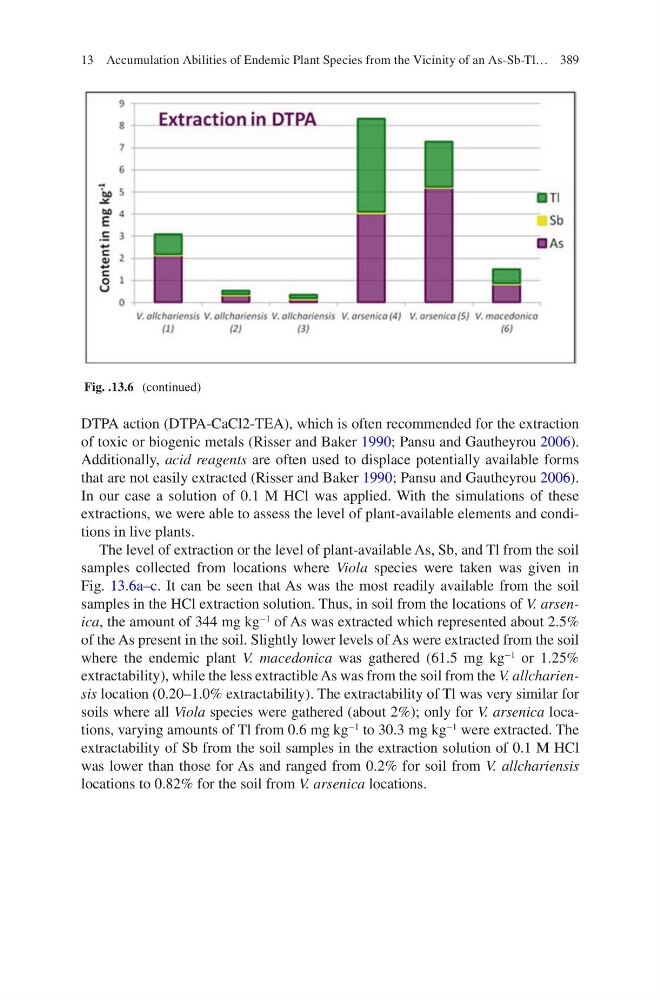
The level of extraction or the level of plant-available As, Sb, and Tl from the soil
samples collected from locations where Viola species were taken was given in
Fig. 13.6a–c. It can be seen that As was the most readily available from the soil
samples in the HCl extraction solution. Thus, in soil from the locations of V. arsenica, the amount of 344 mg kg
−1
of As was extracted which represented about 2.5%
of the As present in the soil. Slightly lower levels of As were extracted from the soil
where the endemic plant V. macedonica was gathered (61.5 mg kg
−1
or 1.25%
extractability), while the less extractible As was from the soil from the V. allchariensis location (0.20–1.0% extractability). The extractability of Tl was very similar for
soils where all Viola species were gathered (about 2%); only for V. arsenica locations, varying amounts of Tl from 0.6 mg kg
−1
to 30.3 mg kg
−1
were extracted. The
extractability of Sb from the soil samples in the extraction solution of 0.1 M HCl
was lower than those for As and ranged from 0.2% for soil from V. allchariensis
locations to 0.82% for the soil from V. arsenica locations.
Fig. .13.6 (continued)
13 Accumulation Abilities of Endemic Plant Species from the Vicinity of an As-Sb-Tl…
DTPA action (DTPA-CaCl2-TEA), which is often recommended for the extraction
of toxic or biogenic metals (Risser and Baker 1990; Pansu and Gautheyrou 2006).
Additionally, acid reagents are often used to displace potentially available forms
that are not easily extracted (Risser and Baker 1990; Pansu and Gautheyrou 2006).
In our case a solution of 0.1 M HCl was applied. With the simulations of these
extractions, we were able to assess the level of plant-available elements and conditions in live plants.
The level of extraction or the level of plant-available As, Sb, and Tl from the soil
samples collected from locations where Viola species were taken was given in
Fig. 13.6a–c. It can be seen that As was the most readily available from the soil
samples in the HCl extraction solution. Thus, in soil from the locations of V. arsenica, the amount of 344 mg kg
−1
of As was extracted which represented about 2.5%
of the As present in the soil. Slightly lower levels of As were extracted from the soil
where the endemic plant V. macedonica was gathered (61.5 mg kg
−1
or 1.25%
extractability), while the less extractible As was from the soil from the V. allchariensis location (0.20–1.0% extractability). The extractability of Tl was very similar for
soils where all Viola species were gathered (about 2%); only for V. arsenica locations, varying amounts of Tl from 0.6 mg kg
−1
to 30.3 mg kg
−1
were extracted. The
extractability of Sb from the soil samples in the extraction solution of 0.1 M HCl
was lower than those for As and ranged from 0.2% for soil from V. allchariensis
locations to 0.82% for the soil from V. arsenica locations.
Fig. .13.6 (continued)
13 Accumulation Abilities of Endemic Plant Species from the Vicinity of an As-Sb-Tl…