

386
fraction to 25%), and lowest in the stems of V. macedonica with 0.25 mg kg
−1
(mass
fraction of 0.16%). The accumulation of As in the leaves and flowers in all three
plant species was low (<40 mg kg
−1
), but the accumulation of As was higher in the
seeds; in V. arsenica the values were in ranges of 6.34 to 2776 mg kg
−1
(median of
1392 mg kg
−1
) and the lowest in V. allchariensis with a median value of 108 mg kg
−1
(mass fraction of 31.2%). There were no seeds available for V. macedonica during
the sample collection period. Despite growing at spots with higher available As, the
content of this toxic element was considerably higher in the roots and seeds.
From data given in Table 13.1, it can be noticed that the content of Sb in all plant
parts was low and it had no significant differences between the different parts of the
plant. For the accumulation of Sb in all three Viola species, we can observe that the
majority of accumulated Sb was in the roots, seeds, and leaves of the V. arsenica
with the median value of 1.06, 0.91, and 0.72 mg kg
−1
(mass fraction 30, 42, and
30%), respectively. The accumulation of Sb in the V. allchariensis and V. macedonica was very low (<0.60 mg kg
−1
).
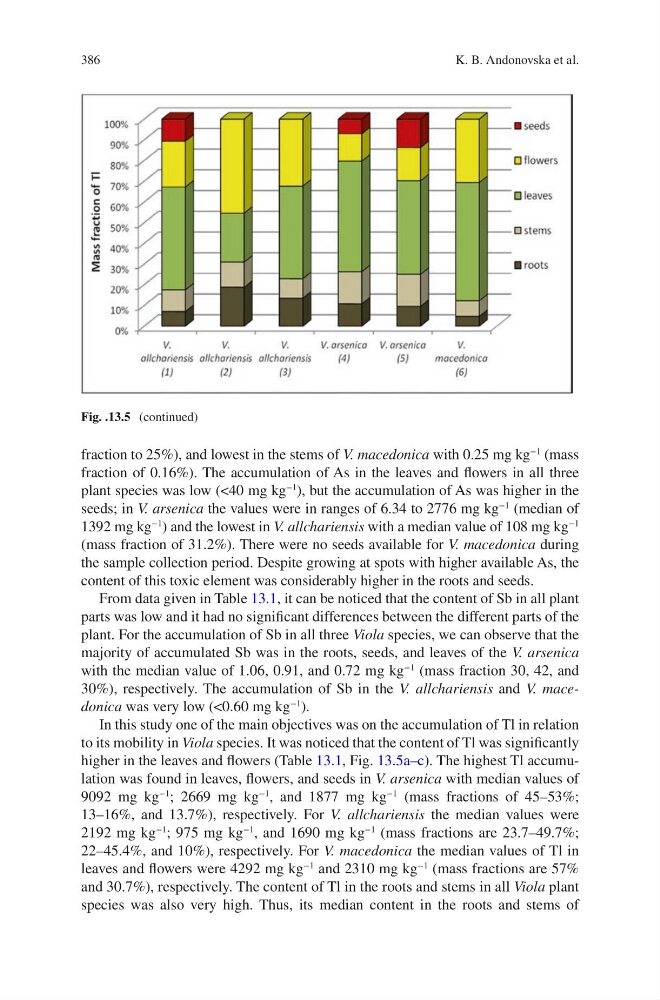
In this study one of the main objectives was on the accumulation of Tl in relation
to its mobility in Viola species. It was noticed that the content of Tl was significantly
higher in the leaves and flowers (Table 13.1, Fig. 13.5a–c). The highest Tl accumulation was found in leaves, flowers, and seeds in V. arsenica with median values of
9092 mg kg
−1
; 2669 mg kg
−1
, and 1877 mg kg
−1
(mass fractions of 45–53%;
13–16%, and 13.7%), respectively. For V. allchariensis the median values were
2192 mg kg
−1
; 975 mg kg
−1
, and 1690 mg kg
−1
(mass fractions are 23.7–49.7%;
22–45.4%, and 10%), respectively. For V. macedonica the median values of Tl in
leaves and flowers were 4292 mg kg
−1
and 2310 mg kg
−1
(mass fractions are 57%
and 30.7%), respectively. The content of Tl in the roots and stems in all Viola plant
species was also very high. Thus, its median content in the roots and stems of
Fig. .13.5 (continued)
K. B. Andonovska et al.
fraction to 25%), and lowest in the stems of V. macedonica with 0.25 mg kg
−1
(mass
fraction of 0.16%). The accumulation of As in the leaves and flowers in all three
plant species was low (<40 mg kg
−1
), but the accumulation of As was higher in the
seeds; in V. arsenica the values were in ranges of 6.34 to 2776 mg kg
−1
(median of
1392 mg kg
−1
) and the lowest in V. allchariensis with a median value of 108 mg kg
−1
(mass fraction of 31.2%). There were no seeds available for V. macedonica during
the sample collection period. Despite growing at spots with higher available As, the
content of this toxic element was considerably higher in the roots and seeds.
From data given in Table 13.1, it can be noticed that the content of Sb in all plant
parts was low and it had no significant differences between the different parts of the
plant. For the accumulation of Sb in all three Viola species, we can observe that the
majority of accumulated Sb was in the roots, seeds, and leaves of the V. arsenica
with the median value of 1.06, 0.91, and 0.72 mg kg
−1
(mass fraction 30, 42, and
30%), respectively. The accumulation of Sb in the V. allchariensis and V. macedonica was very low (<0.60 mg kg
−1
).
In this study one of the main objectives was on the accumulation of Tl in relation
to its mobility in Viola species. It was noticed that the content of Tl was significantly
higher in the leaves and flowers (Table 13.1, Fig. 13.5a–c). The highest Tl accumulation was found in leaves, flowers, and seeds in V. arsenica with median values of
9092 mg kg
−1
; 2669 mg kg
−1
, and 1877 mg kg
−1
(mass fractions of 45–53%;
13–16%, and 13.7%), respectively. For V. allchariensis the median values were
2192 mg kg
−1
; 975 mg kg
−1
, and 1690 mg kg
−1
(mass fractions are 23.7–49.7%;
22–45.4%, and 10%), respectively. For V. macedonica the median values of Tl in
leaves and flowers were 4292 mg kg
−1
and 2310 mg kg
−1
(mass fractions are 57%
and 30.7%), respectively. The content of Tl in the roots and stems in all Viola plant
species was also very high. Thus, its median content in the roots and stems of
Fig. .13.5 (continued)
K. B. Andonovska et al.