

366
the analysis is to explain the changes in it through changes that occur simultaneously on other variables in the model. This variable is called the dependent or criterion variable and is denoted by Y. Other variables are used to explain or predict the
value of the dependent variable. These variables are called independent or predictor
variables and are denoted by X. Usually more independent variables are used in the
model, so they are denoted by X 1 , X 2 , … X n , where n denotes the total number of
independent variables in the regression model. Predictor variables are also called
independent, covariates, regressors, factors or carriers. Although most commonly
used, the name of the independent variable is the least appropriate to reality, as these
variables are rarely independent of each other. The relationship between dependent
and independent variables is expressed in the form of one or more equations called
a regression model. The actual relationship between the dependent and independent
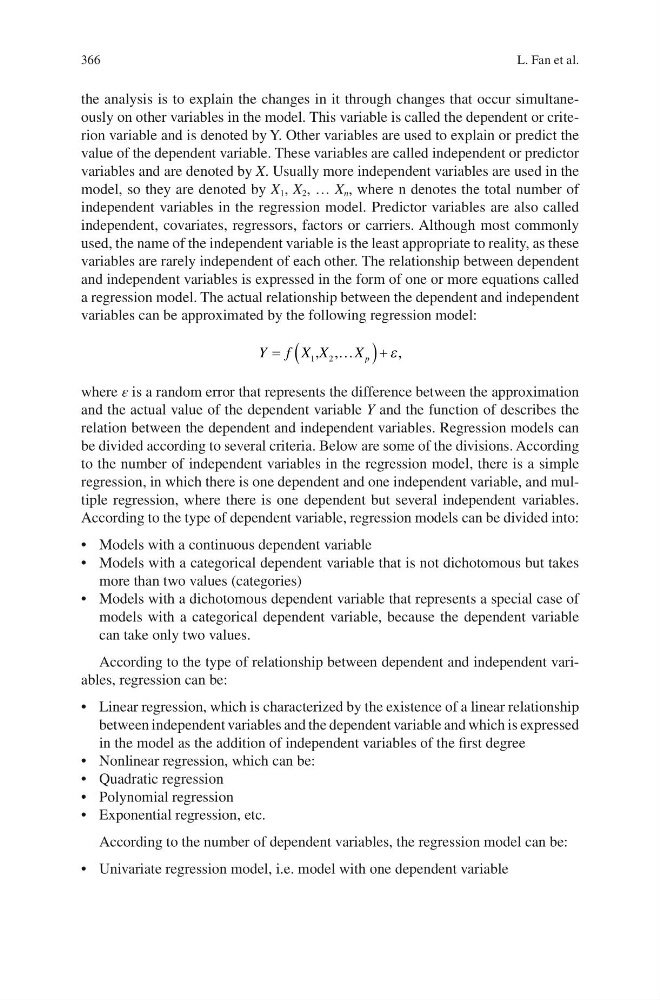
variables can be approximated by the following regression model:
Y f X X
X p
}
1
2
, ,
H ,
where ε is a random error that represents the difference between the approximation
and the actual value of the dependent variable Y and the function of describes the
relation between the dependent and independent variables. Regression models can
be divided according to several criteria. Below are some of the divisions. According
to the number of independent variables in the regression model, there is a simple
regression, in which there is one dependent and one independent variable, and multiple regression, where there is one dependent but several independent variables.
According to the type of dependent variable, regression models can be divided into:
• Models with a continuous dependent variable
• Models with a categorical dependent variable that is not dichotomous but takes
more than two values (categories)
• Models with a dichotomous dependent variable that represents a special case of
models with a categorical dependent variable, because the dependent variable
can take only two values.
According to the type of relationship between dependent and independent variables, regression can be:
• Linear regression, which is characterized by the existence of a linear relationship
between independent variables and the dependent variable and which is expressed
in the model as the addition of independent variables of the first degree
• Nonlinear regression, which can be:
• Quadratic regression
• Polynomial regression
• Exponential regression, etc.
According to the number of dependent variables, the regression model can be:
• Univariate regression model, i.e. model with one dependent variable
L. Fan et al.
the analysis is to explain the changes in it through changes that occur simultaneously on other variables in the model. This variable is called the dependent or criterion variable and is denoted by Y. Other variables are used to explain or predict the
value of the dependent variable. These variables are called independent or predictor
variables and are denoted by X. Usually more independent variables are used in the
model, so they are denoted by X 1 , X 2 , … X n , where n denotes the total number of
independent variables in the regression model. Predictor variables are also called
independent, covariates, regressors, factors or carriers. Although most commonly
used, the name of the independent variable is the least appropriate to reality, as these
variables are rarely independent of each other. The relationship between dependent
and independent variables is expressed in the form of one or more equations called
a regression model. The actual relationship between the dependent and independent
variables can be approximated by the following regression model:
Y f X X
X p
}
1
2
, ,
H ,
where ε is a random error that represents the difference between the approximation
and the actual value of the dependent variable Y and the function of describes the
relation between the dependent and independent variables. Regression models can
be divided according to several criteria. Below are some of the divisions. According
to the number of independent variables in the regression model, there is a simple
regression, in which there is one dependent and one independent variable, and multiple regression, where there is one dependent but several independent variables.
According to the type of dependent variable, regression models can be divided into:
• Models with a continuous dependent variable
• Models with a categorical dependent variable that is not dichotomous but takes
more than two values (categories)
• Models with a dichotomous dependent variable that represents a special case of
models with a categorical dependent variable, because the dependent variable
can take only two values.
According to the type of relationship between dependent and independent variables, regression can be:
• Linear regression, which is characterized by the existence of a linear relationship
between independent variables and the dependent variable and which is expressed
in the model as the addition of independent variables of the first degree
• Nonlinear regression, which can be:
• Quadratic regression
• Polynomial regression
• Exponential regression, etc.
According to the number of dependent variables, the regression model can be:
• Univariate regression model, i.e. model with one dependent variable
L. Fan et al.