

359
used in NMR spectroscopy are
1
H,
2
D,
13
C and
31
P. Mossbauer spectroscopy is based
on the detection of nuclear transitions of certain isotopes.
The isotopic composition of the elements varies from planet to planet. This fact
makes it possible to determine the origin of meteorites (Berglund and Wieser 2011).
Some meteorites are classified as lunar or Mars meteorites. Radioactive isotopes
also have important applications. The development of nuclear energy and nuclear
weapons requires significantly higher amounts of certain isotopes (Rosman and
Taylor 1998). The isotope separation process poses a significant technological challenge. Radioisotopes are also commonly used in medicine, biochemistry and chemistry as tracers. Small amounts of radioisotopes can be easily detected due to the
characteristic emissions of the decaying nucleus (Berglund and Wieser 2011).
The natural radioactive decay of
14
C allows radiocarbon dating. Cosmic rays create the
14
C isotope in the atmosphere by erupting free neutrons from the air in a
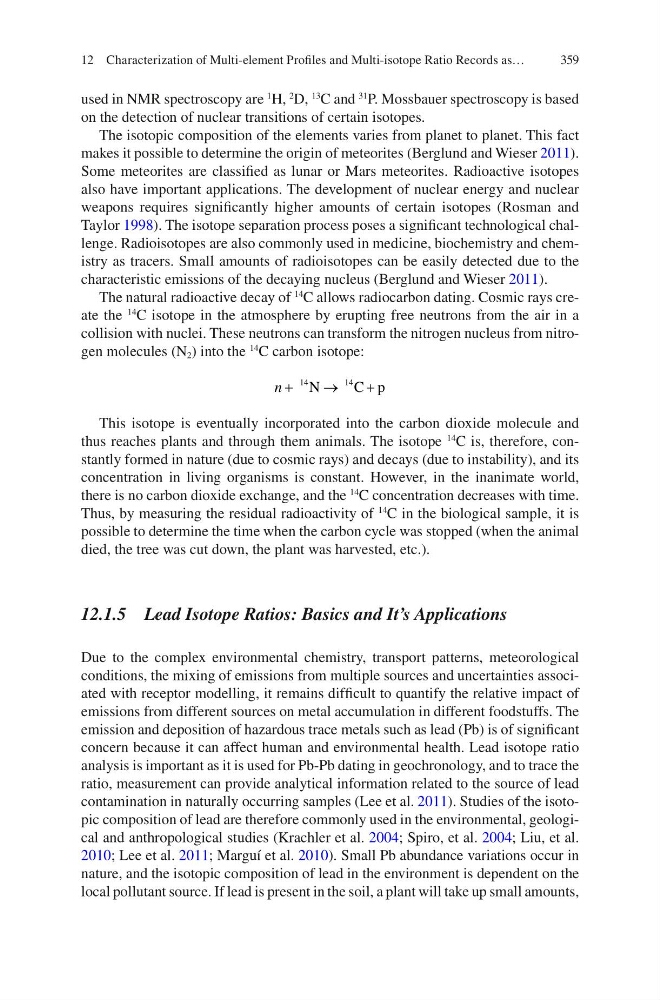
collision with nuclei. These neutrons can transform the nitrogen nucleus from nitrogen molecules (N 2 ) into the
14
C carbon isotope:
n
o
14
14
N
C p
This isotope is eventually incorporated into the carbon dioxide molecule and
thus reaches plants and through them animals. The isotope
14
C is, therefore, constantly formed in nature (due to cosmic rays) and decays (due to instability), and its
concentration in living organisms is constant. However, in the inanimate world,
there is no carbon dioxide exchange, and the
14
C concentration decreases with time.
Thus, by measuring the residual radioactivity of
14
C in the biological sample, it is
possible to determine the time when the carbon cycle was stopped (when the animal
died, the tree was cut down, the plant was harvested, etc.).
12.1.5 Lead Isotope Ratios: Basics and It’s Applications
Due to the complex environmental chemistry, transport patterns, meteorological
conditions, the mixing of emissions from multiple sources and uncertainties associated with receptor modelling, it remains difficult to quantify the relative impact of
emissions from different sources on metal accumulation in different foodstuffs. The
emission and deposition of hazardous trace metals such as lead (Pb) is of significant
concern because it can affect human and environmental health. Lead isotope ratio
analysis is important as it is used for Pb-Pb dating in geochronology, and to trace the
ratio, measurement can provide analytical information related to the source of lead
contamination in naturally occurring samples (Lee et al. 2011). Studies of the isotopic composition of lead are therefore commonly used in the environmental, geological and anthropological studies (Krachler et al. 2004; Spiro, et al. 2004; Liu, et al.
2010; Lee et al. 2011; Marguí et al. 2010). Small Pb abundance variations occur in
nature, and the isotopic composition of lead in the environment is dependent on the
local pollutant source. If lead is present in the soil, a plant will take up small amounts,
12 Characterization of Multi-element Profiles and Multi-isotope Ratio Records as…
used in NMR spectroscopy are
1
H,
2
D,
13
C and
31
P. Mossbauer spectroscopy is based
on the detection of nuclear transitions of certain isotopes.
The isotopic composition of the elements varies from planet to planet. This fact
makes it possible to determine the origin of meteorites (Berglund and Wieser 2011).
Some meteorites are classified as lunar or Mars meteorites. Radioactive isotopes
also have important applications. The development of nuclear energy and nuclear
weapons requires significantly higher amounts of certain isotopes (Rosman and
Taylor 1998). The isotope separation process poses a significant technological challenge. Radioisotopes are also commonly used in medicine, biochemistry and chemistry as tracers. Small amounts of radioisotopes can be easily detected due to the
characteristic emissions of the decaying nucleus (Berglund and Wieser 2011).
The natural radioactive decay of
14
C allows radiocarbon dating. Cosmic rays create the
14
C isotope in the atmosphere by erupting free neutrons from the air in a
collision with nuclei. These neutrons can transform the nitrogen nucleus from nitrogen molecules (N 2 ) into the
14
C carbon isotope:
n
o
14
14
N
C p
This isotope is eventually incorporated into the carbon dioxide molecule and
thus reaches plants and through them animals. The isotope
14
C is, therefore, constantly formed in nature (due to cosmic rays) and decays (due to instability), and its
concentration in living organisms is constant. However, in the inanimate world,
there is no carbon dioxide exchange, and the
14
C concentration decreases with time.
Thus, by measuring the residual radioactivity of
14
C in the biological sample, it is
possible to determine the time when the carbon cycle was stopped (when the animal
died, the tree was cut down, the plant was harvested, etc.).
12.1.5 Lead Isotope Ratios: Basics and It’s Applications
Due to the complex environmental chemistry, transport patterns, meteorological
conditions, the mixing of emissions from multiple sources and uncertainties associated with receptor modelling, it remains difficult to quantify the relative impact of
emissions from different sources on metal accumulation in different foodstuffs. The
emission and deposition of hazardous trace metals such as lead (Pb) is of significant
concern because it can affect human and environmental health. Lead isotope ratio
analysis is important as it is used for Pb-Pb dating in geochronology, and to trace the
ratio, measurement can provide analytical information related to the source of lead
contamination in naturally occurring samples (Lee et al. 2011). Studies of the isotopic composition of lead are therefore commonly used in the environmental, geological and anthropological studies (Krachler et al. 2004; Spiro, et al. 2004; Liu, et al.
2010; Lee et al. 2011; Marguí et al. 2010). Small Pb abundance variations occur in
nature, and the isotopic composition of lead in the environment is dependent on the
local pollutant source. If lead is present in the soil, a plant will take up small amounts,
12 Characterization of Multi-element Profiles and Multi-isotope Ratio Records as…