

344
trometry takes precedence over atomic emission over the limit of detection and
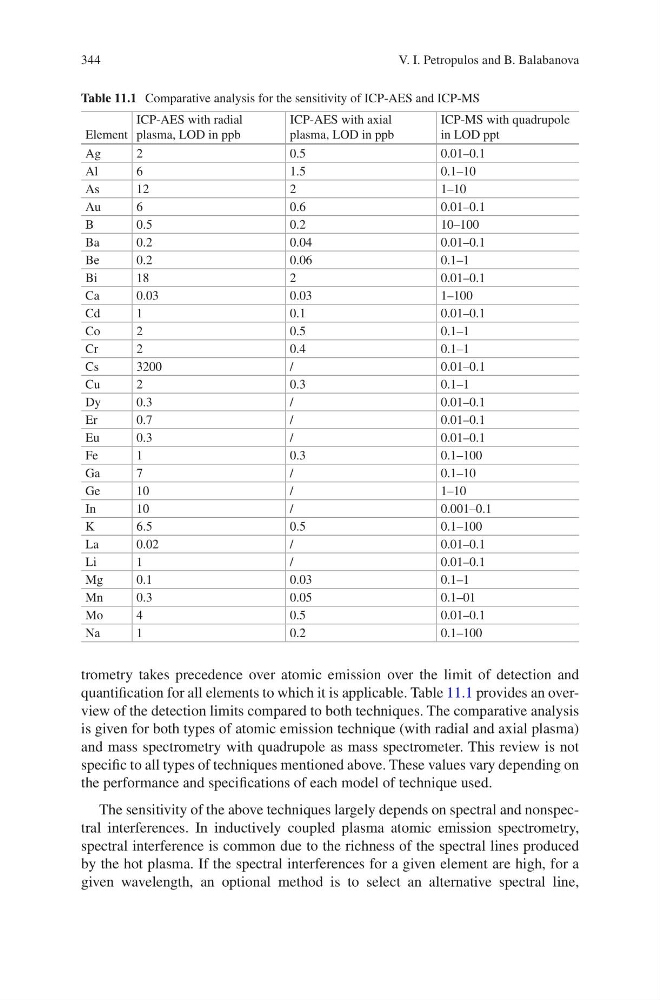
quantification for all elements to which it is applicable. Table 11.1 provides an overview of the detection limits compared to both techniques. The comparative analysis
is given for both types of atomic emission technique (with radial and axial plasma)
and mass spectrometry with quadrupole as mass spectrometer. This review is not
specific to all types of techniques mentioned above. These values vary depending on
the performance and specifications of each model of technique used.
The sensitivity of the above techniques largely depends on spectral and nonspectral interferences. In inductively coupled plasma atomic emission spectrometry,
spectral interference is common due to the richness of the spectral lines produced
by the hot plasma. If the spectral interferences for a given element are high, for a
given wavelength, an optional method is to select an alternative spectral line,
Table 11.1 Comparative analysis for the sensitivity of ICP-AES and ICP-MS
Element
ICP-AES with radial
plasma, LOD in ppb
ICP-AES with axial
plasma, LOD in ppb
ICP-MS with quadrupole
in LOD ppt
Ag
2
0.5
0.01–0.1
Al
6
1.5
0.1–10
As
12
2
1–10
Au
6
0.6
0.01–0.1
B
0.5
0.2
10–100
Ba
0.2
0.04
0.01–0.1
Be
0.2
0.06
0.1–1
Bi
18
2
0.01–0.1
Ca
0.03
0.03
1–100
Cd
1
0.1
0.01–0.1
Co
2
0.5
0.1–1
Cr
2
0.4
0.1–1
Cs
3200
/
0.01–0.1
Cu
2
0.3
0.1–1
Dy
0.3
/
0.01–0.1
Er
0.7
/
0.01–0.1
Eu
0.3
/
0.01–0.1
Fe
1
0.3
0.1–100
Ga
7
/
0.1–10
Ge
10
/
1–10
In
10
/
0.001–0.1
K
6.5
0.5
0.1–100
La
0.02
/
0.01–0.1
Li
1
/
0.01–0.1
Mg
0.1
0.03
0.1–1
Mn
0.3
0.05
0.1–01
Mo
4
0.5
0.01–0.1
Na
1
0.2
0.1–100
V. I. Petropulos and B. Balabanova
trometry takes precedence over atomic emission over the limit of detection and
quantification for all elements to which it is applicable. Table 11.1 provides an overview of the detection limits compared to both techniques. The comparative analysis
is given for both types of atomic emission technique (with radial and axial plasma)
and mass spectrometry with quadrupole as mass spectrometer. This review is not
specific to all types of techniques mentioned above. These values vary depending on
the performance and specifications of each model of technique used.
The sensitivity of the above techniques largely depends on spectral and nonspectral interferences. In inductively coupled plasma atomic emission spectrometry,
spectral interference is common due to the richness of the spectral lines produced
by the hot plasma. If the spectral interferences for a given element are high, for a
given wavelength, an optional method is to select an alternative spectral line,
Table 11.1 Comparative analysis for the sensitivity of ICP-AES and ICP-MS
Element
ICP-AES with radial
plasma, LOD in ppb
ICP-AES with axial
plasma, LOD in ppb
ICP-MS with quadrupole
in LOD ppt
Ag
2
0.5
0.01–0.1
Al
6
1.5
0.1–10
As
12
2
1–10
Au
6
0.6
0.01–0.1
B
0.5
0.2
10–100
Ba
0.2
0.04
0.01–0.1
Be
0.2
0.06
0.1–1
Bi
18
2
0.01–0.1
Ca
0.03
0.03
1–100
Cd
1
0.1
0.01–0.1
Co
2
0.5
0.1–1
Cr
2
0.4
0.1–1
Cs
3200
/
0.01–0.1
Cu
2
0.3
0.1–1
Dy
0.3
/
0.01–0.1
Er
0.7
/
0.01–0.1
Eu
0.3
/
0.01–0.1
Fe
1
0.3
0.1–100
Ga
7
/
0.1–10
Ge
10
/
1–10
In
10
/
0.001–0.1
K
6.5
0.5
0.1–100
La
0.02
/
0.01–0.1
Li
1
/
0.01–0.1
Mg
0.1
0.03
0.1–1
Mn
0.3
0.05
0.1–01
Mo
4
0.5
0.01–0.1
Na
1
0.2
0.1–100
V. I. Petropulos and B. Balabanova