

328
(ALA) from the group of omega-3 fatty acids. Fatty acids with several double bonds
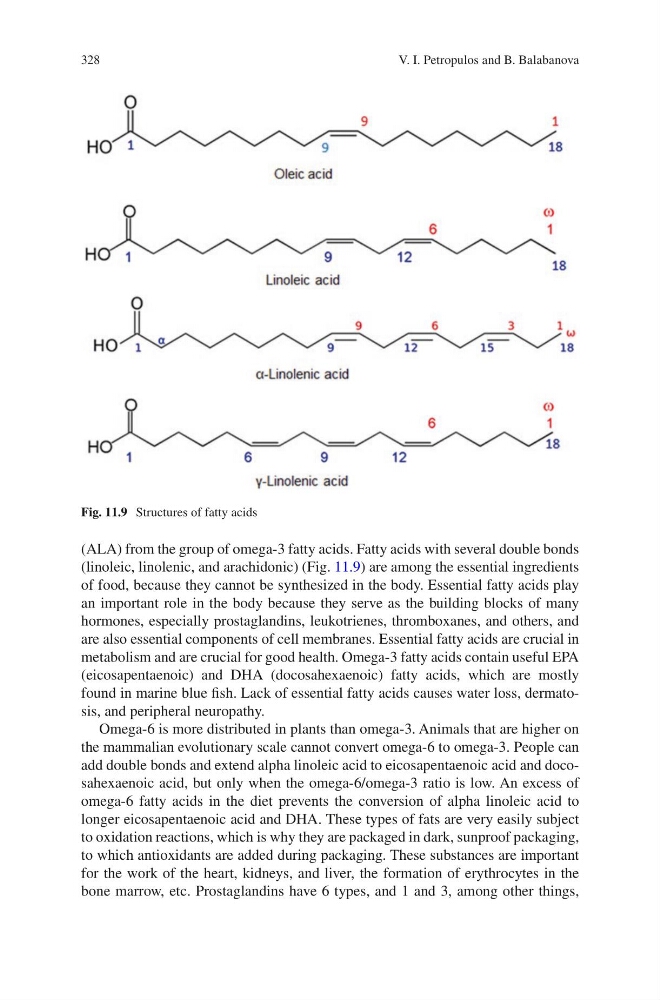
(linoleic, linolenic, and arachidonic) (Fig. 11.9) are among the essential ingredients
of food, because they cannot be synthesized in the body. Essential fatty acids play
an important role in the body because they serve as the building blocks of many
hormones, especially prostaglandins, leukotrienes, thromboxanes, and others, and
are also essential components of cell membranes. Essential fatty acids are crucial in
metabolism and are crucial for good health. Omega-3 fatty acids contain useful EPA
(eicosapentaenoic) and DHA (docosahexaenoic) fatty acids, which are mostly
found in marine blue fish. Lack of essential fatty acids causes water loss, dermatosis, and peripheral neuropathy.
Omega-6 is more distributed in plants than omega-3. Animals that are higher on
the mammalian evolutionary scale cannot convert omega-6 to omega-3. People can
add double bonds and extend alpha linoleic acid to eicosapentaenoic acid and docosahexaenoic acid, but only when the omega-6/omega-3 ratio is low. An excess of
omega-6 fatty acids in the diet prevents the conversion of alpha linoleic acid to
longer eicosapentaenoic acid and DHA. These types of fats are very easily subject
to oxidation reactions, which is why they are packaged in dark, sunproof packaging,
to which antioxidants are added during packaging. These substances are important
for the work of the heart, kidneys, and liver, the formation of erythrocytes in the
bone marrow, etc. Prostaglandins have 6 types, and 1 and 3, among other things,
Fig. 11.9 Structures of fatty acids
V. I. Petropulos and B. Balabanova
(ALA) from the group of omega-3 fatty acids. Fatty acids with several double bonds
(linoleic, linolenic, and arachidonic) (Fig. 11.9) are among the essential ingredients
of food, because they cannot be synthesized in the body. Essential fatty acids play
an important role in the body because they serve as the building blocks of many
hormones, especially prostaglandins, leukotrienes, thromboxanes, and others, and
are also essential components of cell membranes. Essential fatty acids are crucial in
metabolism and are crucial for good health. Omega-3 fatty acids contain useful EPA
(eicosapentaenoic) and DHA (docosahexaenoic) fatty acids, which are mostly
found in marine blue fish. Lack of essential fatty acids causes water loss, dermatosis, and peripheral neuropathy.
Omega-6 is more distributed in plants than omega-3. Animals that are higher on
the mammalian evolutionary scale cannot convert omega-6 to omega-3. People can
add double bonds and extend alpha linoleic acid to eicosapentaenoic acid and docosahexaenoic acid, but only when the omega-6/omega-3 ratio is low. An excess of
omega-6 fatty acids in the diet prevents the conversion of alpha linoleic acid to
longer eicosapentaenoic acid and DHA. These types of fats are very easily subject
to oxidation reactions, which is why they are packaged in dark, sunproof packaging,
to which antioxidants are added during packaging. These substances are important
for the work of the heart, kidneys, and liver, the formation of erythrocytes in the
bone marrow, etc. Prostaglandins have 6 types, and 1 and 3, among other things,
Fig. 11.9 Structures of fatty acids
V. I. Petropulos and B. Balabanova