

321
Polyphenols are divided according to their chemical structure, although they can
also be classified by their source of origin, natural distribution, or biological
function. In particular, according to their chemical structure, they can be classified
into different groups, as function of the number of phenol rings contained and the
structural elements that bind these rings. The phenol structure has one phenolic –
OH group; catechol, hydroquinone, and resorcinol (benzenediol) structures have
two phenolic –OH groups; and gallocatechol and phloroglucinol (benzenetriol)
structures have three phenolic –OH groups. Most polyphenols are formed by the
deamination of the phenylalanine and tyrosine amino acids to cinnamic acids, as
part of the phenylpropanoid pathway. Although these compounds have a common
carbon C6-C3 phenylpropanoid element, an essential step in their biosynthesis is
the attachment of one or more –OH groups to the phenyl ring, which gives rise to a
great diversity of molecules: cinnamic acids (C6-C3), benzoic acids (C6-C1), flavonoids (C6-C3-C6), proanthocyanidins [(C6-C3-C6)n], coumarins (C6-C3), stilbenes (C6-C2-C6), lignans (C6-C3-C3-C6), and lignins [(C6-C3)n]
(Chiorcea-Paquim et al. 2020).
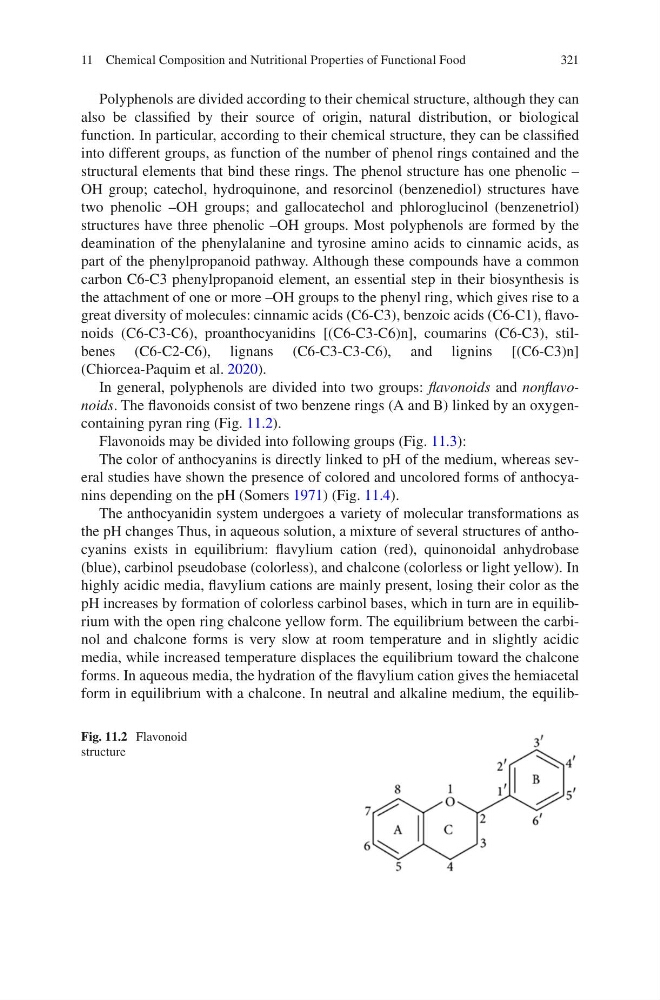
In general, polyphenols are divided into two groups: flavonoids and nonflavonoids. The flavonoids consist of two benzene rings (A and B) linked by an oxygencontaining pyran ring (Fig. 11.2).
Flavonoids may be divided into following groups (Fig. 11.3):
The color of anthocyanins is directly linked to pH of the medium, whereas several studies have shown the presence of colored and uncolored forms of anthocyanins depending on the pH (Somers 1971) (Fig. 11.4).
The anthocyanidin system undergoes a variety of molecular transformations as
the pH changes Thus, in aqueous solution, a mixture of several structures of anthocyanins exists in equilibrium: flavylium cation (red), quinonoidal anhydrobase
(blue), carbinol pseudobase (colorless), and chalcone (colorless or light yellow). In
highly acidic media, flavylium cations are mainly present, losing their color as the
pH increases by formation of colorless carbinol bases, which in turn are in equilibrium with the open ring chalcone yellow form. The equilibrium between the carbinol and chalcone forms is very slow at room temperature and in slightly acidic
media, while increased temperature displaces the equilibrium toward the chalcone
forms. In aqueous media, the hydration of the flavylium cation gives the hemiacetal
form in equilibrium with a chalcone. In neutral and alkaline medium, the equilibFig. 11.2 Flavonoid
structure
11 Chemical Composition and Nutritional Properties of Functional Food
Polyphenols are divided according to their chemical structure, although they can
also be classified by their source of origin, natural distribution, or biological
function. In particular, according to their chemical structure, they can be classified
into different groups, as function of the number of phenol rings contained and the
structural elements that bind these rings. The phenol structure has one phenolic –
OH group; catechol, hydroquinone, and resorcinol (benzenediol) structures have
two phenolic –OH groups; and gallocatechol and phloroglucinol (benzenetriol)
structures have three phenolic –OH groups. Most polyphenols are formed by the
deamination of the phenylalanine and tyrosine amino acids to cinnamic acids, as
part of the phenylpropanoid pathway. Although these compounds have a common
carbon C6-C3 phenylpropanoid element, an essential step in their biosynthesis is
the attachment of one or more –OH groups to the phenyl ring, which gives rise to a
great diversity of molecules: cinnamic acids (C6-C3), benzoic acids (C6-C1), flavonoids (C6-C3-C6), proanthocyanidins [(C6-C3-C6)n], coumarins (C6-C3), stilbenes (C6-C2-C6), lignans (C6-C3-C3-C6), and lignins [(C6-C3)n]
(Chiorcea-Paquim et al. 2020).
In general, polyphenols are divided into two groups: flavonoids and nonflavonoids. The flavonoids consist of two benzene rings (A and B) linked by an oxygencontaining pyran ring (Fig. 11.2).
Flavonoids may be divided into following groups (Fig. 11.3):
The color of anthocyanins is directly linked to pH of the medium, whereas several studies have shown the presence of colored and uncolored forms of anthocyanins depending on the pH (Somers 1971) (Fig. 11.4).
The anthocyanidin system undergoes a variety of molecular transformations as
the pH changes Thus, in aqueous solution, a mixture of several structures of anthocyanins exists in equilibrium: flavylium cation (red), quinonoidal anhydrobase
(blue), carbinol pseudobase (colorless), and chalcone (colorless or light yellow). In
highly acidic media, flavylium cations are mainly present, losing their color as the
pH increases by formation of colorless carbinol bases, which in turn are in equilibrium with the open ring chalcone yellow form. The equilibrium between the carbinol and chalcone forms is very slow at room temperature and in slightly acidic
media, while increased temperature displaces the equilibrium toward the chalcone
forms. In aqueous media, the hydration of the flavylium cation gives the hemiacetal
form in equilibrium with a chalcone. In neutral and alkaline medium, the equilibFig. 11.2 Flavonoid
structure
11 Chemical Composition and Nutritional Properties of Functional Food