

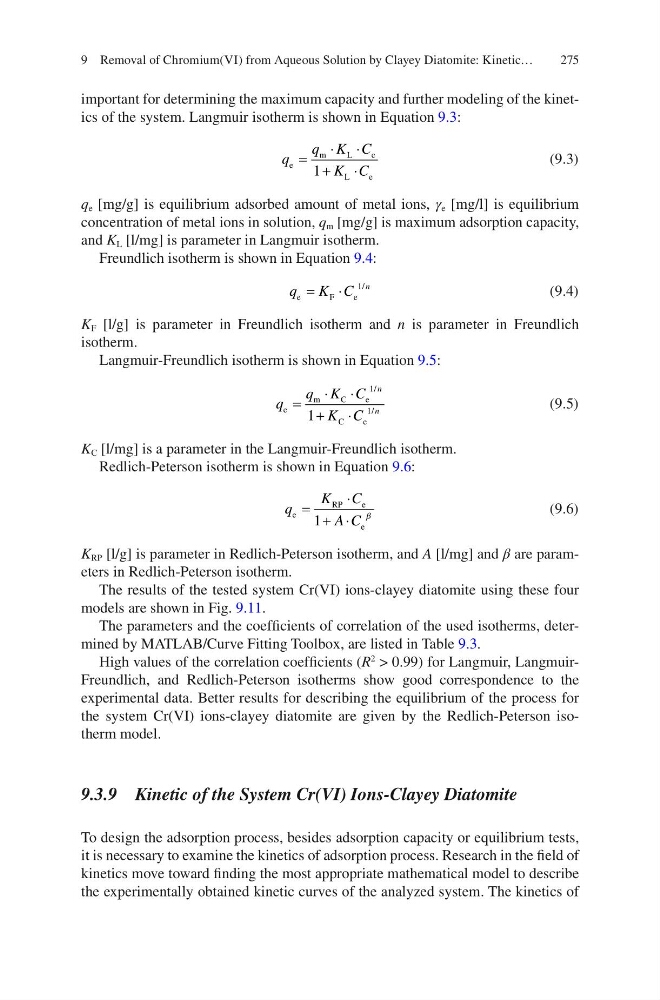
275
important for determining the maximum capacity and further modeling of the kinetics of the system. Langmuir isotherm is shown in Equation 9.3:
q
q K C
K C
e
m
L
e
L
e
1
(9.3)
q e [mg/g] is equilibrium adsorbed amount of metal ions, γ e [mg/l] is equilibrium
concentration of metal ions in solution, q m [mg/g] is maximum adsorption capacity,
and K L [l/mg] is parameter in Langmuir isotherm.
Freundlich isotherm is shown in Equation 9.4:
q K C
n
e
F
e
1/
(9.4)
K F [l/g] is parameter in Freundlich isotherm and n is parameter in Freundlich
isotherm.
Langmuir-Freundlich isotherm is shown in Equation 9.5:
q
q K C
K C
n
n
e
m
C
e
C
e
1
1
1
/
/
(9.5)
K C [l/mg] is a parameter in the Langmuir-Freundlich isotherm.
Redlich-Peterson isotherm is shown in Equation 9.6:
q
K C
A C
e
RP
e
e
1
E
(9.6)
K RP [l/g] is parameter in Redlich-Peterson isotherm, and A [l/mg] and β are parameters in Redlich-Peterson isotherm.
The results of the tested system Cr(VI) ions-clayey diatomite using these four
models are shown in Fig. 9.11.
The parameters and the coefficients of correlation of the used isotherms, determined by MATLAB/Curve Fitting Toolbox, are listed in Table 9.3.
High values of the correlation coefficients (R
2
> 0.99) for Langmuir, LangmuirFreundlich, and Redlich-Peterson isotherms show good correspondence to the
experimental data. Better results for describing the equilibrium of the process for
the system Cr(VI) ions-clayey diatomite are given by the Redlich-Peterson isotherm model.
9.3.9 Kinetic of the System Cr(VI) Ions-Clayey Diatomite
To design the adsorption process, besides adsorption capacity or equilibrium tests,
it is necessary to examine the kinetics of adsorption process. Research in the field of
kinetics move toward finding the most appropriate mathematical model to describe
the experimentally obtained kinetic curves of the analyzed system. The kinetics of
9 Removal of Chromium(VI) from Aqueous Solution by Clayey Diatomite: Kinetic…
important for determining the maximum capacity and further modeling of the kinetics of the system. Langmuir isotherm is shown in Equation 9.3:
q
q K C
K C
e
m
L
e
L
e
1
(9.3)
q e [mg/g] is equilibrium adsorbed amount of metal ions, γ e [mg/l] is equilibrium
concentration of metal ions in solution, q m [mg/g] is maximum adsorption capacity,
and K L [l/mg] is parameter in Langmuir isotherm.
Freundlich isotherm is shown in Equation 9.4:
q K C
n
e
F
e
1/
(9.4)
K F [l/g] is parameter in Freundlich isotherm and n is parameter in Freundlich
isotherm.
Langmuir-Freundlich isotherm is shown in Equation 9.5:
q
q K C
K C
n
n
e
m
C
e
C
e
1
1
1
/
/
(9.5)
K C [l/mg] is a parameter in the Langmuir-Freundlich isotherm.
Redlich-Peterson isotherm is shown in Equation 9.6:
q
K C
A C
e
RP
e
e
1
E
(9.6)
K RP [l/g] is parameter in Redlich-Peterson isotherm, and A [l/mg] and β are parameters in Redlich-Peterson isotherm.
The results of the tested system Cr(VI) ions-clayey diatomite using these four
models are shown in Fig. 9.11.
The parameters and the coefficients of correlation of the used isotherms, determined by MATLAB/Curve Fitting Toolbox, are listed in Table 9.3.
High values of the correlation coefficients (R
2
> 0.99) for Langmuir, LangmuirFreundlich, and Redlich-Peterson isotherms show good correspondence to the
experimental data. Better results for describing the equilibrium of the process for
the system Cr(VI) ions-clayey diatomite are given by the Redlich-Peterson isotherm model.
9.3.9 Kinetic of the System Cr(VI) Ions-Clayey Diatomite
To design the adsorption process, besides adsorption capacity or equilibrium tests,
it is necessary to examine the kinetics of adsorption process. Research in the field of
kinetics move toward finding the most appropriate mathematical model to describe
the experimentally obtained kinetic curves of the analyzed system. The kinetics of
9 Removal of Chromium(VI) from Aqueous Solution by Clayey Diatomite: Kinetic…