

267
Redlich-Peterson), using the software package MATLAB/Curve Fitting Toolbox. In
order to define the kinetics of the studied systems, the following kinetic models
were applied: pseudo-first- and pseudo-second-order models and model of Elovic.
9.3 Results and Discussion
9.3.1 Physical-Mechanical Characterization
of Clayey Diatomite
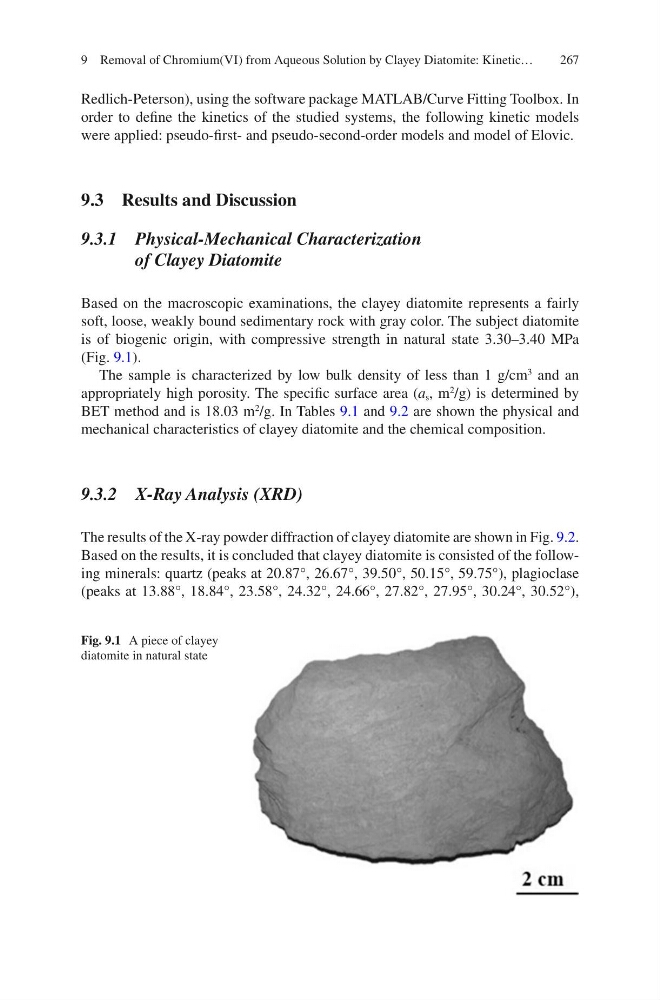
Based on the macroscopic examinations, the clayey diatomite represents a fairly
soft, loose, weakly bound sedimentary rock with gray color. The subject diatomite
is of biogenic origin, with compressive strength in natural state 3.30–3.40 MPa
(Fig. 9.1).
The sample is characterized by low bulk density of less than 1 g/cm
3
and an
appropriately high porosity. The specific surface area (a s , m
2
/g) is determined by
BET method and is 18.03 m
2
/g. In Tables 9.1 and 9.2 are shown the physical and
mechanical characteristics of clayey diatomite and the chemical composition.
9.3.2 X-Ray Analysis (XRD)
The results of the X-ray powder diffraction of clayey diatomite are shown in Fig. 9.2.
Based on the results, it is concluded that clayey diatomite is consisted of the following minerals: quartz (peaks at 20.87°, 26.67°, 39.50°, 50.15°, 59.75°), plagioclase
(peaks at 13.88°, 18.84°, 23.58°, 24.32°, 24.66°, 27.82°, 27.95°, 30.24°, 30.52°),
Fig. 9.1 A piece of clayey
diatomite in natural state
9 Removal of Chromium(VI) from Aqueous Solution by Clayey Diatomite: Kinetic…
Redlich-Peterson), using the software package MATLAB/Curve Fitting Toolbox. In
order to define the kinetics of the studied systems, the following kinetic models
were applied: pseudo-first- and pseudo-second-order models and model of Elovic.
9.3 Results and Discussion
9.3.1 Physical-Mechanical Characterization
of Clayey Diatomite
Based on the macroscopic examinations, the clayey diatomite represents a fairly
soft, loose, weakly bound sedimentary rock with gray color. The subject diatomite
is of biogenic origin, with compressive strength in natural state 3.30–3.40 MPa
(Fig. 9.1).
The sample is characterized by low bulk density of less than 1 g/cm
3
and an
appropriately high porosity. The specific surface area (a s , m
2
/g) is determined by
BET method and is 18.03 m
2
/g. In Tables 9.1 and 9.2 are shown the physical and
mechanical characteristics of clayey diatomite and the chemical composition.
9.3.2 X-Ray Analysis (XRD)
The results of the X-ray powder diffraction of clayey diatomite are shown in Fig. 9.2.
Based on the results, it is concluded that clayey diatomite is consisted of the following minerals: quartz (peaks at 20.87°, 26.67°, 39.50°, 50.15°, 59.75°), plagioclase
(peaks at 13.88°, 18.84°, 23.58°, 24.32°, 24.66°, 27.82°, 27.95°, 30.24°, 30.52°),
Fig. 9.1 A piece of clayey
diatomite in natural state
9 Removal of Chromium(VI) from Aqueous Solution by Clayey Diatomite: Kinetic…