

255
not uniform in its quality regarding minor component concentrations. Welch’s
t-test was performed for normal and Box-Cox transformed values showing significant differences between shallow and deep groundwater regarding As, Ba, Mo,
Pb, and Ti concentrations when normal values are processed and between As, Ba,
Mo, Ti, and Zn when Box-Cox transformed values are processed (Table 8.4). The
power analysis showed a high percentage of accuracy (>95%) only for As and Ba
when normal values are processed and for As, Ba, Ti, and Zn when Box-Cox normalized values are processed. The median values for these elements and ions are
higher in deep groundwater except for Ti which was found that have significantly
greater concentrations in shallow groundwater. Median values for Ti in shallow
and deep groundwater were 152 μg/l and 131 μg/l with a maximum concentration
of 1036 μg/l. The average content of Ti in igneous rock is around 4.83 g/kg, while
in sedimentary rock, the content is 4.44 g/kg, 1.95 g/kg, and 0.38 g/kg for shale,
sandstone, and carbonates (Chilton 1996). The important anthropogenic source of
Ti is the aircraft and space industry. The oxide is used principally as a white pigment in paint. Such industries are not common for the investigated region, so it is
assumed that the presence of Ti in groundwater has a lithological origin. The
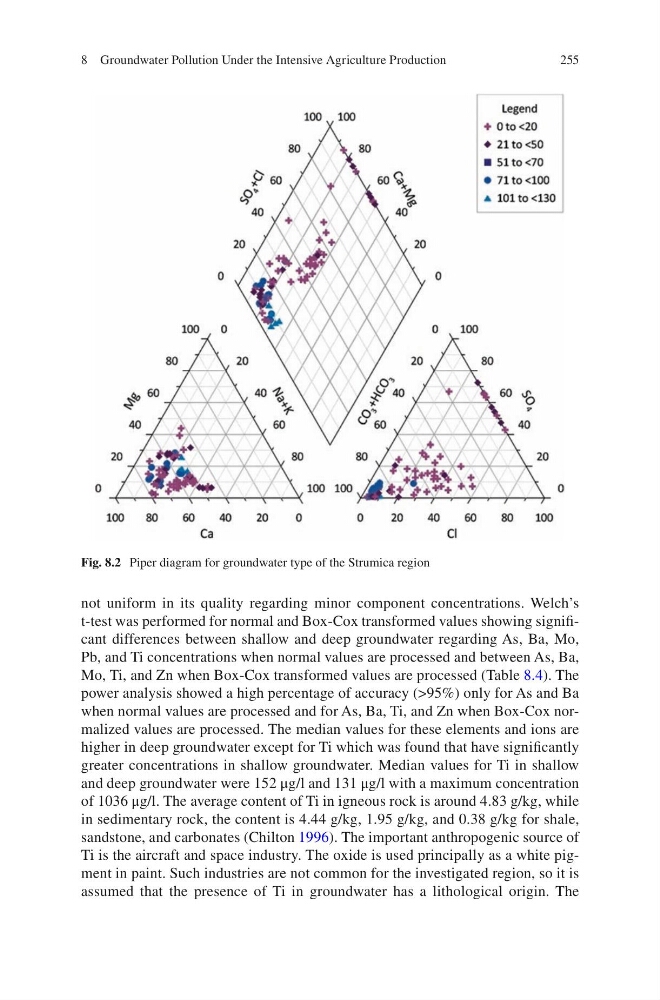
Fig. 8.2 Piper diagram for groundwater type of the Strumica region
8 Groundwater Pollution Under the Intensive Agriculture Production
not uniform in its quality regarding minor component concentrations. Welch’s
t-test was performed for normal and Box-Cox transformed values showing significant differences between shallow and deep groundwater regarding As, Ba, Mo,
Pb, and Ti concentrations when normal values are processed and between As, Ba,
Mo, Ti, and Zn when Box-Cox transformed values are processed (Table 8.4). The
power analysis showed a high percentage of accuracy (>95%) only for As and Ba
when normal values are processed and for As, Ba, Ti, and Zn when Box-Cox normalized values are processed. The median values for these elements and ions are
higher in deep groundwater except for Ti which was found that have significantly
greater concentrations in shallow groundwater. Median values for Ti in shallow
and deep groundwater were 152 μg/l and 131 μg/l with a maximum concentration
of 1036 μg/l. The average content of Ti in igneous rock is around 4.83 g/kg, while
in sedimentary rock, the content is 4.44 g/kg, 1.95 g/kg, and 0.38 g/kg for shale,
sandstone, and carbonates (Chilton 1996). The important anthropogenic source of
Ti is the aircraft and space industry. The oxide is used principally as a white pigment in paint. Such industries are not common for the investigated region, so it is
assumed that the presence of Ti in groundwater has a lithological origin. The
Fig. 8.2 Piper diagram for groundwater type of the Strumica region
8 Groundwater Pollution Under the Intensive Agriculture Production