

218
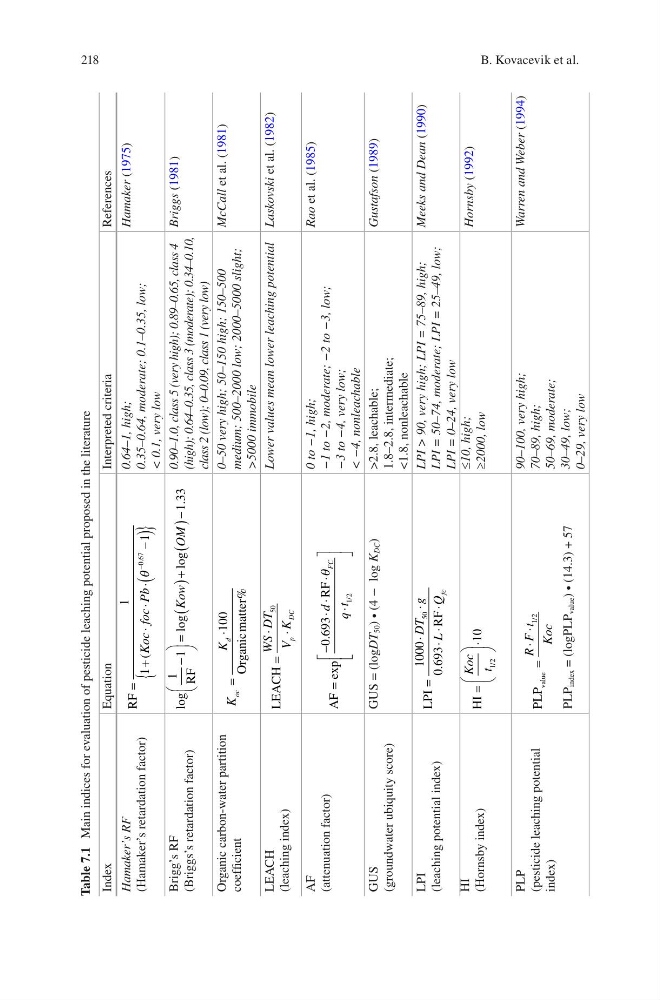
Table 7.1 Main indices for evaluation of pesticide leaching potential proposed in the literature
Index
Equation
Interpreted criteria
References
Hamaker’s RF
(Hamaker’s retardation factor)
RF
=
+
⋅
⋅ ⋅
−
(
)
{
}
−
1
1
1
0 67
(
.
Koc foc Pb
θ
0.64–1, high;
0.35–0.64, moderate; 0.1–0.35, low;
< 0.1, very low
Hamaker
(1975)
Brigg’s RF
(Briggs’s retardation factor)
log
l og
log
.
1
1
1 33
RF
−
=
( )+ ( )−
Kow
O M
0.90–1.0, class 5 (very high); 0.89–0.65, class 4
(high); 0.64–0.35, class 3 (moderate); 0.34–0.10,
class 2 (low); 0–0.09, class 1 (very low)
Briggs
(1981)
Organic carbon-water partition
coefficient
K
K
oc
d
=
⋅100
Organic matter%
0–50 very high; 50–150 high; 150–500
medium; 500–2000 low; 2000–5000 slight;
>5000 immobile
McCall
et al. (1981)
LEACH
(leaching index)
LEACH
=
⋅
⋅
WS DT
V K
p
D C
50
Lower values mean lower leaching potential Laskovski
et al. (1982)
AF
(attenuation factor)
AF
RF
=
−
⋅ ⋅ ⋅
⋅
exp
.
/
0 693
1 2
d
q t
FC
θ
0 to
−1, high;
−1 to
−2, moderate;
−2 to
−3, low;
−3 to
−4, very low;
<
−4, nonleachable
Rao
et al. (1985)
GUS
(groundwater ubiquity score)
GUS = (logDT
50 ) ∙ (4 − log K
DC )
>2.8, leachable;
1.8–2.8, intermediate;
<1.8, nonleachable
Gustafson
(1989)
LPI
(leaching potential index)
LPI
RF
=
⋅
⋅
⋅ ⋅ ⋅
1000
0 693
50
DT g
L
Q
fc
.
LPI > 90, very high; LPI = 75–89, high;
LPI = 50–74, moderate; LPI = 25–49, low;
LPI = 0–24, very low
Meeks and Dean
(1990)
HI
(Hornsby index)
HI
=
⋅
Koc
t
1 2
10
/
≤10, high;
≥2000, low
Hornsby
(1992)
PLP
(pesticide leaching potential
index)
PLP
value =
⋅ ⋅
R F t
Koc
1 2
/
PLP
index = (logPLP
value ) ∙ (14.3) + 57
90–100, very high;
70–89, high;
50–69, moderate;
30–49, low;
0–29, very low
Warren and Weber
(1994)
B. Kovacevik et al.
Table 7.1 Main indices for evaluation of pesticide leaching potential proposed in the literature
Index
Equation
Interpreted criteria
References
Hamaker’s RF
(Hamaker’s retardation factor)
RF
=
+
⋅
⋅ ⋅
−
(
)
{
}
−
1
1
1
0 67
(
.
Koc foc Pb
θ
0.64–1, high;
0.35–0.64, moderate; 0.1–0.35, low;
< 0.1, very low
Hamaker
(1975)
Brigg’s RF
(Briggs’s retardation factor)
log
l og
log
.
1
1
1 33
RF
−
=
( )+ ( )−
Kow
O M
0.90–1.0, class 5 (very high); 0.89–0.65, class 4
(high); 0.64–0.35, class 3 (moderate); 0.34–0.10,
class 2 (low); 0–0.09, class 1 (very low)
Briggs
(1981)
Organic carbon-water partition
coefficient
K
K
oc
d
=
⋅100
Organic matter%
0–50 very high; 50–150 high; 150–500
medium; 500–2000 low; 2000–5000 slight;
>5000 immobile
McCall
et al. (1981)
LEACH
(leaching index)
LEACH
=
⋅
⋅
WS DT
V K
p
D C
50
Lower values mean lower leaching potential Laskovski
et al. (1982)
AF
(attenuation factor)
AF
RF
=
−
⋅ ⋅ ⋅
⋅
exp
.
/
0 693
1 2
d
q t
FC
θ
0 to
−1, high;
−1 to
−2, moderate;
−2 to
−3, low;
−3 to
−4, very low;
<
−4, nonleachable
Rao
et al. (1985)
GUS
(groundwater ubiquity score)
GUS = (logDT
50 ) ∙ (4 − log K
DC )
>2.8, leachable;
1.8–2.8, intermediate;
<1.8, nonleachable
Gustafson
(1989)
LPI
(leaching potential index)
LPI
RF
=
⋅
⋅
⋅ ⋅ ⋅
1000
0 693
50
DT g
L
Q
fc
.
LPI > 90, very high; LPI = 75–89, high;
LPI = 50–74, moderate; LPI = 25–49, low;
LPI = 0–24, very low
Meeks and Dean
(1990)
HI
(Hornsby index)
HI
=
⋅
Koc
t
1 2
10
/
≤10, high;
≥2000, low
Hornsby
(1992)
PLP
(pesticide leaching potential
index)
PLP
value =
⋅ ⋅
R F t
Koc
1 2
/
PLP
index = (logPLP
value ) ∙ (14.3) + 57
90–100, very high;
70–89, high;
50–69, moderate;
30–49, low;
0–29, very low
Warren and Weber
(1994)
B. Kovacevik et al.