

146
main disadvantages of the method are ignorance of the efficiency of accumulation
for different types of pollutants, as well as the choice of exposure time.
Biomonitors are organisms, parts of organisms, or a community of organisms
that are exposed to different types of pollution and provide information on the quality and condition of the environment. They can also be used to detect the negative
impacts that various anthropogenic activities (industrial activity, transport, etc.)
have on the environment. The information obtained can make a significant contribution to sustainable development and the development of strategies to prevent or
reduce adverse environmental impacts.
Each organism in the ecosystem can give us information about the state of its
environment. Many plant species show sensitivity to various pollutants. The degree
of their sensitivity to pollutants varies depending on the species. According to
numerous previous researches, mosses have proven to be very good biomonitors of
air pollution. Moss (Bryophyta) is a primitive in evolutionary sense, but a widespread group of terrestrial plants. In most cases, mosses are perennial plants ranging
in size from a few millimeters to 60 cm. Unlike “higher” plants, mosses do not have
a developed true root system, stem, and leaf, but only analogous parts that resemble
the mentioned organs. Due to the non-existence of the cuticle on the surface of the
leaves, mosses absorb water and nutrients from the air and thus pollutants. Thanks
to these morphological and physiological properties, mosses are good biomonitors
of pollutants, primarily heavy metals, present in the surrounding air.
Heavy metals can reach the environment from anthropogenic sources, industry
and traffic, and to a lesser extent from natural sources: volcanic eruptions or forest
fires. Heavy metals, as pollutants in the living and working environment, are a serious health and environmental problem because they are toxic and non- biodegradable
and have a very long stay in the environment. Active biomonitoring is another
research methodology in determination of the millimeter atmospheric depositions.
Active biomonitoring is the removal of mosses from their natural habitat and exposure to locations from which they are absent – urban areas, industrial zones, and
other polluted areas – in order to monitor air quality. There are several proposed
chemometric interpretations of data obtained from this kind of investigations:
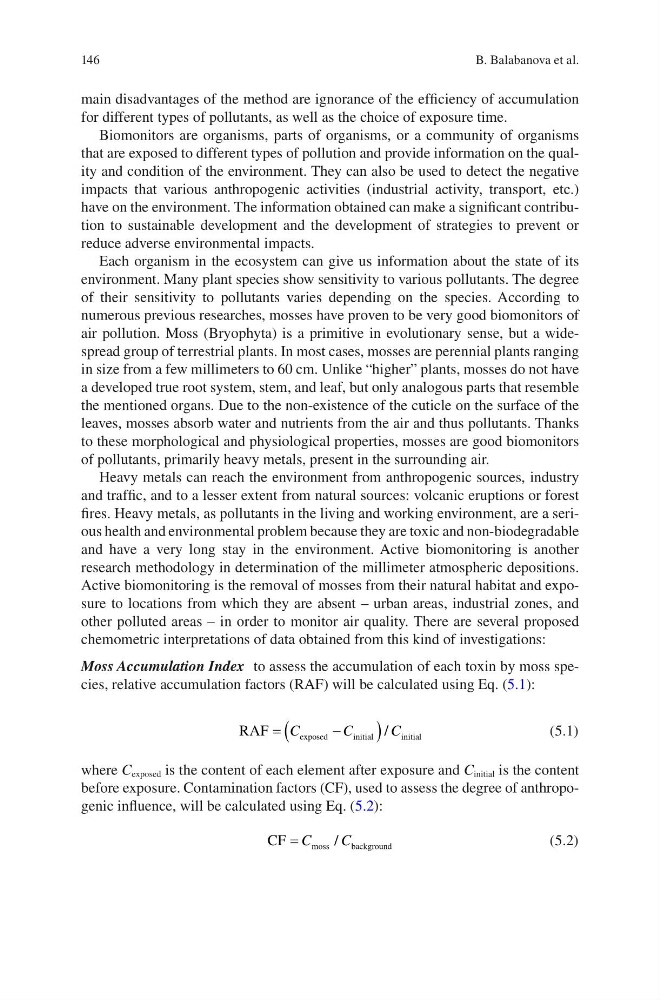
Moss Accumulation Index to assess the accumulation of each toxin by moss species, relative accumulation factors (RAF) will be calculated using Eq. (5.1):
RAF
exposed
initial
i nitial
C
C
C
/
(5.1)
where C exposed is the content of each element after exposure and C initial is the content
before exposure. Contamination factors (CF), used to assess the degree of anthropogenic influence, will be calculated using Eq. (5.2):
CF
moss
background
= C
C
/
(5.2)
B. Balabanova et al.
main disadvantages of the method are ignorance of the efficiency of accumulation
for different types of pollutants, as well as the choice of exposure time.
Biomonitors are organisms, parts of organisms, or a community of organisms
that are exposed to different types of pollution and provide information on the quality and condition of the environment. They can also be used to detect the negative
impacts that various anthropogenic activities (industrial activity, transport, etc.)
have on the environment. The information obtained can make a significant contribution to sustainable development and the development of strategies to prevent or
reduce adverse environmental impacts.
Each organism in the ecosystem can give us information about the state of its
environment. Many plant species show sensitivity to various pollutants. The degree
of their sensitivity to pollutants varies depending on the species. According to
numerous previous researches, mosses have proven to be very good biomonitors of
air pollution. Moss (Bryophyta) is a primitive in evolutionary sense, but a widespread group of terrestrial plants. In most cases, mosses are perennial plants ranging
in size from a few millimeters to 60 cm. Unlike “higher” plants, mosses do not have
a developed true root system, stem, and leaf, but only analogous parts that resemble
the mentioned organs. Due to the non-existence of the cuticle on the surface of the
leaves, mosses absorb water and nutrients from the air and thus pollutants. Thanks
to these morphological and physiological properties, mosses are good biomonitors
of pollutants, primarily heavy metals, present in the surrounding air.
Heavy metals can reach the environment from anthropogenic sources, industry
and traffic, and to a lesser extent from natural sources: volcanic eruptions or forest
fires. Heavy metals, as pollutants in the living and working environment, are a serious health and environmental problem because they are toxic and non- biodegradable
and have a very long stay in the environment. Active biomonitoring is another
research methodology in determination of the millimeter atmospheric depositions.
Active biomonitoring is the removal of mosses from their natural habitat and exposure to locations from which they are absent – urban areas, industrial zones, and
other polluted areas – in order to monitor air quality. There are several proposed
chemometric interpretations of data obtained from this kind of investigations:
Moss Accumulation Index to assess the accumulation of each toxin by moss species, relative accumulation factors (RAF) will be calculated using Eq. (5.1):
RAF
exposed
initial
i nitial
C
C
C
/
(5.1)
where C exposed is the content of each element after exposure and C initial is the content
before exposure. Contamination factors (CF), used to assess the degree of anthropogenic influence, will be calculated using Eq. (5.2):
CF
moss
background
= C
C
/
(5.2)
B. Balabanova et al.