

107
Lichen communities under the influence of the presence of various pollutants in
the atmosphere are subject to various alterations in the structure of the communities
themselves. Several studies have proven that the most sensitive lichen species completely disappear in urban and highly industrialized areas where the concentration
of pollutants is the highest. In contrast, species tolerant of pollution survive even in
moderately polluted areas (Davies et al. 2007; Larsen et al. 2007). Negative effects
of pollutants on sensitive lichen species are manifested in inhibition and reduction
of photosynthesis, respiration, chlorophyll content, membrane damage, and oxidative stress (Oztetik and Cicek 2011; Paoli et al. 2011; Majumder et al. 2013; Karakoti
et al. 2014). Spatial organization of lichens’ communities depends on many different factors, which act individually or complement each other.
Another approach used in studies of lichen indications of air quality is the index
of poleotolerance (IP) (Trass 1973). This index describes the tolerance of lichen
species to the presence of different air pollutants, which is measured on the basis of
the level of coverage of each species individually as well as the total coverage of all
species whose presence is detected at a given point of research.
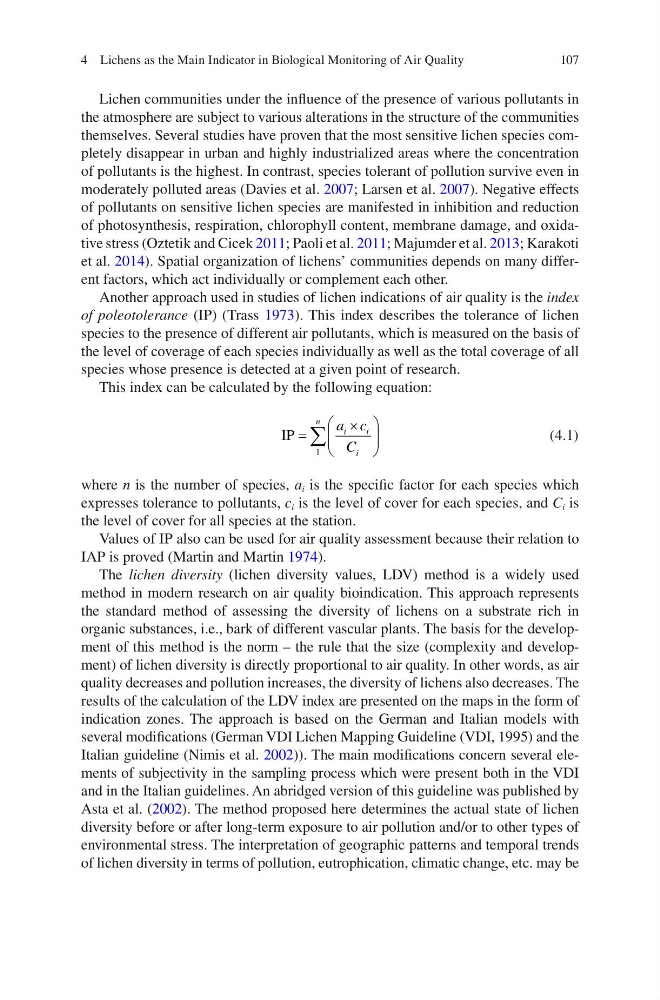
This index can be calculated by the following equation:
IP
u
§
©
¨
·
¹
¸
¦
1
n
i
i
i
a c
C
(4.1)
where n is the number of species, a i is the specific factor for each species which
expresses tolerance to pollutants, c i is the level of cover for each species, and C i is
the level of cover for all species at the station.
Values of IP also can be used for air quality assessment because their relation to
IAP is proved (Mаrtin and Mаrtin 1974).
The lichen diversity (lichen diversity values, LDV) method is a widely used
method in modern research on air quality bioindication. This approach represents
the standard method of assessing the diversity of lichens on a substrate rich in
organic substances, i.e., bark of different vascular plants. The basis for the development of this method is the norm – the rule that the size (complexity and development) of lichen diversity is directly proportional to air quality. In other words, as air
quality decreases and pollution increases, the diversity of lichens also decreases. The
results of the calculation of the LDV index are presented on the maps in the form of
indication zones. The approach is based on the German and Italian models with
several modifications (German VDI Lichen Mapping Guideline (VDI, 1995) and the
Italian guideline (Nimis et al. 2002)). The main modifications concern several elements of subjectivity in the sampling process which were present both in the VDI
and in the Italian guidelines. An abridged version of this guideline was published by
Asta et al. (2002). The method proposed here determines the actual state of lichen
diversity before or after long-term exposure to air pollution and/or to other types of
environmental stress. The interpretation of geographic patterns and temporal trends
of lichen diversity in terms of pollution, eutrophication, climatic change, etc. may be
4 Lichens as the Main Indicator in Biological Monitoring of Air Quality
Lichen communities under the influence of the presence of various pollutants in
the atmosphere are subject to various alterations in the structure of the communities
themselves. Several studies have proven that the most sensitive lichen species completely disappear in urban and highly industrialized areas where the concentration
of pollutants is the highest. In contrast, species tolerant of pollution survive even in
moderately polluted areas (Davies et al. 2007; Larsen et al. 2007). Negative effects
of pollutants on sensitive lichen species are manifested in inhibition and reduction
of photosynthesis, respiration, chlorophyll content, membrane damage, and oxidative stress (Oztetik and Cicek 2011; Paoli et al. 2011; Majumder et al. 2013; Karakoti
et al. 2014). Spatial organization of lichens’ communities depends on many different factors, which act individually or complement each other.
Another approach used in studies of lichen indications of air quality is the index
of poleotolerance (IP) (Trass 1973). This index describes the tolerance of lichen
species to the presence of different air pollutants, which is measured on the basis of
the level of coverage of each species individually as well as the total coverage of all
species whose presence is detected at a given point of research.
This index can be calculated by the following equation:
IP
u
§
©
¨
·
¹
¸
¦
1
n
i
i
i
a c
C
(4.1)
where n is the number of species, a i is the specific factor for each species which
expresses tolerance to pollutants, c i is the level of cover for each species, and C i is
the level of cover for all species at the station.
Values of IP also can be used for air quality assessment because their relation to
IAP is proved (Mаrtin and Mаrtin 1974).
The lichen diversity (lichen diversity values, LDV) method is a widely used
method in modern research on air quality bioindication. This approach represents
the standard method of assessing the diversity of lichens on a substrate rich in
organic substances, i.e., bark of different vascular plants. The basis for the development of this method is the norm – the rule that the size (complexity and development) of lichen diversity is directly proportional to air quality. In other words, as air
quality decreases and pollution increases, the diversity of lichens also decreases. The
results of the calculation of the LDV index are presented on the maps in the form of
indication zones. The approach is based on the German and Italian models with
several modifications (German VDI Lichen Mapping Guideline (VDI, 1995) and the
Italian guideline (Nimis et al. 2002)). The main modifications concern several elements of subjectivity in the sampling process which were present both in the VDI
and in the Italian guidelines. An abridged version of this guideline was published by
Asta et al. (2002). The method proposed here determines the actual state of lichen
diversity before or after long-term exposure to air pollution and/or to other types of
environmental stress. The interpretation of geographic patterns and temporal trends
of lichen diversity in terms of pollution, eutrophication, climatic change, etc. may be
4 Lichens as the Main Indicator in Biological Monitoring of Air Quality