

Carbon Footprint of Karnataka: Accounting of Sources and Sinks
89
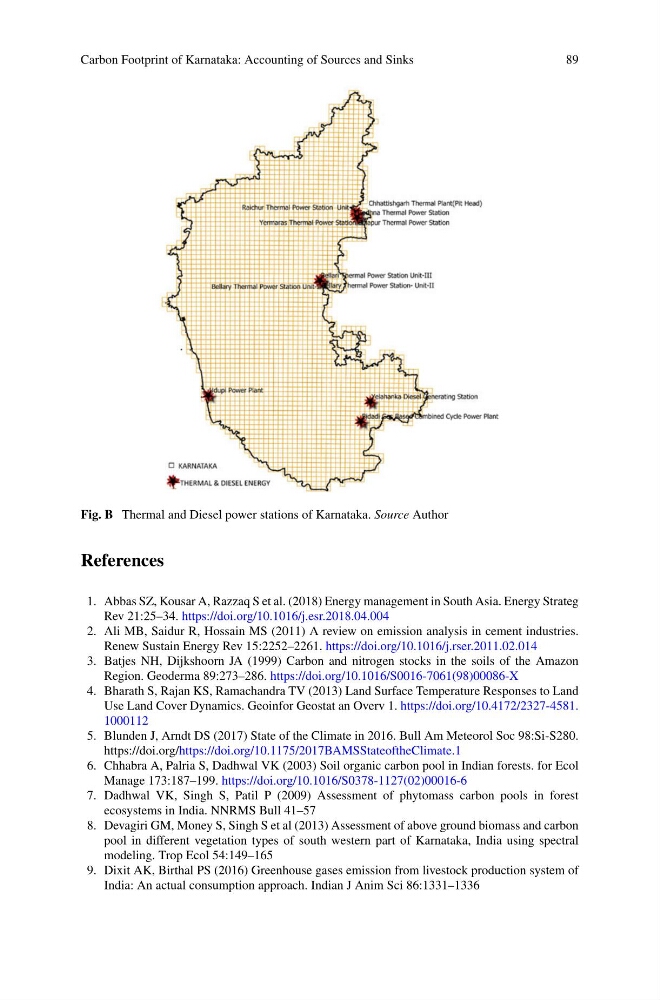
Fig. B Thermal and Diesel power stations of Karnataka. Source Author
References
1. Abbas SZ, Kousar A, Razzaq S et al. (2018) Energy management in South Asia. Energy Strateg
Rev 21:25–34. https://doi.org/10.1016/j.esr.2018.04.004
2. Ali MB, Saidur R, Hossain MS (2011) A review on emission analysis in cement industries.
Renew Sustain Energy Rev 15:2252–2261. https://doi.org/10.1016/j.rser.2011.02.014
3. Batjes NH, Dijkshoorn JA (1999) Carbon and nitrogen stocks in the soils of the Amazon
Region. Geoderma 89:273–286. https://doi.org/10.1016/S0016-7061(98)00086-X
4. Bharath S, Rajan KS, Ramachandra TV (2013) Land Surface Temperature Responses to Land
Use Land Cover Dynamics. Geoinfor Geostat an Overv 1. https://doi.org/10.4172/2327-4581.
1000112
5. Blunden J, Arndt DS (2017) State of the Climate in 2016. Bull Am Meteorol Soc 98:Si-S280.
https://doi.org/https://doi.org/10.1175/2017BAMSStateoftheClimate.1
6. Chhabra A, Palria S, Dadhwal VK (2003) Soil organic carbon pool in Indian forests. for Ecol
Manage 173:187–199. https://doi.org/10.1016/S0378-1127(02)00016-6
7. Dadhwal VK, Singh S, Patil P (2009) Assessment of phytomass carbon pools in forest
ecosystems in India. NNRMS Bull 41–57
8. Devagiri GM, Money S, Singh S et al (2013) Assessment of above ground biomass and carbon
pool in different vegetation types of south western part of Karnataka, India using spectral
modeling. Trop Ecol 54:149–165
9. Dixit AK, Birthal PS (2016) Greenhouse gases emission from livestock production system of
India: An actual consumption approach. Indian J Anim Sci 86:1331–1336
89
Fig. B Thermal and Diesel power stations of Karnataka. Source Author
References
1. Abbas SZ, Kousar A, Razzaq S et al. (2018) Energy management in South Asia. Energy Strateg
Rev 21:25–34. https://doi.org/10.1016/j.esr.2018.04.004
2. Ali MB, Saidur R, Hossain MS (2011) A review on emission analysis in cement industries.
Renew Sustain Energy Rev 15:2252–2261. https://doi.org/10.1016/j.rser.2011.02.014
3. Batjes NH, Dijkshoorn JA (1999) Carbon and nitrogen stocks in the soils of the Amazon
Region. Geoderma 89:273–286. https://doi.org/10.1016/S0016-7061(98)00086-X
4. Bharath S, Rajan KS, Ramachandra TV (2013) Land Surface Temperature Responses to Land
Use Land Cover Dynamics. Geoinfor Geostat an Overv 1. https://doi.org/10.4172/2327-4581.
1000112
5. Blunden J, Arndt DS (2017) State of the Climate in 2016. Bull Am Meteorol Soc 98:Si-S280.
https://doi.org/https://doi.org/10.1175/2017BAMSStateoftheClimate.1
6. Chhabra A, Palria S, Dadhwal VK (2003) Soil organic carbon pool in Indian forests. for Ecol
Manage 173:187–199. https://doi.org/10.1016/S0378-1127(02)00016-6
7. Dadhwal VK, Singh S, Patil P (2009) Assessment of phytomass carbon pools in forest
ecosystems in India. NNRMS Bull 41–57
8. Devagiri GM, Money S, Singh S et al (2013) Assessment of above ground biomass and carbon
pool in different vegetation types of south western part of Karnataka, India using spectral
modeling. Trop Ecol 54:149–165
9. Dixit AK, Birthal PS (2016) Greenhouse gases emission from livestock production system of
India: An actual consumption approach. Indian J Anim Sci 86:1331–1336