

24
F. Scrucca et al.
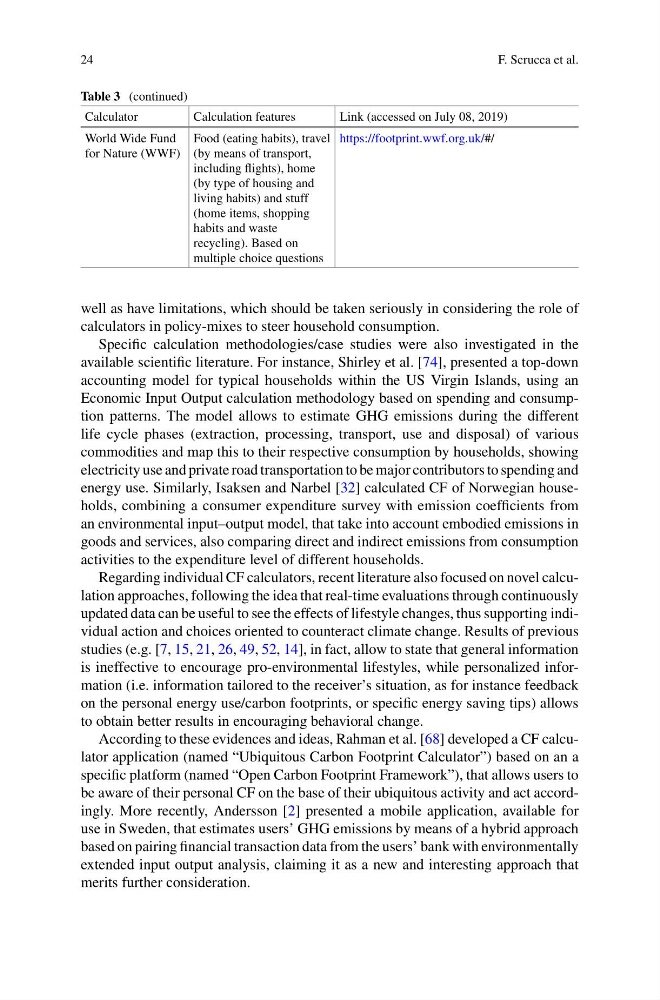
Table 3 (continued)
Calculator
Calculation features
Link (accessed on July 08, 2019)
World Wide Fund
for Nature (WWF)
Food (eating habits), travel
(by means of transport,
including flights), home
(by type of housing and
living habits) and stuff
(home items, shopping
habits and waste
recycling). Based on
multiple choice questions
https://footprint.wwf.org.uk/#/
well as have limitations, which should be taken seriously in considering the role of
calculators in policy-mixes to steer household consumption.
Specific calculation methodologies/case studies were also investigated in the
available scientific literature. For instance, Shirley et al. [74], presented a top-down
accounting model for typical households within the US Virgin Islands, using an
Economic Input Output calculation methodology based on spending and consumption patterns. The model allows to estimate GHG emissions during the different
life cycle phases (extraction, processing, transport, use and disposal) of various
commodities and map this to their respective consumption by households, showing
electricity use and private road transportation to be major contributors to spending and
energy use. Similarly, Isaksen and Narbel [32] calculated CF of Norwegian households, combining a consumer expenditure survey with emission coefficients from
an environmental input–output model, that take into account embodied emissions in
goods and services, also comparing direct and indirect emissions from consumption
activities to the expenditure level of different households.
Regarding individual CF calculators, recent literature also focused on novel calculation approaches, following the idea that real-time evaluations through continuously
updated data can be useful to see the effects of lifestyle changes, thus supporting individual action and choices oriented to counteract climate change. Results of previous
studies (e.g. [7, 15, 21, 26, 49, 52, 14], in fact, allow to state that general information
is ineffective to encourage pro-environmental lifestyles, while personalized information (i.e. information tailored to the receiver’s situation, as for instance feedback
on the personal energy use/carbon footprints, or specific energy saving tips) allows
to obtain better results in encouraging behavioral change.
According to these evidences and ideas, Rahman et al. [68] developed a CF calculator application (named “Ubiquitous Carbon Footprint Calculator”) based on an a
specific platform (named “Open Carbon Footprint Framework”), that allows users to
be aware of their personal CF on the base of their ubiquitous activity and act accordingly. More recently, Andersson [2] presented a mobile application, available for
use in Sweden, that estimates users’ GHG emissions by means of a hybrid approach
based on pairing financial transaction data from the users’ bank with environmentally
extended input output analysis, claiming it as a new and interesting approach that
merits further consideration.
F. Scrucca et al.
Table 3 (continued)
Calculator
Calculation features
Link (accessed on July 08, 2019)
World Wide Fund
for Nature (WWF)
Food (eating habits), travel
(by means of transport,
including flights), home
(by type of housing and
living habits) and stuff
(home items, shopping
habits and waste
recycling). Based on
multiple choice questions
https://footprint.wwf.org.uk/#/
well as have limitations, which should be taken seriously in considering the role of
calculators in policy-mixes to steer household consumption.
Specific calculation methodologies/case studies were also investigated in the
available scientific literature. For instance, Shirley et al. [74], presented a top-down
accounting model for typical households within the US Virgin Islands, using an
Economic Input Output calculation methodology based on spending and consumption patterns. The model allows to estimate GHG emissions during the different
life cycle phases (extraction, processing, transport, use and disposal) of various
commodities and map this to their respective consumption by households, showing
electricity use and private road transportation to be major contributors to spending and
energy use. Similarly, Isaksen and Narbel [32] calculated CF of Norwegian households, combining a consumer expenditure survey with emission coefficients from
an environmental input–output model, that take into account embodied emissions in
goods and services, also comparing direct and indirect emissions from consumption
activities to the expenditure level of different households.
Regarding individual CF calculators, recent literature also focused on novel calculation approaches, following the idea that real-time evaluations through continuously
updated data can be useful to see the effects of lifestyle changes, thus supporting individual action and choices oriented to counteract climate change. Results of previous
studies (e.g. [7, 15, 21, 26, 49, 52, 14], in fact, allow to state that general information
is ineffective to encourage pro-environmental lifestyles, while personalized information (i.e. information tailored to the receiver’s situation, as for instance feedback
on the personal energy use/carbon footprints, or specific energy saving tips) allows
to obtain better results in encouraging behavioral change.
According to these evidences and ideas, Rahman et al. [68] developed a CF calculator application (named “Ubiquitous Carbon Footprint Calculator”) based on an a
specific platform (named “Open Carbon Footprint Framework”), that allows users to
be aware of their personal CF on the base of their ubiquitous activity and act accordingly. More recently, Andersson [2] presented a mobile application, available for
use in Sweden, that estimates users’ GHG emissions by means of a hybrid approach
based on pairing financial transaction data from the users’ bank with environmentally
extended input output analysis, claiming it as a new and interesting approach that
merits further consideration.