

144
M. Gautam and M. Agrawal
Table 5 (continued)
States
Solid waste generation (tonne day −1 ) Wastes disposed to landfill
(%)
2011
2013
2014
2015
2011 2013 2014 2015
Tripura
413
487
526
565
90
100
52
56
Uttar Pradesh
20,135 21,816 22,677 23,553 100
76
77
92
Uttrakhand
1,014
1,122
1,178
1,234 100
100
100
100
West Bengal
15,924 17,282 17,978 18,686
96
92
95
95
Source GHG Platform, India [31]
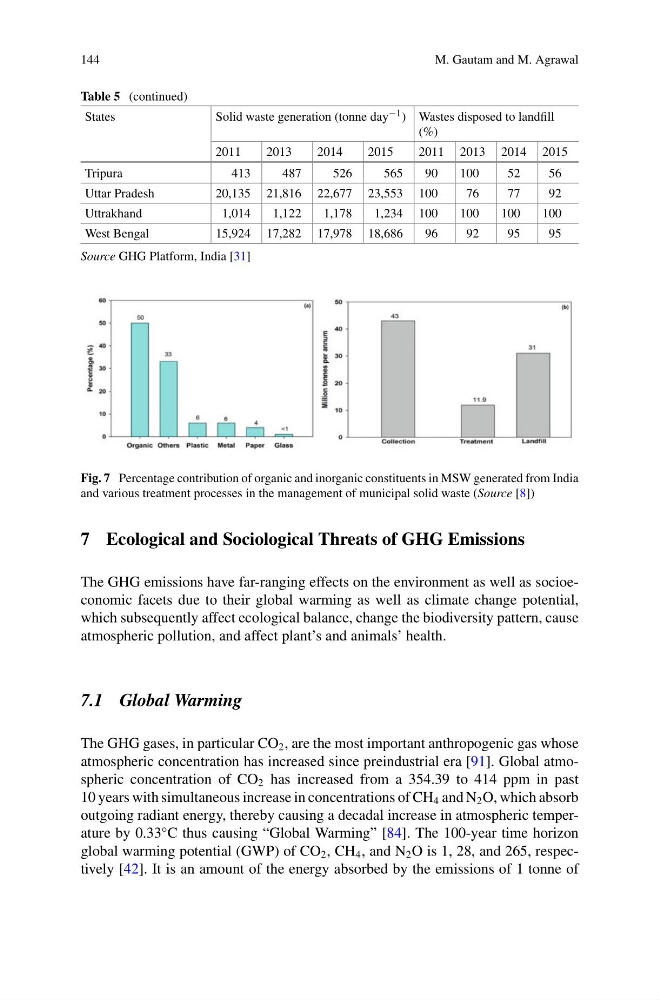
Fig. 7 Percentage contribution of organic and inorganic constituents in MSW generated from India
and various treatment processes in the management of municipal solid waste (Source [8])
7 Ecological and Sociological Threats of GHG Emissions
The GHG emissions have far-ranging effects on the environment as well as socioeconomic facets due to their global warming as well as climate change potential,
which subsequently affect ecological balance, change the biodiversity pattern, cause
atmospheric pollution, and affect plant’s and animals’ health.
7.1 Global Warming
The GHG gases, in particular CO 2 , are the most important anthropogenic gas whose
atmospheric concentration has increased since preindustrial era [91]. Global atmospheric concentration of CO 2 has increased from a 354.39 to 414 ppm in past
10 years with simultaneous increase in concentrations of CH 4 and N 2 O, which absorb
outgoing radiant energy, thereby causing a decadal increase in atmospheric temperature by 0.33°C thus causing “Global Warming” [84]. The 100-year time horizon
global warming potential (GWP) of CO 2 , CH 4 , and N 2 O is 1, 28, and 265, respectively [42]. It is an amount of the energy absorbed by the emissions of 1 tonne of
M. Gautam and M. Agrawal
Table 5 (continued)
States
Solid waste generation (tonne day −1 ) Wastes disposed to landfill
(%)
2011
2013
2014
2015
2011 2013 2014 2015
Tripura
413
487
526
565
90
100
52
56
Uttar Pradesh
20,135 21,816 22,677 23,553 100
76
77
92
Uttrakhand
1,014
1,122
1,178
1,234 100
100
100
100
West Bengal
15,924 17,282 17,978 18,686
96
92
95
95
Source GHG Platform, India [31]
Fig. 7 Percentage contribution of organic and inorganic constituents in MSW generated from India
and various treatment processes in the management of municipal solid waste (Source [8])
7 Ecological and Sociological Threats of GHG Emissions
The GHG emissions have far-ranging effects on the environment as well as socioeconomic facets due to their global warming as well as climate change potential,
which subsequently affect ecological balance, change the biodiversity pattern, cause
atmospheric pollution, and affect plant’s and animals’ health.
7.1 Global Warming
The GHG gases, in particular CO 2 , are the most important anthropogenic gas whose
atmospheric concentration has increased since preindustrial era [91]. Global atmospheric concentration of CO 2 has increased from a 354.39 to 414 ppm in past
10 years with simultaneous increase in concentrations of CH 4 and N 2 O, which absorb
outgoing radiant energy, thereby causing a decadal increase in atmospheric temperature by 0.33°C thus causing “Global Warming” [84]. The 100-year time horizon
global warming potential (GWP) of CO 2 , CH 4 , and N 2 O is 1, 28, and 265, respectively [42]. It is an amount of the energy absorbed by the emissions of 1 tonne of