

36
E. A. Zaghloul
Mut
Tenida
G. Edmonstone
Qur El-Malik
Fault
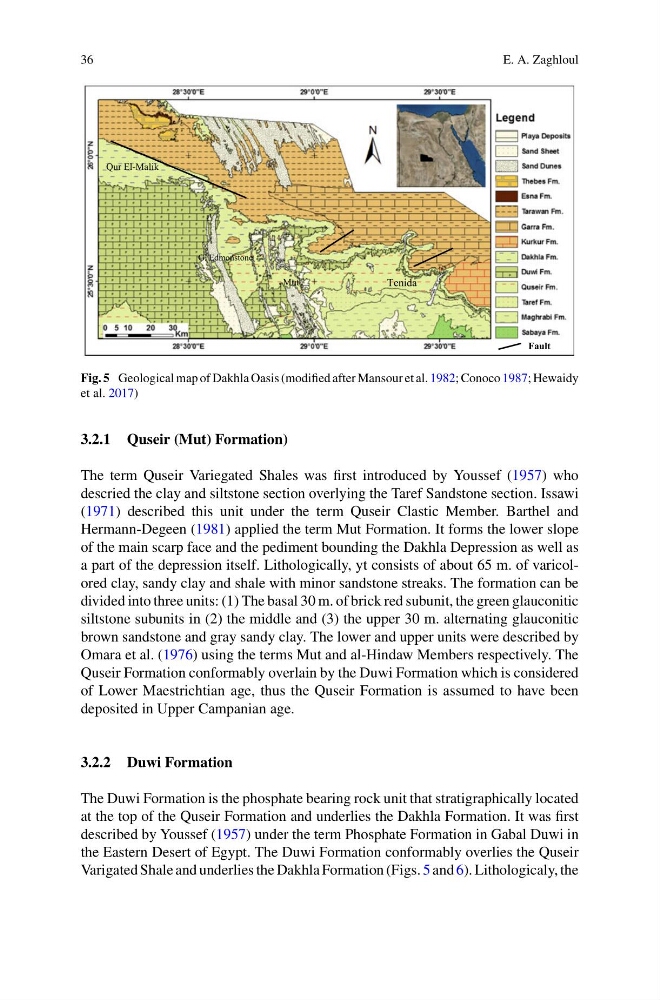
Fig. 5 Geological map of Dakhla Oasis (modified after Mansour et al. 1982; Conoco 1987; Hewaidy
et al. 2017)
3.2.1 Quseir (Mut) Formation)
The term Quseir Variegated Shales was first introduced by Youssef (1957) who
descried the clay and siltstone section overlying the Taref Sandstone section. Issawi
(1971) described this unit under the term Quseir Clastic Member. Barthel and
Hermann-Degeen (1981) applied the term Mut Formation. It forms the lower slope
of the main scarp face and the pediment bounding the Dakhla Depression as well as
a part of the depression itself. Lithologically, yt consists of about 65 m. of varicolored clay, sandy clay and shale with minor sandstone streaks. The formation can be
divided into three units: (1) The basal 30 m. of brick red subunit, the green glauconitic
siltstone subunits in (2) the middle and (3) the upper 30 m. alternating glauconitic
brown sandstone and gray sandy clay. The lower and upper units were described by
Omara et al. (1976) using the terms Mut and al-Hindaw Members respectively. The
Quseir Formation conformably overlain by the Duwi Formation which is considered
of Lower Maestrichtian age, thus the Quseir Formation is assumed to have been
deposited in Upper Campanian age.
3.2.2 Duwi Formation
The Duwi Formation is the phosphate bearing rock unit that stratigraphically located
at the top of the Quseir Formation and underlies the Dakhla Formation. It was first
described by Youssef (1957) under the term Phosphate Formation in Gabal Duwi in
the Eastern Desert of Egypt. The Duwi Formation conformably overlies the Quseir
Varigated Shale and underlies the Dakhla Formation (Figs. 5 and 6). Lithologicaly, the
E. A. Zaghloul
Mut
Tenida
G. Edmonstone
Qur El-Malik
Fault
Fig. 5 Geological map of Dakhla Oasis (modified after Mansour et al. 1982; Conoco 1987; Hewaidy
et al. 2017)
3.2.1 Quseir (Mut) Formation)
The term Quseir Variegated Shales was first introduced by Youssef (1957) who
descried the clay and siltstone section overlying the Taref Sandstone section. Issawi
(1971) described this unit under the term Quseir Clastic Member. Barthel and
Hermann-Degeen (1981) applied the term Mut Formation. It forms the lower slope
of the main scarp face and the pediment bounding the Dakhla Depression as well as
a part of the depression itself. Lithologically, yt consists of about 65 m. of varicolored clay, sandy clay and shale with minor sandstone streaks. The formation can be
divided into three units: (1) The basal 30 m. of brick red subunit, the green glauconitic
siltstone subunits in (2) the middle and (3) the upper 30 m. alternating glauconitic
brown sandstone and gray sandy clay. The lower and upper units were described by
Omara et al. (1976) using the terms Mut and al-Hindaw Members respectively. The
Quseir Formation conformably overlain by the Duwi Formation which is considered
of Lower Maestrichtian age, thus the Quseir Formation is assumed to have been
deposited in Upper Campanian age.
3.2.2 Duwi Formation
The Duwi Formation is the phosphate bearing rock unit that stratigraphically located
at the top of the Quseir Formation and underlies the Dakhla Formation. It was first
described by Youssef (1957) under the term Phosphate Formation in Gabal Duwi in
the Eastern Desert of Egypt. The Duwi Formation conformably overlies the Quseir
Varigated Shale and underlies the Dakhla Formation (Figs. 5 and 6). Lithologicaly, the