

232
E. Iwasaki et al.
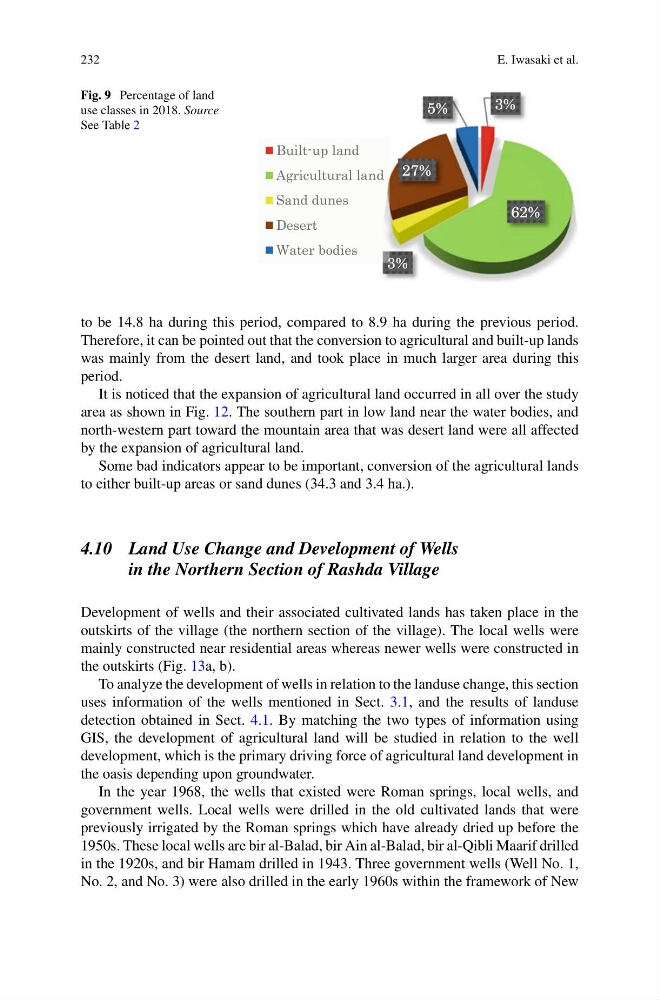
Fig. 9 Percentage of land
use classes in 2018. Source
See Table 2
3%
62%
3%
27%
5%
Built-up land
Agricultural land
Sand dunes
Desert
Water bodies
to be 14.8 ha during this period, compared to 8.9 ha during the previous period.
Therefore, it can be pointed out that the conversion to agricultural and built-up lands
was mainly from the desert land, and took place in much larger area during this
period.
It is noticed that the expansion of agricultural land occurred in all over the study
area as shown in Fig. 12. The southern part in low land near the water bodies, and
north-western part toward the mountain area that was desert land were all affected
by the expansion of agricultural land.
Some bad indicators appear to be important, conversion of the agricultural lands
to either built-up areas or sand dunes (34.3 and 3.4 ha.).
4.10 Land Use Change and Development of Wells
in the Northern Section of Rashda Village
Development of wells and their associated cultivated lands has taken place in the
outskirts of the village (the northern section of the village). The local wells were
mainly constructed near residential areas whereas newer wells were constructed in
the outskirts (Fig. 13a, b).
To analyze the development of wells in relation to the landuse change, this section
uses information of the wells mentioned in Sect. 3.1, and the results of landuse
detection obtained in Sect. 4.1. By matching the two types of information using
GIS, the development of agricultural land will be studied in relation to the well
development, which is the primary driving force of agricultural land development in
the oasis depending upon groundwater.
In the year 1968, the wells that existed were Roman springs, local wells, and
government wells. Local wells were drilled in the old cultivated lands that were
previously irrigated by the Roman springs which have already dried up before the
1950s. These local wells are bir al-Balad, bir Ain al-Balad, bir al-Qibli Maarif drilled
in the 1920s, and bir Hamam drilled in 1943. Three government wells (Well No. 1,
No. 2, and No. 3) were also drilled in the early 1960s within the framework of New
E. Iwasaki et al.
Fig. 9 Percentage of land
use classes in 2018. Source
See Table 2
3%
62%
3%
27%
5%
Built-up land
Agricultural land
Sand dunes
Desert
Water bodies
to be 14.8 ha during this period, compared to 8.9 ha during the previous period.
Therefore, it can be pointed out that the conversion to agricultural and built-up lands
was mainly from the desert land, and took place in much larger area during this
period.
It is noticed that the expansion of agricultural land occurred in all over the study
area as shown in Fig. 12. The southern part in low land near the water bodies, and
north-western part toward the mountain area that was desert land were all affected
by the expansion of agricultural land.
Some bad indicators appear to be important, conversion of the agricultural lands
to either built-up areas or sand dunes (34.3 and 3.4 ha.).
4.10 Land Use Change and Development of Wells
in the Northern Section of Rashda Village
Development of wells and their associated cultivated lands has taken place in the
outskirts of the village (the northern section of the village). The local wells were
mainly constructed near residential areas whereas newer wells were constructed in
the outskirts (Fig. 13a, b).
To analyze the development of wells in relation to the landuse change, this section
uses information of the wells mentioned in Sect. 3.1, and the results of landuse
detection obtained in Sect. 4.1. By matching the two types of information using
GIS, the development of agricultural land will be studied in relation to the well
development, which is the primary driving force of agricultural land development in
the oasis depending upon groundwater.
In the year 1968, the wells that existed were Roman springs, local wells, and
government wells. Local wells were drilled in the old cultivated lands that were
previously irrigated by the Roman springs which have already dried up before the
1950s. These local wells are bir al-Balad, bir Ain al-Balad, bir al-Qibli Maarif drilled
in the 1920s, and bir Hamam drilled in 1943. Three government wells (Well No. 1,
No. 2, and No. 3) were also drilled in the early 1960s within the framework of New