

176
E. Iwasaki and K. Kashiwagi
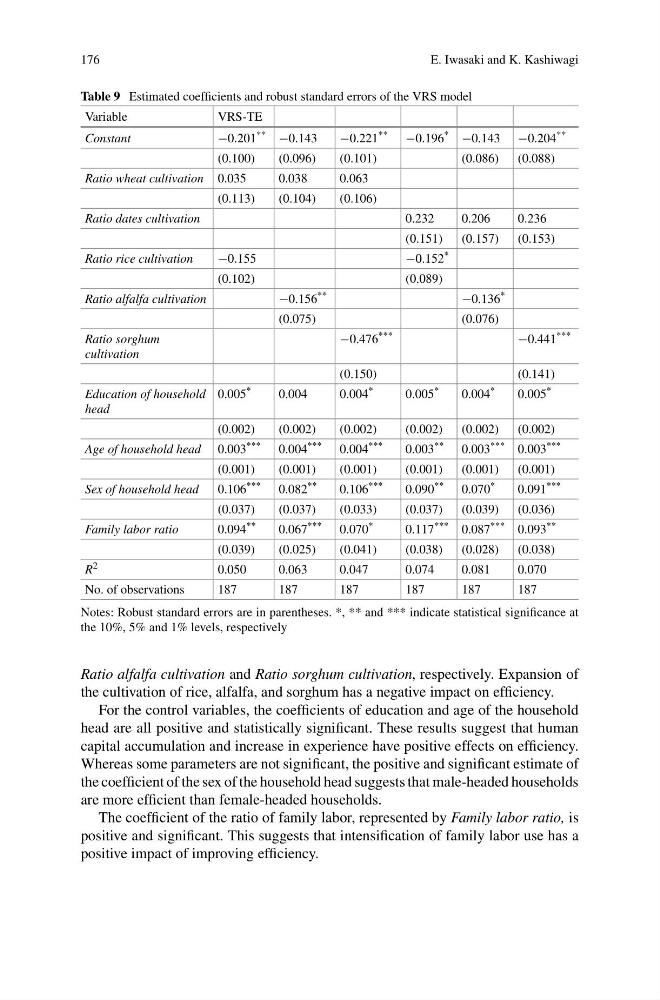
Table 9 Estimated coefficients and robust standard errors of the VRS model
Variable
VRS-TE
Constant
−0.201 ** −0.143
−0.221 ** −0.196 * −0.143 −0.204 **
(0.100)
(0.096)
(0.101)
(0.086)
(0.088)
Ratio wheat cultivation 0.035
0.038
0.063
(0.113)
(0.104)
(0.106)
Ratio dates cultivation
0.232
0.206
0.236
(0.151)
(0.157)
(0.153)
Ratio rice cultivation
−0.155
−0.152 *
(0.102)
(0.089)
Ratio alfalfa cultivation
−0.156 **
−0.136 *
(0.075)
(0.076)
Ratio sorghum
cultivation
−0.476 ***
−0.441 ***
(0.150)
(0.141)
Education of household
head
0.005 *
0.004
0.004 *
0.005 *
0.004 *
0.005 *
(0.002)
(0.002)
(0.002)
(0.002)
(0.002)
(0.002)
Age of household head 0.003 *** 0.004 *** 0.004 ***
0.003 ** 0.003 *** 0.003 ***
(0.001)
(0.001)
(0.001)
(0.001)
(0.001)
(0.001)
Sex of household head 0.106 *** 0.082 **
0.106 ***
0.090 ** 0.070 *
0.091 ***
(0.037)
(0.037)
(0.033)
(0.037)
(0.039)
(0.036)
Family labor ratio
0.094 **
0.067 *** 0.070 *
0.117 *** 0.087 *** 0.093 **
(0.039)
(0.025)
(0.041)
(0.038)
(0.028)
(0.038)
R 2
0.050
0.063
0.047
0.074
0.081
0.070
No. of observations
187
187
187
187
187
187
Notes: Robust standard errors are in parentheses. *, ** and *** indicate statistical significance at
the 10%, 5% and 1% levels, respectively
Ratio alfalfa cultivation and Ratio sorghum cultivation, respectively. Expansion of
the cultivation of rice, alfalfa, and sorghum has a negative impact on efficiency.
For the control variables, the coefficients of education and age of the household
head are all positive and statistically significant. These results suggest that human
capital accumulation and increase in experience have positive effects on efficiency.
Whereas some parameters are not significant, the positive and significant estimate of
the coefficient of the sex of the household head suggests that male-headed households
are more efficient than female-headed households.
The coefficient of the ratio of family labor, represented by Family labor ratio, is
positive and significant. This suggests that intensification of family labor use has a
positive impact of improving efficiency.
E. Iwasaki and K. Kashiwagi
Table 9 Estimated coefficients and robust standard errors of the VRS model
Variable
VRS-TE
Constant
−0.201 ** −0.143
−0.221 ** −0.196 * −0.143 −0.204 **
(0.100)
(0.096)
(0.101)
(0.086)
(0.088)
Ratio wheat cultivation 0.035
0.038
0.063
(0.113)
(0.104)
(0.106)
Ratio dates cultivation
0.232
0.206
0.236
(0.151)
(0.157)
(0.153)
Ratio rice cultivation
−0.155
−0.152 *
(0.102)
(0.089)
Ratio alfalfa cultivation
−0.156 **
−0.136 *
(0.075)
(0.076)
Ratio sorghum
cultivation
−0.476 ***
−0.441 ***
(0.150)
(0.141)
Education of household
head
0.005 *
0.004
0.004 *
0.005 *
0.004 *
0.005 *
(0.002)
(0.002)
(0.002)
(0.002)
(0.002)
(0.002)
Age of household head 0.003 *** 0.004 *** 0.004 ***
0.003 ** 0.003 *** 0.003 ***
(0.001)
(0.001)
(0.001)
(0.001)
(0.001)
(0.001)
Sex of household head 0.106 *** 0.082 **
0.106 ***
0.090 ** 0.070 *
0.091 ***
(0.037)
(0.037)
(0.033)
(0.037)
(0.039)
(0.036)
Family labor ratio
0.094 **
0.067 *** 0.070 *
0.117 *** 0.087 *** 0.093 **
(0.039)
(0.025)
(0.041)
(0.038)
(0.028)
(0.038)
R 2
0.050
0.063
0.047
0.074
0.081
0.070
No. of observations
187
187
187
187
187
187
Notes: Robust standard errors are in parentheses. *, ** and *** indicate statistical significance at
the 10%, 5% and 1% levels, respectively
Ratio alfalfa cultivation and Ratio sorghum cultivation, respectively. Expansion of
the cultivation of rice, alfalfa, and sorghum has a negative impact on efficiency.
For the control variables, the coefficients of education and age of the household
head are all positive and statistically significant. These results suggest that human
capital accumulation and increase in experience have positive effects on efficiency.
Whereas some parameters are not significant, the positive and significant estimate of
the coefficient of the sex of the household head suggests that male-headed households
are more efficient than female-headed households.
The coefficient of the ratio of family labor, represented by Family labor ratio, is
positive and significant. This suggests that intensification of family labor use has a
positive impact of improving efficiency.